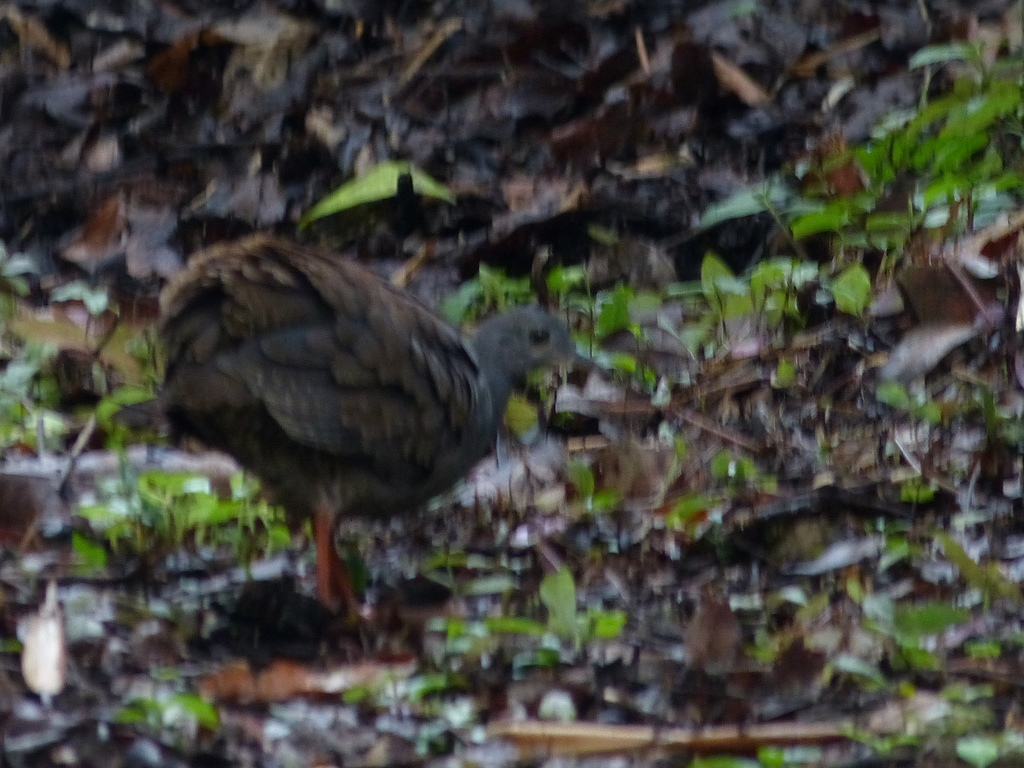
Slaty-breasted Tinamou
Photo © Yves Bas
Photo © Yves Bas — CC BY 4.0 — Source: iNaturalist #68802743Identification
The slaty-breasted tinamou is a small bird averaging 27 cm in length and weighing about 470 g. Despite their modest size, these birds are distinctive in appearance. They have a black to chestnut back and head, brown wings, and their namesake slaty grey breast contrasting with a white throat. The remainder of their underparts are grey-brown with darker barring on the flanks and undertail. Females display barring on their wings, a feature absent in males. Their legs are notably pink to bright red, while their bill is dark above and yellow below, providing helpful field marks for identification.
Range & Habitat
The slaty-breasted tinamou is commonly found in lowland moist forests throughout Mexico and Central America, ranging from southern Veracruz and northern Oaxaca in Mexico south to northern Costa Rica. Two subspecies are recognized: C. b. boucardi occupies the Gulf of Mexico and Caribbean coast in southeastern Mexico, Belize, Guatemala, and northwestern Honduras, while C. b. costaricensis inhabits the Caribbean slope of Honduras, Nicaragua, and northern Costa Rica.
These birds prefer elevations up to 700 m, though they may occasionally be found at higher altitudes up to 1,500 m in Mexico. They favour thick evergreen forests with dense undergrowth, but also adapt to thick forests with minimal undergrowth, secondary forests, and regenerating plantations, particularly in moist areas.
Behaviour & Diet
The slaty-breasted tinamou is notoriously shy and difficult to observe on the dark forest floor. It is best located by its distinctive three-note call, which is lower in pitch than those of other tinamou species. Birds produce these calls in extended bouts that can last up to five hours. Interestingly, this species occasionally hybridizes with the thicket tinamou where their ranges overlap.
Like other tinamous, this species is primarily frugivorous and granivorous, feeding on fruits and seeds. They supplement their diet with invertebrates, particularly ants and termites. Reproduction follows the typical tinamou pattern: males attract 2 to 4 females to lay eggs in ground nests situated in thick vegetation or between raised tree roots. Males alone incubate and raise the young, while females mate with multiple males.
Best Time & Places to See It
Locating slaty-breasted tinamous requires patience and keen ears rather than keen eyes. Early morning and dusk are optimal times to listen for their distinctive calls along the Caribbean slope forests of Central America and the Gulf coast of Mexico. The species' Caribbean slope range in Costa Rica, Nicaragua, and Honduras offers accessible opportunities for nature travellers, though finding them visually remains challenging due to their cryptic forest-floor behaviour.
Photography Tips
Photographing slaty-breasted tinamous presents a significant challenge due to their shy nature and preference for dense, dark forest understory. Success requires locating birds by their calls and then moving slowly and quietly into position. Early morning light penetrating the forest canopy offers the best opportunities for photography. Given their small size and dark colouration against shadowy forest floors, a camera capable of handling high ISO settings and fast lenses are essential. Patient, stationary observation near calling birds offers the greatest chance of a photograph before they slip quietly away into the undergrowth.
Tortuguero National Park
Roxana, Costa Rica
+420 birds+23 mammals
Canals and lagoons thread through a labyrinth of lowland rainforest where the Caribbean coast of Costa Rica meets the wetland frontier. This is terrain shaped by…
VIEW NATIONAL PARKBraulio Carrillo National Park
Las Horquetas, Costa Rica
+547 birds+18 mammals
Where the Caribbean slope descends from the central volcanic cordillera toward the humid lowlands of Heredia, Braulio Carrillo National Park preserves one of Costa Rica's most…
VIEW NATIONAL PARKGuanacaste National Park
Santa Elena, Costa Rica
+461 birds+17 mammals
Where the Pacific slopes of northwestern Costa Rica rise toward the Continental Divide, dry tropical forest gives way to cloud-laden peaks and misty ridges—a landscape that…
VIEW NATIONAL PARKLagunas de Montebello National Park
Laguna de Montebello, Mexico
+360 birds+2 mammals
Where turquoise lagoons pierce the limestone plateau of southeastern Chiapas, the Lagunas de Montebello National Park unfolds across roughly 174 square kilometers of spectral water and…
VIEW NATIONAL PARKMontes Azules
Candelaria, Mexico
+395 birds+47 mammals
Where jungle-clad limestone plateaus plunge into canyon systems carved by the Usumacinta River, Mexico's most pristine rainforest reserve unfolds across the Lacandón region of Chiapas. Montes…
VIEW BIOSPHERE RESERVETikal National Park
Tikal, Guatemala
+399 birds+16 mammals
Dense rainforest canopy rises above the limestone plateau of Petén, where archaeological wonder and ecological richness merge seamlessly across one of Central America's most biodiverse landscapes.…
VIEW NATIONAL PARKLaguna del Tigre National Park
Petén, Guatemala
+399 birds+29 mammals
Where the Petén lowlands dissolve into wetland and forest, Laguna del Tigre National Park protects one of Guatemala's most ecologically vital landscapes. This sprawling reserve encompasses…
VIEW NATIONAL PARKSierra del Lacandón National Park
Petén, Guatemala
+348 birds+7 mammals
Where the Petén rainforest rises into limestone ridges and deep ravines, Sierra del Lacandón National Park protects one of Central America's most intact tropical wilderness zones.…
VIEW NATIONAL PARKRincón de la Vieja National Park
Liberia, Costa Rica
+451 birds+30 mammals
Where volcanic slopes rise abruptly from the Guanacaste lowlands, Rincón de la Vieja National Park sprawls across a landscape shaped by geothermal drama and seasonal extremes.…
VIEW NATIONAL PARKBarbilla National Park
Chirripó, Costa Rica
+226 birds
Where the Caribbean slope of Costa Rica's eastern cordillera plunges into perpetual moisture, Barbilla National Park rises as one of Central America's most water-rich ecosystems. Fed…
VIEW NATIONAL PARKVolcán Tenorio National Park
Guatuso, Costa Rica
+480 birds+12 mammals
Where volcanic slopes rise through Costa Rica's northwestern borderlands, Volcán Tenorio National Park sprawls across terrain shaped by ancient lava flows and mineral-rich springs. The park's…
VIEW NATIONAL PARKBarra del Colorado National Wildlife Refuge
Tortuguero, Costa Rica
+462 birds+36 mammals
Where the Caribbean's restless waters meet the Limón Province coastline, Barra del Colorado National Wildlife Sanctuary unfolds across a landscape of extraordinary ecological complexity. This equatorial…
VIEW WILDLIFE SANCTUARYNo community photos yet. Log in to add the first one.
No community observations of this species yet.