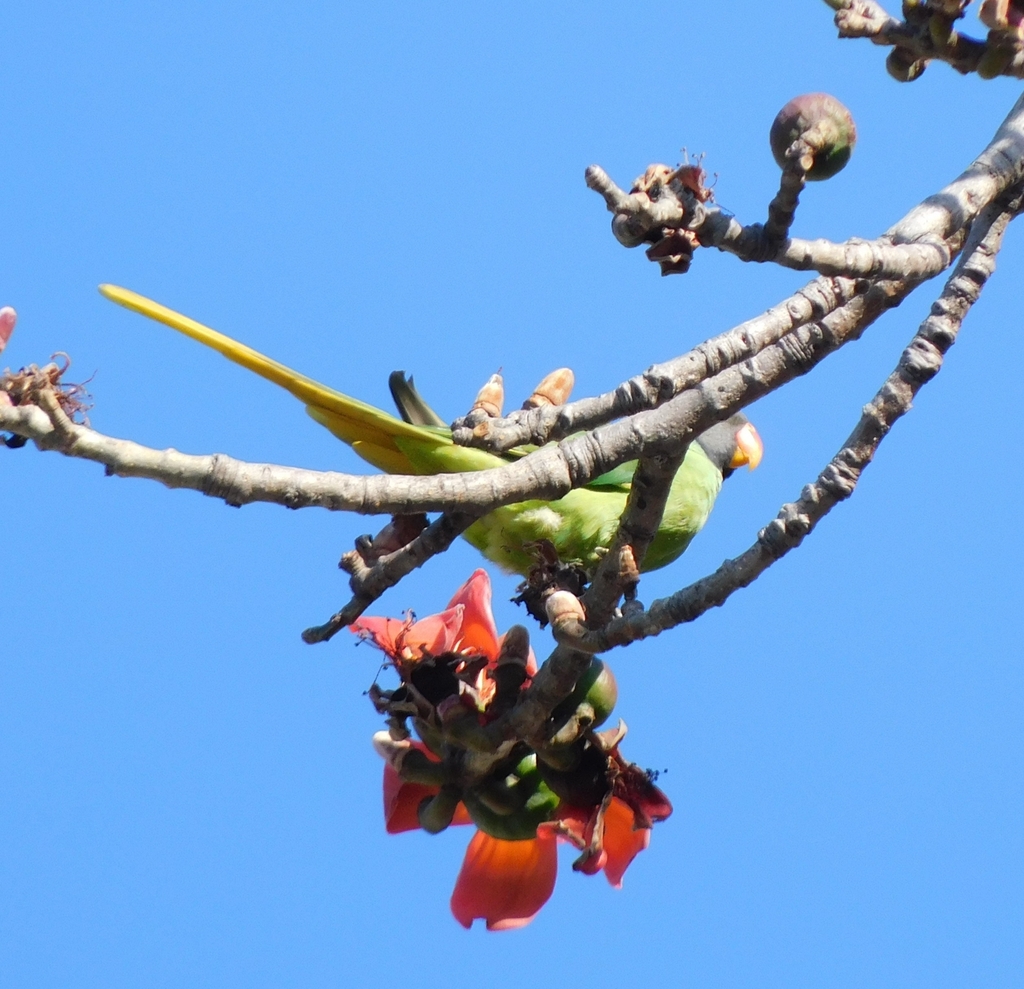
Slaty-headed Parakeet
Photo © Jagdish Singh Negi
Photo © Jagdish Singh Negi — CC BY 4.0 — Source: iNaturalist #201784465Identification
The slaty-headed parakeet is unmistakably marked by its dark grey, slate-coloured head with a light blue tint where the head meets the neck. The rest of the body is predominantly green with blue tinting. The tail is particularly striking: green at the base, deepening to blue and tipped with bright yellow. The upper mandible is bright red-orange, contrasting with a pale yellow lower mandible, and the eye is pale yellow.
Sexual dimorphism is evident in this species. Males feature dark maroon patches on their inner wing coverts and possess noticeably longer central tail feathers than females, who lack the maroon markings entirely. These differences make it possible to distinguish males from females in the field with careful observation.
Range & Habitat
This species is unique among Old World parrots for its altitudinal migration patterns. Its range spans the entire Himalayan chain from Pakistan through the western Himalayas of India, Nepal, and Bhutan, extending eastward to Arunachal Pradesh. Smaller populations are found in mountainous areas of Afghanistan. The slaty-headed parakeet inhabits highland and hillside forests and valley woodlands, typically between 460 and 2400 meters elevation.
In winter, approximately from late October onwards, birds descend into the valleys to escape harsh mountain conditions, making them more accessible to observers during these months. This altitudinal migration is a behaviour unique among parakeet species.
Behaviour & Diet
These parakeets are social birds, usually encountered in small flocks or family groups, though larger assemblies gather near the end of the wet season before moving to winter valleys. They are gregarious and frequently mingle with other parakeet species, including rose-ringed, plum-headed, and blossom-headed parakeets. Their diet comprises various fruits—both wild and cultivated—nuts, pine nuts, seeds, nectar, and acorns.
Breeding occurs from March to May, with females typically laying 4–5 eggs measuring approximately 28.5 × 22 mm. Incubation lasts 23–24 days. In Afghanistan, they often nest in abandoned cavities created by scaly-bellied woodpeckers, sometimes nesting in close proximity to this species for mutual protection against predators. The typical lifespan is 15–17 years in the wild.
Best Time & Places to See It
Winter months from late October onwards offer the best viewing opportunities, as birds descend to lower elevations and are more concentrated in valley woodlands. Nepal and Bhutan are particularly rewarding destinations, as are the Indian states of Sikkim, Uttarakhand, Himachal Pradesh, and Jammu and Kashmir. The species is also present in parts of Pakistan and Afghanistan, though access varies.
Look for them in mixed flocks with other parakeet species, particularly near fruiting trees and in open woodland. Early morning and late afternoon are typically the most active feeding periods.
Photography Tips
The slaty-headed parakeet's distinctive head colouration and bright tail markings make it highly photogenic. In good light, the contrast between the slate head and blue-tinted nape, combined with the vivid yellow tail tips and red-orange mandible, creates striking images. The sexual differences—particularly males' maroon wing coverts and longer tail feathers—are worth capturing for documentation.
Winter valley locations offer easier access and more predictable viewing than high-altitude breeding grounds. Patient positioning near fruiting trees during early morning hours will yield opportunities for flight shots and feeding behaviour. The birds' social nature means they often pause while flocking, providing moments for sharp, detailed portraits of individuals within the group.
Langtang National Park
Helambu, Nepal
+364 birds+14 mammals
Where the southern slopes of the Himalayan highlands descend toward the subtropical valleys of central Nepal, Langtang National Park sprawls across one of the subcontinent's most…
VIEW NATIONAL PARKGangotri National Park
Bhatwari, India
+119 birds+1 mammals
Where the Bhagirathi River carves through the western Himalayas in northern Uttarakhand, Gangotri National Park rises across steep alpine terrain that defines the boundary between temperate…
VIEW NATIONAL PARKKhangchendzonga National Park
Sakkyong, India
+290 birds+1 mammals
Where the eastern Himalayas surge toward their crowning peaks, Khangchendzonga National Park embraces a landscape of almost overwhelming vertical drama. Rising from subtropical river valleys into…
VIEW NATIONAL PARKNanda Devi National Park
Garpak, India
+218 birds+5 mammals
Where the Himalayas surge into their most dramatic alpine amphitheater, a wilderness of raw geological power unfolds across 624 square kilometers of pristine terrain. Nanda Devi,…
VIEW NATIONAL PARKValley of Flowers National Park
Ghangaria, India
+117 birds+1 mammals
Where alpine meadows explode with color each monsoon season, the Himalayan slopes of Uttarakhand rise to create one of Earth's most extraordinary floral displays. Perched between…
VIEW NATIONAL PARKHemis National Park
Raigahar Dhar, India
+131 birds+13 mammals
Where granite gorges cleave through the Himalayas at dizzying altitudes, a vast wilderness of alpine desert unfolds across the rain shadow of Ladakh. Hemis sprawls across…
VIEW NATIONAL PARKNo community photos yet. Log in to add the first one.
No community observations of this species yet.