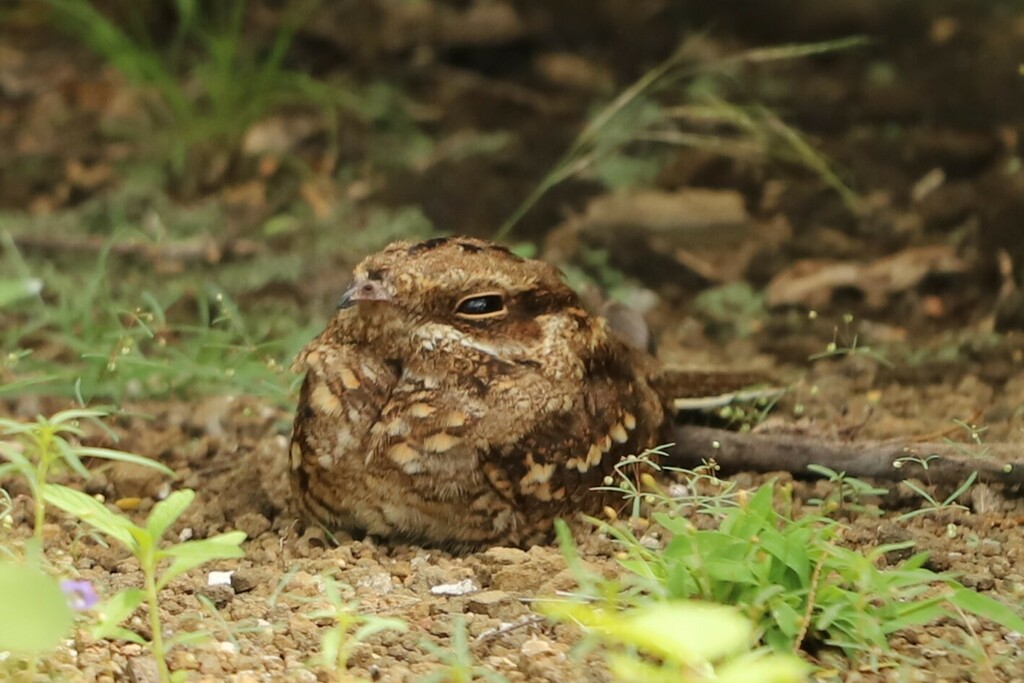
Slender-tailed Nightjar
Photo © Adrien Jailloux
Photo © Adrien Jailloux — CC BY 4.0 — Source: iNaturalist photo #465886590Identification
The slender-tailed nightjar is a medium-sized nightjar measuring approximately 25–28 cm in length. Its most distinctive feature is its long, tapered tail with central feathers that extend beyond the others—a characteristic that gives the species its common name. The plumage is cryptically patterned in browns, greys, and blacks, providing excellent camouflage against dry ground and leaf litter. The head is relatively large and flattened, with a small bill and remarkably wide gape perfectly adapted for capturing insects in flight. Males may display slightly more prominent pale patches on the wings compared to females, though the sexes are otherwise similar in appearance.
Range & Habitat
This species is found across eastern and parts of central Africa, with populations occurring in the Democratic Republic of the Congo, Ethiopia, Kenya, Somalia, South Sudan, Tanzania, and Uganda. The slender-tailed nightjar is a resident species with no evidence of long-distance migration, remaining throughout its range year-round. It favours dry, open environments including savanna, dry woodland, bushland, open scrub, rocky areas, and sparsely vegetated grassland, often associated with semi-arid regions and frequently found near water sources.
Behaviour & Diet
Entirely nocturnal, this nightjar is strictly insectivorous, foraging mainly at dusk and throughout the night. It hunts by capturing flying insects such as moths and beetles on the wing, using its characteristic wide gape to snatch prey from the air. During daylight hours, it roosts on the ground or low branches, relying entirely on its cryptic plumage for concealment from predators and human observers. Breeding biology remains poorly documented, but is presumed to follow the typical Caprimulgus pattern, with eggs laid directly on bare ground in shallow scrapes among leaf litter or stones, without construction of a nest. The species produces characteristic churring calls most often heard at dusk and during the night.
Best Time & Places to See It
The slender-tailed nightjar is best located during the twilight hours at dusk or during the night when it becomes vocally active and begins foraging. Dry, open habitats such as savanna and bushland offer the best opportunities for encounters. Several protected areas across its African range provide suitable habitat and accessibility for wildlife travellers seeking this elusive species.
Photography Tips
Photographing this species presents significant challenges due to its nocturnal habits and excellent camouflage. Night vision equipment or specialized low-light photography techniques are essential. Patience is crucial—scan the ground and low branches at dusk with a headlamp or torch, as roosting birds may be spotted before they flush. The cryptic plumage means that subjects blend seamlessly into their surroundings, so look for the distinctive silhouette of the elongated tail. Audio recordings of churring calls may help locate calling birds at night, though approach should be cautious and ethical.
Lake Mburo National Park
Murchison Falls National Park
Queen Elizabeth National Park
Abijata-Shalla Lakes National Park
Amboseli National Park
Arabuko Sokoke Forest Reserve
Arusha National Park
Awash National Park
Hell’s Gate National Park
Nothing matches these filters.
No community photos yet. Log in to add the first one.
No community observations of this species yet.