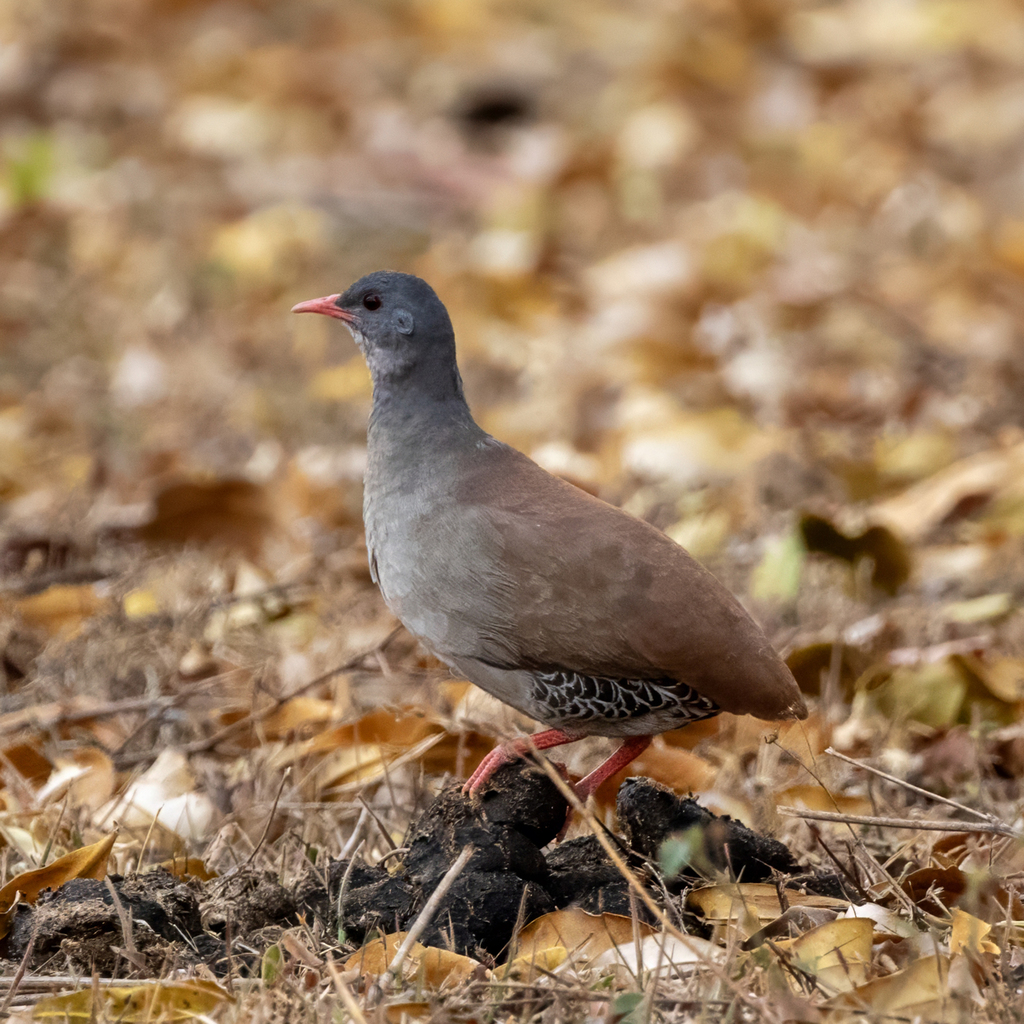
Small-billed Tinamou
Photo © Dan Vickers
Photo © Dan Vickers — CC BY 4.0 — Source: iNaturalist #280419615Identification
The small-billed tinamou is a compact bird approximately 22 cm (8.7 inches) in length, making it a relatively small member of the tinamou family. Its most distinctive features are its bright red bill and legs, which provide striking contrast against its otherwise subdued plumage. The upperparts are dark brown, while the head and underparts display grey to brownish tones. This modest coloration serves the bird well in its preferred savanna habitat, offering effective camouflage in dry grassland and shrubland environments.
Range & Habitat
The small-billed tinamou is distributed across a vast range of Amazonian South America, occurring throughout most of Brazil except the southeastern portion, as well as northeastern Peru, eastern Bolivia, Paraguay, and northeastern Argentina. This extensive distribution spans approximately 6,700,000 square kilometers. The species shows a clear preference for dry savanna habitats, though it will also inhabit lowland shrubland where suitable conditions exist, making it adaptable to various open and semi-open landscapes across its range.
Behaviour & Diet
Small-billed tinamous are ground foragers that feed on fruit gleaned from the ground or low-lying bushes. Their diet is supplemented with small amounts of invertebrates, flower buds, tender leaves, seeds, and roots, reflecting their opportunistic feeding strategy. The species exhibits a particularly interesting breeding system: males incubate eggs that may originate from as many as four different females, and subsequently raise the chicks until they achieve independence, typically within 2–3 weeks. Nests are constructed on the ground in dense brush or between raised root buttresses, providing shelter and concealment for eggs and young birds.
Best Time & Places to See It
Travellers and photographers seeking the small-billed tinamou should focus on dry savanna regions throughout Amazonian South America. The species' extensive range and Least Concern conservation status suggest it remains reasonably common within suitable habitats. Given the bird's ground-feeding behaviour and preference for dry savanna, exploring open and semi-open lowland areas with scattered brush and vegetation in central and northern Brazil, Peru, Bolivia, Paraguay, and Argentina offers the best prospects for encounters.
Photography Tips
Photographing small-billed tinamous presents the challenge common to many ground-dwelling birds: their cryptic coloration and preference for dense brush can make them difficult to locate and photograph. Early morning visits to dry savanna habitats may increase encounter rates when birds are most active in foraging. The species' relatively modest size and subtle plumage require patience and careful stalking. The bright red bill and legs, however, provide valuable focal points for photography when birds are visible, offering colour contrast that can enhance images of these otherwise camouflaged birds.
Emas National Park
Brazil
+333 birds+23 mammals
Across the high plateaux of central Brazil, where the cerrado grasslands roll toward distant horizons under an immense sky, Emas National Park anchors one of South…
VIEW NATIONAL PARKSerra do Cipó National Park
Brazil
+379 birds+5 mammals
Where granite escarpments rise above the Atlantic Forest transition zone in southeastern Brazil, Serra do Cipó National Park unfolds across a landscape of dramatic ridges, cascading…
VIEW NATIONAL PARKItatiaia National Park
Brazil
+519 birds+12 mammals
Where granite peaks pierce the Atlantic rainforest canopy in southeastern Brazil, Itatiaia National Park rises as one of the country's oldest and most ecologically vital protected…
VIEW NATIONAL PARKUbajara National Park
Brazil
+122 birds+1 mammals
Granite peaks rise sharply from the humid tropical forests of northeastern Brazil, where Ubajara's 234 square kilometres straddle the transition between Atlantic rainforest and drier cerrado…
VIEW NATIONAL PARKIguaçu National Park
Brazil
+387 birds+17 mammals
Where the Paraná Plateau plunges toward the Atlantic watershed, six thousand square kilometers of subtropical rainforest cling to steep gorges and river valleys in this corner…
VIEW NATIONAL PARKIlha Grande National Park
Brazil
+233 birds
Across the subtropical plateaus and Atlantic forest remnants of southern Brazil, a vast protected landscape spanning nearly 4,600 square kilometers safeguards one of the continent's most…
VIEW NATIONAL PARKSerra da Capivara National Park
Brazil
+156 birds+6 mammals
Across the semi-arid plateaus and deeply incised canyons of northeastern Brazil, where Piauí's ancient sandstone formations rise and fall in weathered waves, Serra da Capivara National…
VIEW NATIONAL PARKPau Brasil National Park
Brazil
+211 birds
Tropical Atlantic forest cloaks the rolling terrain of northeastern Bahia, where Pau Brasil National Park protects nearly 390 square kilometers of one of Brazil's most biodiverse…
VIEW NATIONAL PARKSerra dos Órgãos National Park
Brazil
+446 birds+13 mammals
Granite peaks thrust skyward through the Atlantic Forest canopy in the mountains immediately north of Rio de Janeiro, their bare rock faces rising above a landscape…
VIEW NATIONAL PARKSete Cidades National Park
Brazil
+125 birds+1 mammals
Sete Cidades sprawls across 113 square kilometres of northeastern Brazil's interior plateau, where weathered sandstone formations rise dramatically from the cerrado landscape. The park's geology tells…
VIEW NATIONAL PARKChapada dos Guimarães National Park
Brazil
+450 birds+1 mammals
Where weathered sandstone plateaus rise above the cerrado grasslands of central Brazil, Chapada dos Guimarães National Park protects 624 square kilometres of ecological transition zone that…
VIEW NATIONAL PARKChapada dos Veadeiros National Park
Brazil
+324 birds+6 mammals
Where granite plateaus rise above the cerrado savanna in central Brazil, Chapada dos Veadeiros National Park unfolds across 6,665 square kilometres of some of the world's…
VIEW NATIONAL PARKPantanal Matogrossense National Park
Brazil
+322 birds+17 mammals
Where the flooded forests of central Brazil meet vast seasonally inundated grasslands, Pantanal Matogrossense National Park sprawls across nearly 2,900 square kilometers of one of the…
VIEW NATIONAL PARKChapada Diamantina National Park
Brazil
+346 birds+5 mammals
Where granite peaks and sandstone cliffs rise abruptly from the Brazilian interior, Chapada Diamantina National Park sprawls across 4,215 square kilometers of some of Brazil's most…
VIEW NATIONAL PARKSerra do Gandarela National Park
Brazil
+333 birds+3 mammals
Where granite massifs rise through Atlantic Forest in southeastern Brazil's highlands, Serra do Gandarela National Park protects nearly 1,000 square kilometres of montane terrain that few…
VIEW NATIONAL PARKCatimbau National Park
Brazil
+118 birds+6 mammals
Where sandstone plateaus rise from the semi-arid scrublands of northeastern Brazil, Catimbau National Park unfolds across more than 1,000 square kilometres of geological drama and surprising…
VIEW NATIONAL PARKBrasília National Park
Plano Piloto, Brazil
+338 birds+15 mammals
Cerrado grassland and scattered woodland sweep across the central Brazilian plateau where this national park sprawls across more than a thousand square kilometres of the Federal…
VIEW NATIONAL PARKPacaás Novos National Park
Brazil
+279 birds+1 mammals
Across the border between Rondônia and Amazonas, vast tracts of humid tropical forest rise and fall in gentle undulations, carved by clear-flowing rivers that feed into…
VIEW NATIONAL PARKBahuaja Sonene National Park
San Pedro de Putina Punco, Peru
+602 birds+8 mammals
Where the Madre de Dios and Heath rivers converge in southeastern Peru rises one of South America's most biodiverse wilderness regions: a vast protected realm of…
VIEW NATIONAL PARKIguazú National Park
Puerto Iguazú, Argentina
+346 birds+15 mammals
Where the Paraná Plateau plunges toward the Atlantic watershed, nearly 800 square kilometers of subtropical rainforest drape across Misiones Province in a landscape carved by millennia…
VIEW NATIONAL PARKNo community photos yet. Log in to add the first one.
No community observations of this species yet.