Smith’s Longspur
Photo © Paul Bedell
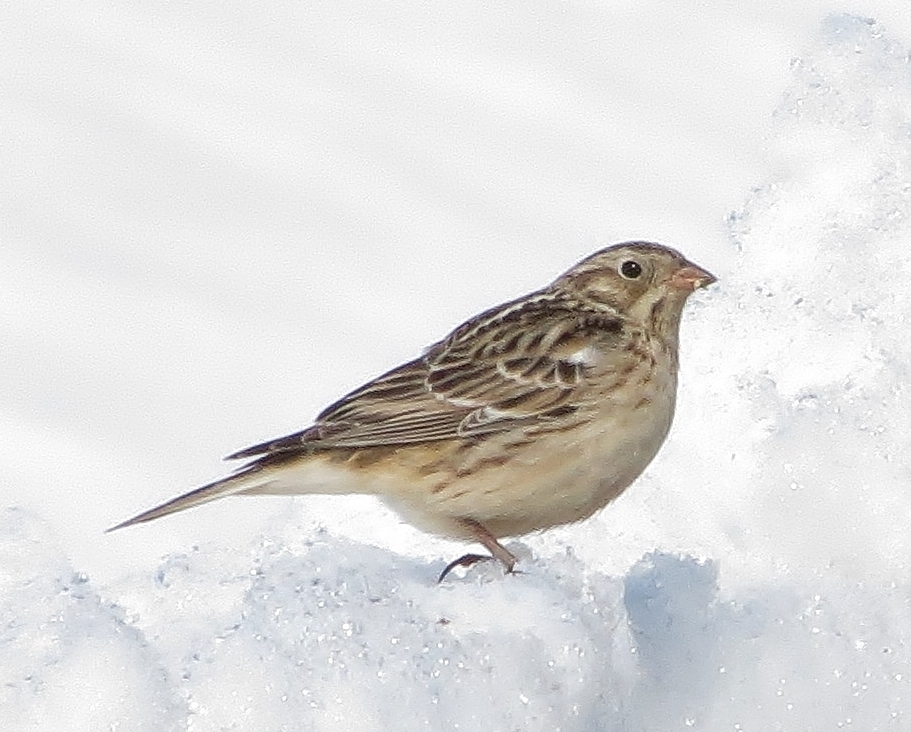
Photo © Paul Bedell — CC BY-SA 4.0 — Source: iNaturalist photo #1584569Smith's longspur (Calcarius pictus) is a bird from the family Calcariidae, which also contains the other species of longspurs. A bird of open habitats, it breeds in northern Canada and Alaska, and winters in the southern United States. Primarily a ground-feeding seed-eater, it supplements its diet with insects in the summer. == Description == These birds have short cone-shaped bills, streaked backs, and dark tails with white outer rectrices. In breeding state plumage (mostly formed by worn basic plumage), the male has a pumpkin-orange throat, nape, and underparts contrasting with an intricate black-and-white face pattern. The white lesser coverts are quite pronounced on a male in spring and early summer. Females and immatures have lightly streaked buffy underparts, dark crowns, brown wings with less obvious white lesser coverts, and a light-colored face. The tail is identical at all ages. === Measurements === Length: 15–17 cm (5.9–6.7 in) Weight: 20–31 g (0.7–1.1 oz) Wingspan: 25 cm (9.8 in) == Distribution and habitat == This bird breeds in open grassy areas near the tree line in northern Canada and Alaska. In winter, they congregate in open fields, including airports, in the south-central United States. Migration is elliptical, with northbound birds staging in…
Gates of the Arctic National Park
Unorganized Borough, United States
+112 birds+12 mammals
Where granite gorges pierce the Brooks Range and alpine tundra stretches endlessly beneath the Alaskan sky, Gates of the Arctic National Park unfolds across nearly 50,000…
VIEW NATIONAL PARKDenali National Park
Denali Borough, United States
+144 birds+18 mammals
Across nearly 31,000 square kilometres of interior Alaska, subarctic boreal forest gives way to alpine tundra, where the raw architecture of mountains—including the continent's tallest peak—shapes…
VIEW NATIONAL PARKWrangell-Saint Elias National Park
Unorganized Borough, United States
+155 birds+13 mammals
Where granite peaks thrust above 5,400 metres and vast fields of glacial ice dominate the landscape, Wrangell-Saint Elias encompasses one of North America's most extreme wilderness…
VIEW NATIONAL PARKWapusk National Park
Unorganized Division No. 23, Canada
+140 birds+6 mammals
Across the subarctic lowlands of northern Manitoba, where permafrost underlies a mosaic of stunted boreal forest, open muskeg, and coastal tundra, Wapusk National Park sprawls across…
VIEW NATIONAL PARKWood Buffalo National Park
Improvement District No. 24, Canada
+187 birds+10 mammals
Across nearly 75,000 square kilometres of boreal forest, wetland and grassland in northern Alberta, the landscape unfolds in a mosaic of spruce and pine woodland interspersed…
VIEW NATIONAL PARKTombstone Territorial Park
Dawson City, Canada
+150 birds+17 mammals
Where granite peaks pierce the Yukon sky and tundra stretches endlessly toward the Arctic horizon, the Tombstone Range commands attention with uncompromising beauty. This subarctic wilderness…
VIEW NATURE RESERVEArctic National Wildlife Refuge
Arctic Village, United States
+132 birds+15 mammals
Across the northernmost reaches of Alaska's Unorganized Borough, where the Brooks Range rises from the coastal plain and tundra spreads endlessly toward the Arctic Ocean, lies…
VIEW WILDLIFE SANCTUARYAlaska Maritime National Wildlife Refuge
Alaska, United States
+391 birds+58 mammals
Where the North Pacific collides with Alaska's rugged coastline, a sprawling archipelago of islands, rocky outcrops, and coastal headlands forms one of North America's most remote…
VIEW WILDLIFE SANCTUARYWichita Mountains National Wildlife Refuge
Medicine Park, United States
+256 birds+17 mammals
Granite peaks rise abruptly from rolling prairie in southwestern Oklahoma, where the Wichita Mountains National Wildlife Refuge protects a rare collision of ecosystems. This sanctuary encompasses…
VIEW WILDLIFE SANCTUARYFarallon National Wildlife Refuge
San Francisco, United States
+384 birds+16 mammals
Windswept granite peaks rising abruptly from the Pacific, the Farallon Islands form a wildlife sanctuary of extraordinary seabird abundance and ecological significance just twenty-seven miles west…
VIEW WILDLIFE SANCTUARYNo community photos yet. Log in to add the first one.
No community observations of this species yet.