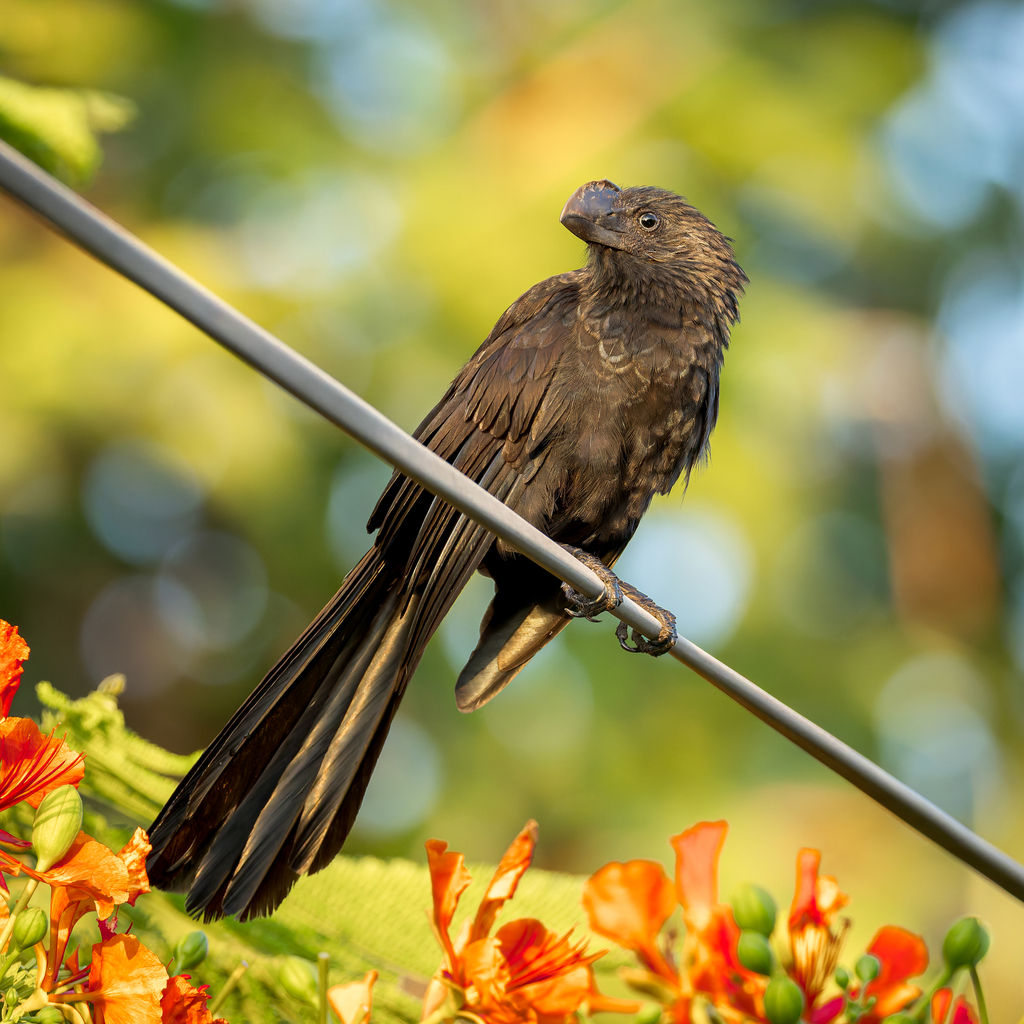
Smooth-billed Ani
Photo © Chris Kirby-Lambert
Photo © Chris Kirby-Lambert — CC BY 4.0 — Source: iNaturalist #332166308Identification
The smooth-billed ani is a mid-sized member of the cuckoo family, measuring approximately 35 cm (14 in) in length. Adults are unmistakable: predominantly glossy black with a long tail, a distinctive deep ridged black bill, and a brown iris. Males weigh around 115 g, while females are slightly lighter at approximately 95 g. The bird's flight is notably weak and wobbly, but it runs well and spends most of its time foraging on the ground. Its whining "ooo-leeek" call is distinctive and often heard before the bird is seen.
Range & Habitat
The smooth-billed ani is a resident breeding species with an extensive range spanning from southern Florida through the Caribbean, parts of Central America, and south to western Ecuador, Brazil, northern Argentina, and southern Chile. The species was introduced to the Galápagos around the 1960s, where it is potentially impacting native and endemic species. It favours open and semi-open country and cultivated areas, and has greatly benefited from deforestation, becoming increasingly common and conspicuous across its range.
Behaviour & Diet
The smooth-billed ani is an exceptionally gregarious bird, always found in noisy, social groups—a behaviour reflected in its name, which derives from the Tupi word "Anim" meaning "social bird." Its diet is varied and opportunistic, including termites, large insects, other invertebrates, lizards, frogs, and eggs and hatchlings of other birds, supplemented with fruit. The species will occasionally remove ticks and other parasites from grazing animals, a behaviour noted by early naturalists.
Breeding is highly communal, with several pairs constructing a single deep cup nest made of twigs and lined with leaves, typically placed 2–6 m high in a tree. Multiple females lay chalky blue eggs in the shared nest and collectively incubate and feed the chicks. Nests have contained up to 29 eggs, though more than ten rarely hatch successfully. Incubation lasts 13–15 days, with fledging occurring after another 10 days. Up to three broods may be raised seasonally, with older chicks helping to feed younger nestmates.
Best Time & Places to See It
The smooth-billed ani is a year-round resident throughout its range, making it accessible to travellers and photographers in any season. Look for it in open and semi-open habitats, cultivated areas, and scrubland. The species' gregarious nature and conspicuous behaviour—along with its loud, distinctive calls—make it relatively easy to locate. Southern Florida, the Caribbean islands, and Central and South America offer reliable sighting opportunities, particularly in suitable open country habitat.
Photography Tips
Photograph this species in open habitats where it feeds on the ground or forages in low vegetation. The glossy black plumage records well in bright daylight, and the distinctive ridged bill is a key feature to capture. The bird's weak flight makes photography challenging in flight, so focus on ground-feeding behaviour and perched birds. Early morning is ideal, as the species is vocal and active during this period. Remember that these birds are highly social; photograph them in groups to capture their characteristic gregarious behaviour.
Amacayacu National Park
Amazônia National Park
Anavilhanas National Park
Antisana National Park
Araucárias National Park
Bahuaja Sonene National Park
Baritú National Park
Baru Volcano National Park
Biscayne National Park
Nothing matches these filters.
No community photos yet. Log in to add the first one.
No community observations of this species yet.