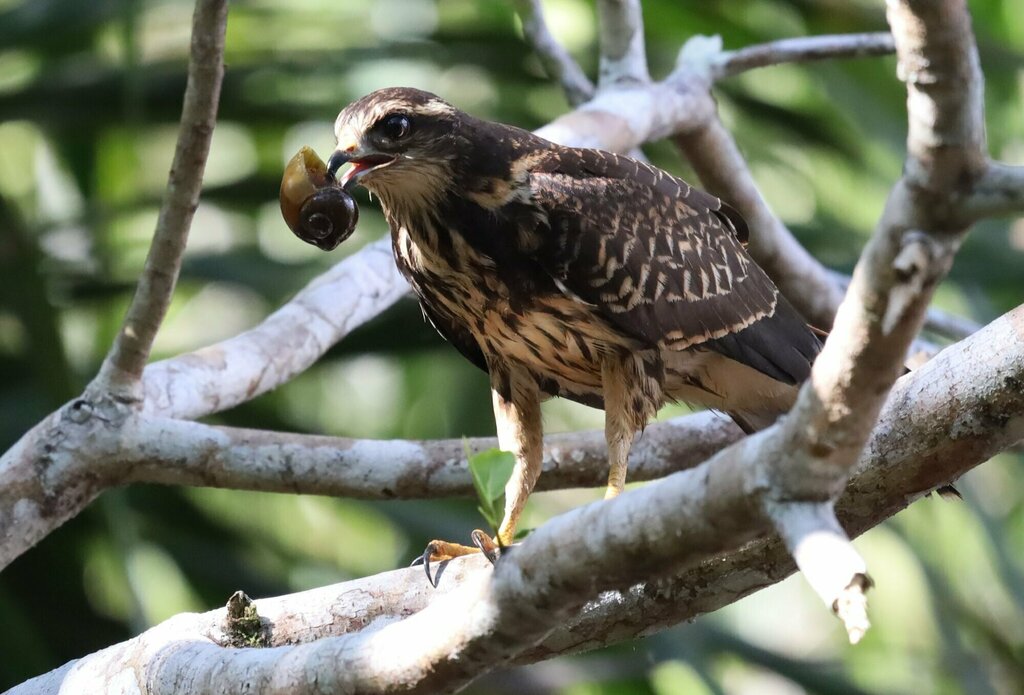
Snail Kite
Photo © Paul Hoekman
Photo © Paul Hoekman — CC BY 4.0 — Source: iNaturalist photo #219789346Identification
The snail kite is a medium-sized raptor measuring 36 to 48 cm in length with a distinctive wingspan of 99–120 cm. Its most striking feature is a dark, deeply hooked beak—a specialized adaptation for extracting snails from their shells. Adult males display dark blue-gray plumage with red legs and cere, while females are dark brown above with heavily streaked pale underparts, a whitish face, and yellow or orange legs and cere. Juveniles resemble females but have streaked crowns and dark brown irises, compared to the red or orangish-brown irises of adults. All birds show a characteristic white rump and undertail coverts, which are visible in flight.
Range & Habitat
The snail kite breeds throughout tropical South America, the Caribbean, and central and southern Florida. It is a year-round resident across most of its range, though southernmost populations migrate northward in winter and Caribbean birds disperse widely after breeding. The species favors freshwater wetlands, where it forms large communal roosts, particularly in winter months.
Behaviour & Diet
This gregarious bird is a specialist molluscivore, feeding almost exclusively on apple snails of the genus Pomacea. It hunts by flying slowly with its head facing downward, scanning wetlands for prey. In Florida, the diet consists primarily of native species P. paludosa, P. diffusa, and the introduced P. maculata, which can be five times larger than native species. When apple snails become scarce during droughts, snail kites occasionally take alternative prey including crayfish, crabs, small freshwater snails, ring-necked snakes, small turtles, and rodents. Remarkably, Florida's snail kite population has evolved larger bodies and beaks—approximately 12% bigger—over recent decades to exploit the introduced larger snail species.
Best Time & Places to See It
Winter months offer excellent viewing opportunities, when snail kites form large roosts in freshwater marshes and wetlands. In Florida's Everglades, dedicated wetland habitats provide reliable sightings. Beyond North America, winter dispersal makes the species observable in Central America and the Caribbean during winter months, with El Salvador's Embalse Cerrón Grande, Laguna El Jocotal, and especially Lago de Güija offering regular sightings.
Photography Tips
Photograph snail kites during their characteristic low, slow hunting flights when their distinctive silhouette and white rump are most visible. Winter roosts provide opportunities for capturing multiple birds in social behavior. Position yourself near wetlands during dawn and dusk for optimal lighting. The bird's pale facial markings in females and juveniles, contrasting with darker plumage, offer striking compositional elements. Capturing the characteristic downward-facing hunting posture requires patience and positioning along open water margins.
Amacayacu National Park
Amazônia National Park
Anavilhanas National Park
Arenal Volcano National Park
Bahuaja Sonene National Park
Barra del Colorado National Wildlife Refuge
Biscayne National Park
Brasília National Park
Campos del Tuyú National Park
Nothing matches these filters.
No community photos yet. Log in to add the first one.
No community observations of this species yet.