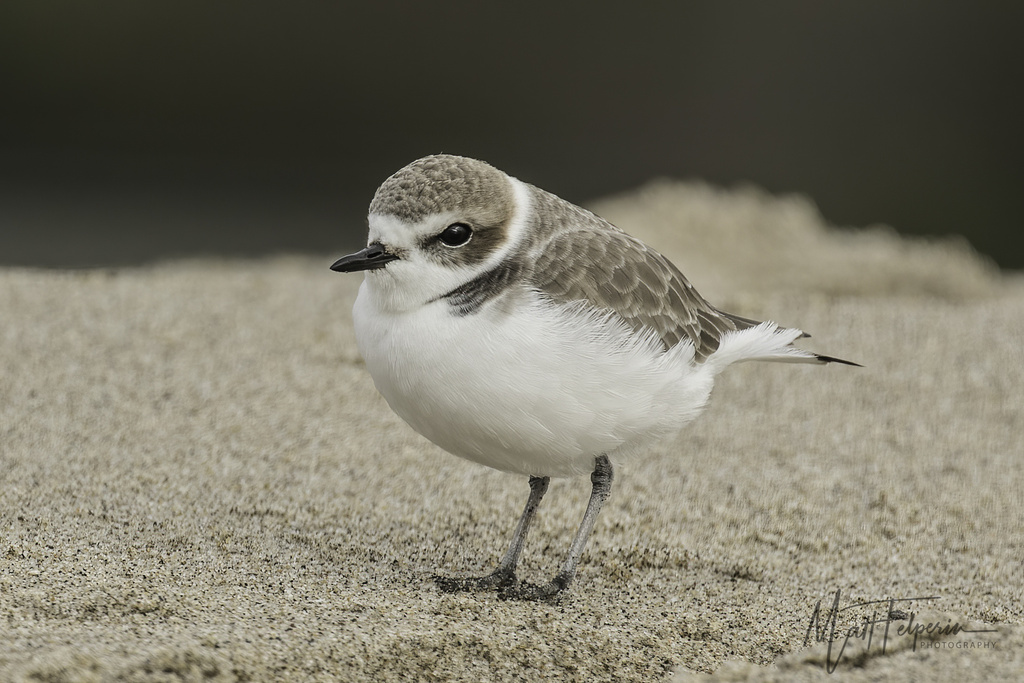
Snowy Plover
Photo © Matt Felperin
Photo © Matt Felperin — CC BY 4.0 — Source: iNaturalist photo #365545789Identification
The snowy plover is a small shorebird with pale brown upperparts and white underparts, distinguished by a white band across the hind neck. During breeding season, males display diagnostic black patches behind the eye and on the side of the neck—notably, these patches remain separate rather than forming a continuous breast band as seen in many other plover species. The bird's all-black, slender bill and gray to black legs provide reliable identification features that separate it from related plovers. Its typical call is a repeated "tu-wheet."
Range & Habitat
The snowy plover is found throughout the Americas, with populations distributed along the Pacific coast of North America, Ecuador, Peru, and Chile, as well as in several inland areas of the US and Mexico, along the Gulf Coast, and on Caribbean islands. Coastal populations consist of both residential and migratory birds, while inland populations are predominantly migratory. This species is one of the rarest and best-studied endemic shorebirds of the Americas.
The bird inhabits open areas with absent or sparse vegetation, particularly coastal sand beaches and the shores of salt or soda lakes. These sparse, open habitats are essential for the species' feeding and breeding activities.
Behaviour & Diet
Snowy plovers feed on small invertebrates including crustaceans, worms, beetles, and flies, gleaned from the sandy and open habitats they favour. Their breeding behaviour is notably unusual for birds. At the start of the breeding season, males excavate multiple nest scrapes in the sand to attract females; one scrape is eventually selected for actual breeding. Some females desert their brood shortly after chicks hatch to re-mate with another male, while their initial partner continues caring for the chicks—a polyandrous mating system that is uncommon among birds.
This polygamous strategy may serve to maximize breeding success, and research suggests it correlates with sex ratio imbalances in the population. In California populations, there are approximately 1.4 times more males than females, and populations with greater sex ratio imbalances show higher rates of female polyandry.
Best Time & Places to See It
The snowy plover's wide geographic range across the Americas offers multiple opportunities for observation. Coastal sand beaches and salt lake shores throughout its range are the most reliable habitats. Timing visits to coincide with the breeding season will increase chances of observing the distinctive plumage patterns of males, particularly the characteristic black patches that appear at this time.
Photography Tips
The snowy plover's pale coloration and preference for open, sandy habitats can present challenges for photography. The bird's small size and tendency to remain in sparse vegetation means patient stalking and a telephoto lens will be necessary. During breeding season, males' black facial and neck patches provide stronger contrast and more distinctive features for photography. Early morning or late afternoon light on pale sand beaches will help define the bird's subtle plumage patterns and reveal the details that distinguish it from similar plover species.
Redwood National Park
Humboldt County, United States
+343 birds+43 mammals
Where the Pacific fog rolls deep into northern California's coastal valleys, some of the tallest trees on Earth rise from a landscape shaped by tectonic forces…
VIEW NATIONAL PARKPan de Azúcar National Park
Chañaral, Chile
+74 birds+4 mammals
Where the Atacama Desert plunges toward the Pacific, Pan de Azúcar National Park sprawls across 727 square kilometres of one of Earth's most extreme transitions—a landscape…
VIEW NATIONAL PARKNo community photos yet. Log in to add the first one.
No community observations of this species yet.