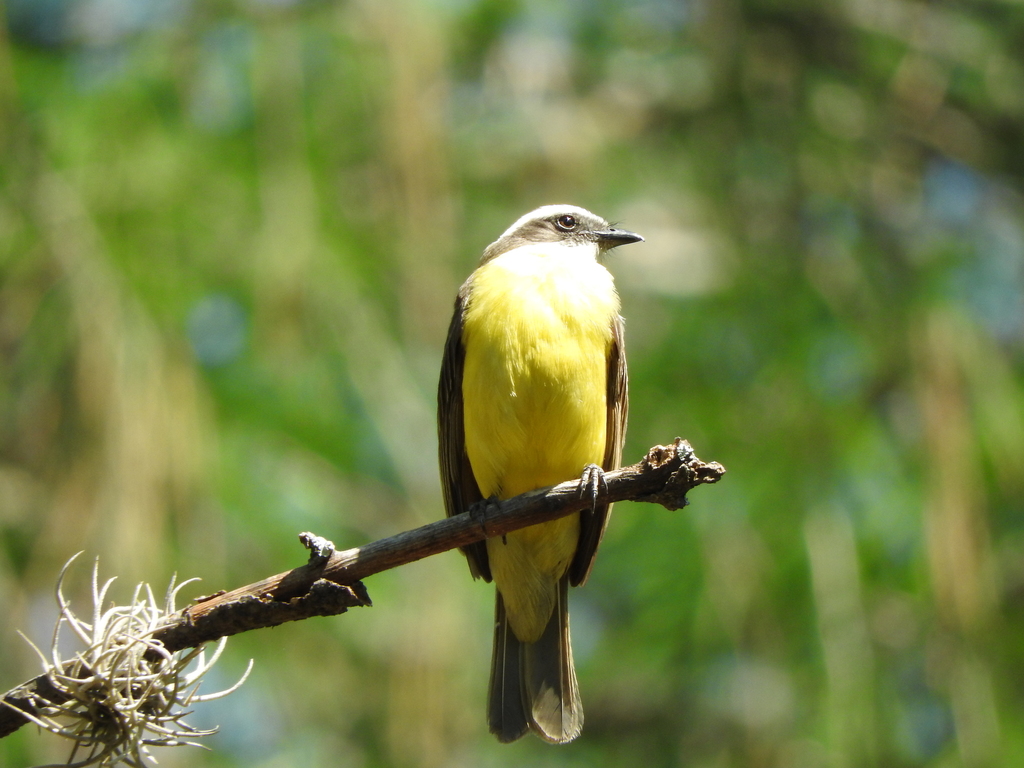
Social Flycatcher
Photo © Oscar Alejandro Morales Juárez
Photo © Oscar Alejandro Morales Juárez — CC BY-SA 4.0 — Source: iNaturalist photo #130360001Identification
The Sociable Bienteveo is a small flycatcher, 16 to 18.5 cm long and weighing 24 to 27 grams. The most distinctive feature is a hidden bright red to orangish-red crown patch—rarely visible unless the bird raises its head feathers—contrasting with a dark gray to brownish-gray head. A bold white eyebrow stripe runs from the forehead well past the eye. The upperparts are dull olive-green to brownish-olive, while the bright yellow underparts are striking. The wings are deep grayish-brown with pale edges, and the tail similarly dark with olive edges. Both sexes share identical plumage, though females average slightly smaller. Juveniles resemble adults but show little to no red on the crown and broader rufous edges on wings and tail feathers.
Multiple subspecies occur across the range with subtle variations in crown tone and wing-feather edges. The largest subspecies, M. s. grandis, shows wider and paler wing coverts and slightly brighter yellow underparts. All subspecies share a brown iris, stubby black bill, and black legs and feet. The species closely resembles several other flycatchers, including the rusty-margined flycatcher and both great and lesser kiskadees, making careful observation of field marks essential.
Range & Habitat
The Sociable Bienteveo occurs from western Mexico through Central America and across South America, absent only from Chile, Guyana, Suriname, and Uruguay. Seven subspecies are recognized, each occupying distinct geographic regions from southwestern Sonora in Mexico through the Amazon basin and into eastern Brazil, Paraguay, and northeastern Argentina. The species has occasionally appeared as a vagrant in the United States.
This flycatcher inhabits diverse moist to semi-arid tropical and lower subtropical environments, typically in somewhat open settings. It favors lowlands with scattered bushes and trees, secondary forest, forest canopy and edges, riparian margins along rivers and lakes, agricultural and pasture lands, and gardens in residential areas. Elevations range from sea level to approximately 2,250 meters in Central America, with varying altitudinal limits across its South American range.
Behaviour & Diet
As its name suggests, the Sociable Bienteveo is a gregarious species often encountered in small flocks, particularly in suitable open habitats. Like other tyrant flycatchers, it feeds primarily on insects caught in flight, sally-gleaning from perches and making characteristic flycatching sorties. The bird is active and vocal, drawing attention through its calling and social interactions within feeding groups.
The species shows considerable adaptability to human-modified landscapes, frequenting parks, gardens, and agricultural areas alongside natural habitats. Its presence in open, semi-forested terrain with scattered perching opportunities makes it a relatively common and conspicuous bird throughout much of its range.
Best Time & Places to See It
The Sociable Bienteveo is a year-round resident across its range, making it accessible to travelers in any season. Look for it in open lowland habitats with scattered trees and shrubs, gallery forests along watercourses, secondary growth, and the edges of primary forest. The species adapts readily to human settlements, so it can often be found in parks and gardens near towns and villages, making it one of the most accessible flycatchers for visitors.
Early morning is typically the best time for observation, when the bird is most active. Its social nature and preference for somewhat open habitats mean that patient watching of likely perches will usually result in sightings. Gallery forests along rivers and lakes are particularly productive, as are the open margins of forest patches.
Photography Tips
The hidden red crown patch is the species' signature field mark but is frustratingly difficult to photograph as the bird rarely raises its crown feathers. Patient waiting during moments of excitement or alarm may reveal this feature. Focus instead on capturing the distinctive white eyebrow stripe and bright yellow underparts, which are reliable identification features visible in most shots. The contrast between the darker upperparts and bright underparts works well in overcast or filtered light.
The bird's preference for open habitats and relatively exposed perching makes photography opportunities good compared to many forest species. Capture the bird in profile to show the facial pattern clearly, and include surrounding vegetation to convey habitat preference. Early morning light filtering through riverside trees or gaps in secondary forest provides excellent photography conditions.
Amacayacu National Park
Amazônia National Park
Anavilhanas National Park
Antisana National Park
Araucárias National Park
Arenal Volcano National Park
Bahuaja Sonene National Park
Barbilla National Park
Barra del Colorado National Wildlife Refuge
Nothing matches these filters.
No community photos yet. Log in to add the first one.
No community observations of this species yet.