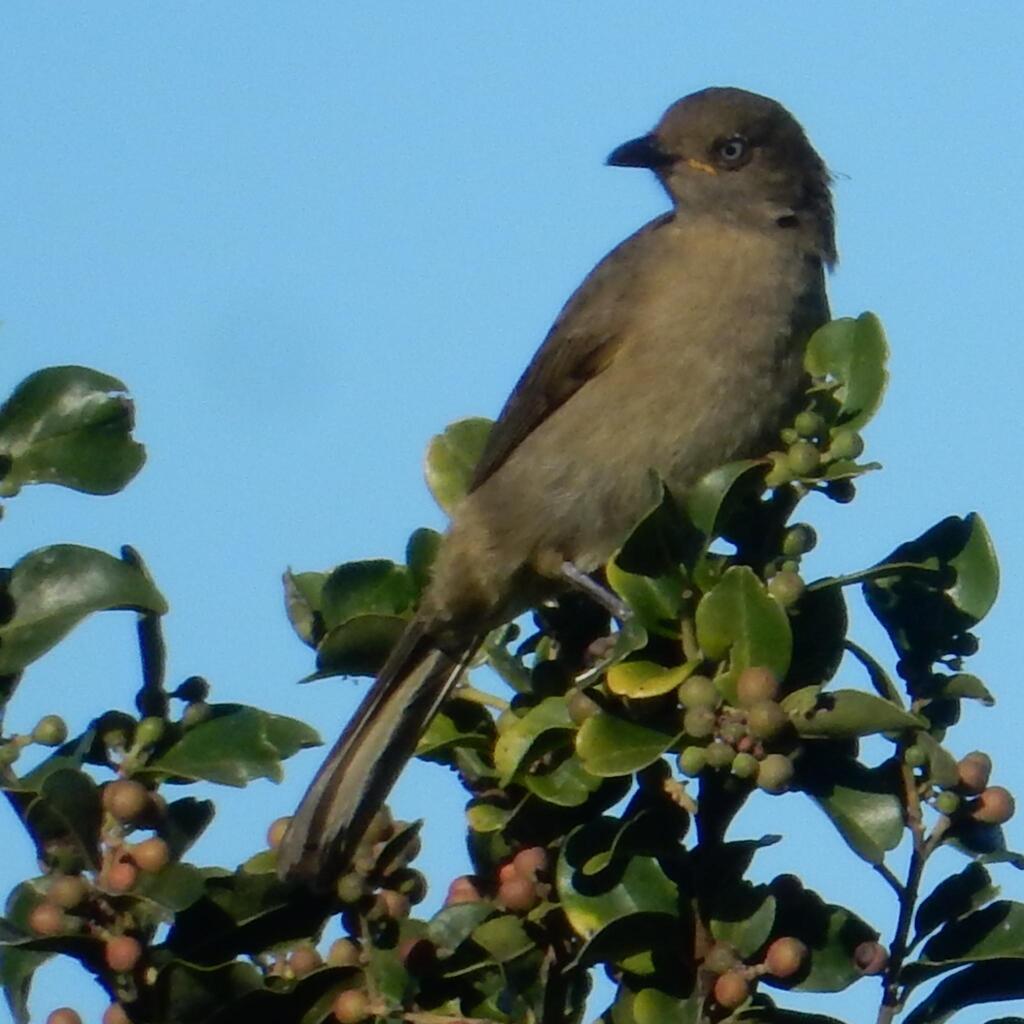
Sombre Greenbul
Photo © Henry de Lange
Photo © Henry de Lange — CC BY 4.0 — Source: iNaturalist #336328791Identification
The sombre greenbul is a small passerine measuring 15–18 cm in length, characterized by mainly dull greyish olive-green plumage with paler underparts. The bird displays regional colour variation: southern African populations tend to be plain olive-green, while northern birds are yellower with greener upper parts. All adults possess a distinctive white iris. The sexes are similar in plumage, though juveniles are noticeably duller with dark grey eyes. The subspecies A. i. hypoxanthus is notably yellower on the underparts compared to the nominate form.
Range & Habitat
The sombre greenbul is a resident breeder throughout eastern and southern Africa, with four recognized subspecies distributed across the region. A. i. insularis ranges from southern Ethiopia and southern Somalia to eastern Tanzania; A. i. importunus occupies the highlands of northern South Africa and western Eswatini south to the Western Cape; A. i. oleaginus is found in southern Zimbabwe, southern Mozambique and lowland northern South Africa; and A. i. hypoxanthus occurs from south-eastern Tanzania through central Mozambique, central Zimbabwe and south-central Zambia. The species inhabits coastal bush, evergreen forest and dry shrub land.
Behaviour & Diet
The sombre greenbul is a vocal and common species, though it tends to remain hidden in foliage and is more often heard than seen. It is a highly distinctive acoustic presence in its habitat, with the most typical call being a monotonous, ringing phrase: a penetrating single whistle weeeewee, followed by a jumbled chortle and ending with a plaintive, drawn-out willy. When agitated, it produces a repeated peeet peeet peeet call. The bird is usually found in pairs or small groups foraging deliberately through vegetation for insects, fruit and small snails.
Best Time & Places to See It
As a year-round resident, the sombre greenbul can be encountered throughout its range in any season. Birders and nature travellers should concentrate their efforts in coastal bush, evergreen forest and dry shrub land habitats across eastern and southern Africa. Early morning hours are often most productive, as the species is vocal and active during dawn chorus periods. Patient observers who familiarize themselves with the bird's distinctive calls will have greater success locating individuals, which prefer to forage within dense foliage.
Photography Tips
Photographing the sombre greenbul presents a genuine challenge due to its cryptic behaviour and preference for dense vegetation. Success requires patience and a good knowledge of the species' vocalizations, which will alert you to nearby birds. Position yourself quietly near calling birds and wait for them to move into more open sections of foliage. Early morning light will best reveal the subtle greyish olive-green plumage and the characteristic white iris. A telephoto lens (300mm or longer) is essential, as the bird rarely permits close approach. Focus on capturing the bird's typical foraging posture and, if possible, the distinctive white eye that helps confirm identification.
Arusha National Park
Tanzania
+555 birds+16 mammals
Where the slopes of Mount Mawenzi rise above the Arusha region, a compact yet ecologically rich national park unfolds across montane forest, moorland, and alpine zones.…
VIEW NATIONAL PARKMapungubwe National Park
Musina Local Municipality, South Africa
+358 birds+29 mammals
Where the Limpopo River cuts through sandstone ridges at the convergence of South Africa, Botswana, and Zimbabwe, Mapungubwe National Park preserves a landscape of profound ecological…
VIEW NATIONAL PARKAmboseli National Park
Etonet/Lenkism ward, Kenya
+501 birds+43 mammals
Where the Amboseli basin opens toward the Tanzanian frontier, a shallow alkaline lake mirrors vast skies across one of East Africa's most iconic savanna landscapes. The…
VIEW NATIONAL PARKTarangire National Park
Tanzania
+527 birds+50 mammals
Acacia woodland and grassland sweep across the Manyara Region where the Tarangire River carves through low hills and volcanic soils, creating one of East Africa's most…
VIEW NATIONAL PARKNgorongoro Conservation Area
Tanzania
+626 birds+55 mammals
Volcanic calderas and open grassland dominate this high plateau in northern Tanzania, where the landscape rises above 2,000 metres and ancient geological forces have shaped both…
VIEW WILDLIFE MANAGEMENT AREAGarden Route National Park
George, South Africa
+353 birds+54 mammals
Sweeping across the Western Cape's coastal and mountainous terrain, this sprawling national park encompasses over five thousand square kilometers of extraordinarily diverse landscape—from coastal limestone cliffs…
VIEW NATIONAL PARKKruger National Park
Ba-Phalaborwa Local Municipality, South Africa
+540 birds+91 mammals
Across the low-lying savanna of northeastern South Africa unfolds one of Africa's largest and most ecologically intact protected areas, where acacia woodlands merge into mopane scrub…
VIEW NATIONAL PARKAgulhas National Park
Cape Agulhas Local Municipality, South Africa
+224 birds+13 mammals
Where the Atlantic and Indian Oceans meet at Africa's southernmost tip, Agulhas National Park stretches across 892 square kilometres of windswept coastal landscape and rugged limestone…
VIEW NATIONAL PARKMountain Zebra National Park
Inxuba Yethemba Local Municipality, South Africa
+265 birds+35 mammals
Across the windswept plateaus and deeply incised valleys of the Eastern Cape's interior, Mountain Zebra National Park unfolds as a landscape of geological drama and ecological…
VIEW NATIONAL PARKBontebok National Park
Swellendam Local Municipality, South Africa
+204 birds+11 mammals
Where the Cape Fold Mountains give way to coastal lowlands, a landscape of rolling sandstone hills and fynbos heathland creates one of South Africa's most compact…
VIEW NATIONAL PARKAddo Elephant National Park
Sundays River Valley Local Municipality, South Africa
+388 birds+55 mammals
Where the Eastern Cape's semi-arid scrublands meet transitional woodland, Addo sprawls across 13,478 square kilometres of one of southern Africa's most biodiverse landscapes. The terrain rises…
VIEW NATIONAL PARKIthala Game Reserve
uPhongolo Local Municipality, South Africa
+328 birds+26 mammals
Rolling thornbush savanna and acacia woodland dominate the landscape of this 494-square-kilometre national park in KwaZulu-Natal's uPhongolo Local Municipality, where granite outcrops punctuate grassland plateaus and…
VIEW NATIONAL PARKMarakele National Park
Modimolle Local Municipality, South Africa
+341 birds+36 mammals
Granite ridges and sprawling grasslands dominate this 1,176-square-kilometre reserve in Limpopo's heartland, where bushveld transitions between rocky outcrops and open savanna. The park's rugged topography creates…
VIEW NATIONAL PARKCamdeboo National Park
Camdeboo Local Municipality, South Africa
+272 birds+24 mammals
Granite ridges and weathered sandstone cliffs rise across a semi-arid landscape where the Karoo transitions into the eastern escarpment of South Africa, creating Camdeboo National Park's…
VIEW NATIONAL PARKNairobi National Park
Nairobi, Kenya
+515 birds+35 mammals
Just minutes from Kenya's capital, where the Nairobi River winds through acacia woodland and open grassland, lies one of Africa's most paradoxical wildlife sanctuaries. The park's…
VIEW NATIONAL PARKMeru National Park
Igembe Central, Kenya
+408 birds+38 mammals
Granite outcrops and acacia woodland rise across the northern reaches of Meru, where semi-arid savanna transitions into drier scrubland under the fierce equatorial sun. The park's…
VIEW NATIONAL PARKChyulu Hills National Park
Kibwezi East, Kenya
+232 birds+30 mammals
Volcanic cones rise abruptly from the Kenyan savanna floor, their flanks clothed in dense acacia woodland and grassland that transforms the Chyulu Hills into an ecological…
VIEW NATIONAL PARKOl Donyo Sabuk National Park
Matungulu North ward, Kenya
+200 birds
Granite peaks rise abruptly from the highland plateau of Matungulu North, their weathered slopes clothed in scattered woodland and montane grassland that shifts between verdant and…
VIEW NATIONAL PARKArabuko Sokoke Forest Reserve
Kilifi, Kenya
+383 birds+29 mammals
Coastal forest rises from the Indian Ocean plains of Kilifi County, where sandy soils and seasonal rainfall have sculpted a woodland ecosystem unlike anywhere else on…
VIEW NATURE RESERVEWatamu Marine National Park
Dabaso ward, Kenya
+328 birds+12 mammals
Where mangrove channels meet coral gardens and sandy shallows blend into the warm waters of the Indian Ocean, Watamu Marine National Park unfolds across the Kilifi…
VIEW NATIONAL PARKNo community photos yet. Log in to add the first one.
No community observations of this species yet.