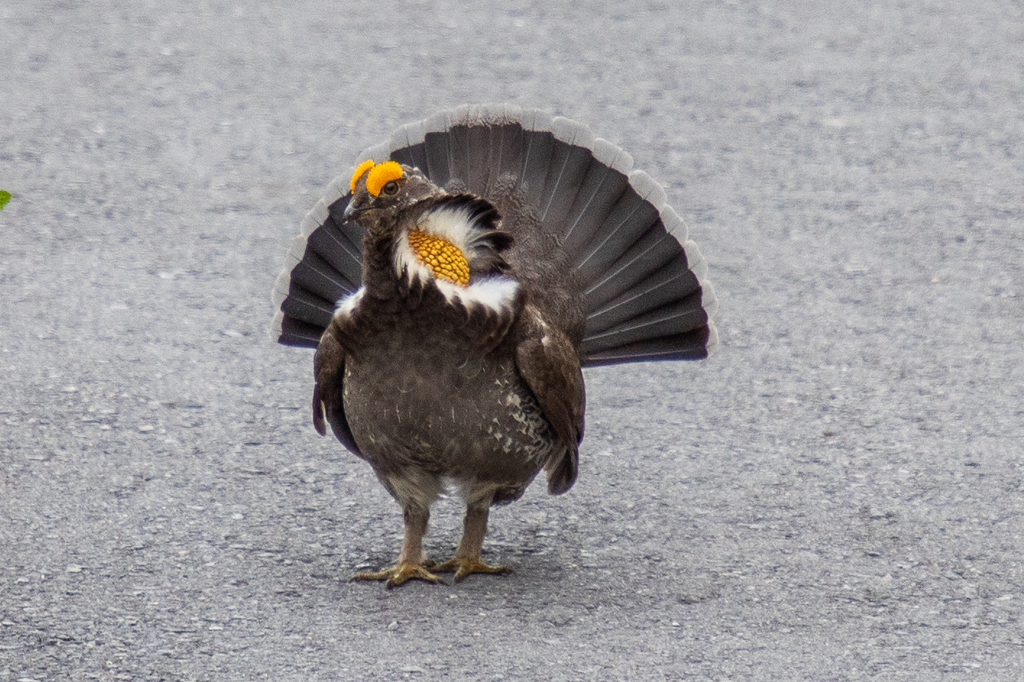
Sooty Grouse
Photo © Yuan Zhuang
Photo © Yuan Zhuang — CC BY-SA 4.0 — Source: iNaturalist photo #42770407Identification
The sooty grouse is a medium-sized forest grouse, averaging 40–50 cm in length and weighing 750–1,300 g. Both sexes display a distinctive long, square tail with light gray at the tip. Males are strikingly dark overall, with a bold yellow throat air sac surrounded by white plumage, and a yellow wattle above the eye that becomes prominent during display. Females are considerably different in appearance, with mottled brown plumage adorned with dark brown and white marks on the underparts. Females also have noticeably longer and skinnier necks compared to males, while males possess stouter, more robust bodies.
Range & Habitat
The sooty grouse is native to North America's Pacific Coast Ranges, occurring from southeastern Alaska and Yukon south to California. These forest-dwelling birds favour the edges of conifer and mixed forests in mountainous regions, with their distribution closely tied to various conifer species. They thrive in old-growth forests where diverse plants and trees provide essential resources. The species also inhabits regenerated logged or burned areas, provided sufficient bushes and shrubs are available for nesting. Grouse Mountain in Vancouver, Canada owes its name to the historical significance and large populations of these birds found there.
Behaviour & Diet
Sooty grouse are permanent residents that exhibit an unusual migration pattern, moving short distances by foot and brief flights to denser forest areas in winter—notably shifting to higher altitudes rather than lower elevations. Males attract females through distinctive deep hooting calls, described as resembling someone striking a deep but quiet drum, typically delivered from high in the trees, accompanied by short flapping flights. Females build ground nests in shallow scrapes concealed beneath shrubs or logs, laying 5 to 10 well-camouflaged eggs with creamy bases and brown speckles.
Their diet varies seasonally. In winter, these birds forage both on the ground and in trees, subsisting primarily on fir and douglas-fir needles, with occasional hemlock and pine needles—they can survive on fir needles alone if necessary. Summer diet includes green plants, berries, and insects, particularly ants, beetles, and grasshoppers. Spring brings a shift toward berries, leaves, and flowers. Chicks depend almost entirely on insects for their first ten days of life. Like many birds, sooty grouse consume grit and small stones to aid food digestion in their gizzard.
Best Time & Places to See It
Spring is an excellent time to observe sooty grouse, particularly when males are actively displaying and calling to establish territories. Look for them in old-growth conifer forests and mixed woodlands throughout the Pacific Coast Ranges from Alaska to California. Grouse Mountain near Vancouver remains a reliable location with established populations. In winter, birds move into denser coniferous forests at higher elevations, making them slightly more challenging to locate but potentially more concentrated in specific areas.
Photography Tips
Spring offers the best photographic opportunities, when males are visible and vocal during breeding displays. Position yourself near conifer stands at dawn or dusk when grouse are most active. The striking contrast between males' dark plumage and yellow throat patches and eye wattles provides excellent subject material. Female photography requires patience, as their cryptic mottled plumage makes them harder to spot in forest settings. A telephoto lens is essential for approaching these wary forest birds without disturbance. Listen for the distinctive deep hooting calls to locate males in their territories.
Gulf Islands National Park Reserve
Southern Gulf Islands Electoral Area, Canada
+268 birds+26 mammals
Scattered across the Salish Sea in British Columbia's southwestern corner, this national park reserve stitches together a fragmented archipelago of forested islands and rocky outcrops where…
VIEW NATIONAL PARKLassen Volcanic National Park
Shasta County, United States
+239 birds+18 mammals
Volcanic peaks and geothermal upheaval have sculpted 545 square kilometers of Northern California into a landscape where fire and water engage in perpetual dialogue. Lassen Peak…
VIEW NATIONAL PARKGlacier Bay National Park
Unorganized Borough, United States
+221 birds+15 mammals
Tidewater glaciers calving into fjords of impossible blue, where temperate rainforest rises steeply from the water's edge and alpine peaks pierce the clouds—this is the ecological…
VIEW NATIONAL PARKYosemite National Park
Mariposa County, United States
+224 birds+28 mammals
Granite cliffs soar nearly a kilometer above the valley floor in this expanse of high Sierra wilderness, where glacial U-shaped valleys sculpt a landscape of dramatic…
VIEW NATIONAL PARKMount Rainier National Park
Pierce County, United States
+187 birds+25 mammals
A volcanic colossus dominates the Cascade Range in western Washington, its 4,392-meter summit crowned year-round with glacial ice that cascades down toward temperate rainforest and subalpine…
VIEW NATIONAL PARKCrater Lake National Park
Klamath County, United States
+174 birds+13 mammals
At 1,949 metres above sea level, a volcanic caldera of impossible clarity holds one of North America's deepest and most pristine alpine lakes, ringed by pumice-and-ash…
VIEW NATIONAL PARKRedwood National Park
Humboldt County, United States
+343 birds+43 mammals
Where the Pacific fog rolls deep into northern California's coastal valleys, some of the tallest trees on Earth rise from a landscape shaped by tectonic forces…
VIEW NATIONAL PARKSequoia National Park
Tulare County, United States
+187 birds+27 mammals
Granite peaks rising above 3,600 meters dominate the southern Sierra Nevada, where Sequoia National Park sprawls across one of North America's most vertically compressed wilderness zones.…
VIEW NATIONAL PARKKings Canyon National Park
Fresno County, United States
+186 birds+20 mammals
Where granite peaks fracture the Sierra Nevada skyline and the Kings River has carved one of North America's most dramatic canyons, a landscape of extreme relief…
VIEW NATIONAL PARKOlympic National Park
Jefferson County, United States
+263 birds+35 mammals
Where temperate rainforest meets alpine wilderness, Olympic National Park sprawls across nearly 11,000 square kilometers of the Pacific Northwest's most pristine landscape. The park's three distinct…
VIEW NATIONAL PARKGwaii Haanas National Park Reserve and Haida Heritage Site
Area E (Moresby Island), Canada
+98 birds+8 mammals
Where temperate rainforest meets the Pacific's edge, the islands of southern Haida Gwaii rise as one of North America's most pristine coastal wilderness areas. Spanning approximately…
VIEW NATIONAL PARKNorth Cascades National Park
Whatcom County, United States
+120 birds+18 mammals
Jagged peaks rise abruptly from the western foothills of Washington's Cascade Range, where glaciers cling to elevations above 10,000 feet and meltwater feeds a landscape of…
VIEW NATIONAL PARKAlaska Maritime National Wildlife Refuge
Alaska, United States
+391 birds+58 mammals
Where the North Pacific collides with Alaska's rugged coastline, a sprawling archipelago of islands, rocky outcrops, and coastal headlands forms one of North America's most remote…
VIEW WILDLIFE SANCTUARYKlamath Marsh National Wildlife Refuge
Klamath County, United States
+219 birds+7 mammals
Where the volcanic plateau of south-central Oregon slopes into a broad, shallow basin lies one of the Pacific Northwest's most underappreciated wetland sanctuaries. Klamath Marsh National…
VIEW WILDLIFE SANCTUARYUpper Klamath National Wildlife Refuge
Klamath County, United States
+217 birds
Where shallow marshes and open water meet the high desert of south-central Oregon, the Upper Klamath National Wildlife Sanctuary creates a landscape of startling contrasts. Fed…
VIEW WILDLIFE SANCTUARYTule Lake National Wildlife Refuge
Siskiyou County, United States
+255 birds+9 mammals
Across the high volcanic plateau of northeastern California, where summer heat scorches the alkali flats and winter winds sweep unobstructed through open water and marsh, Tule…
VIEW WILDLIFE SANCTUARYNo community photos yet. Log in to add the first one.
No community observations of this species yet.