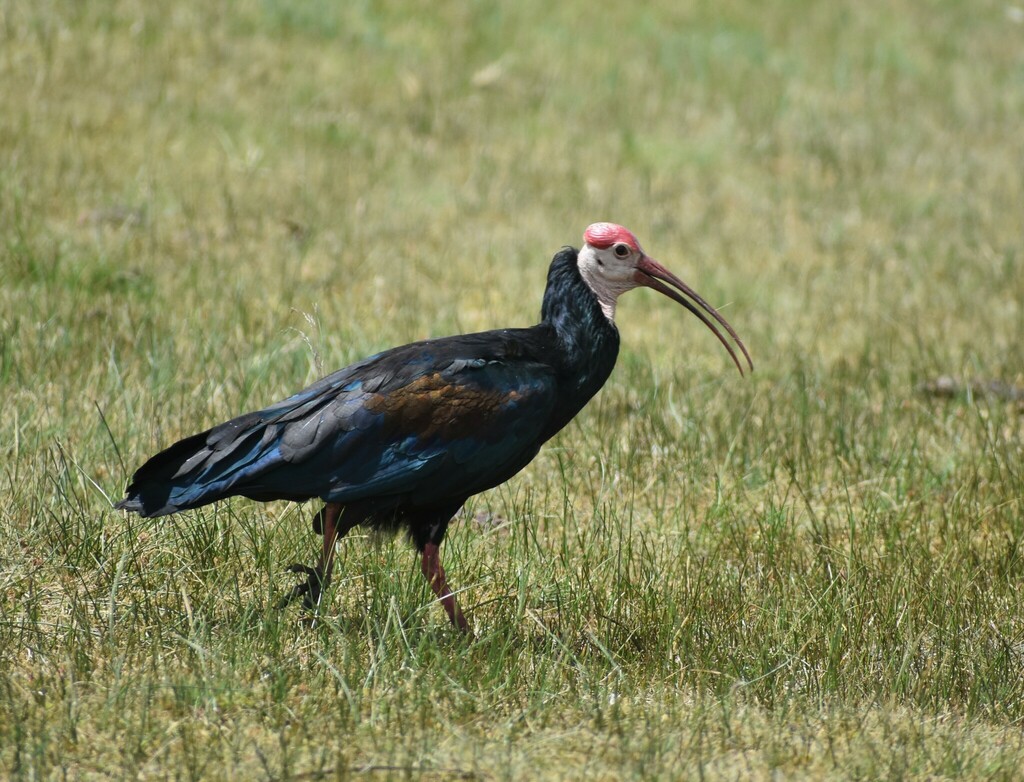
Southern Bald Ibis
Photo © Justin Ponder
Photo © Justin Ponder — CC BY 4.0 — Source: iNaturalist #205957305The southern bald ibis (Geronticus calvus) is a large bird found in open grassland or semi-desert in the mountains of southern Africa. Taxonomically, it is most closely related to its counterpart in the northern regions of Africa, the waldrapp (Geronticus eremita). As a species, it has a very restricted homerange, limited to the southern tips of South Africa in highland and mountainous regions. This large, glossy, blue-black ibis has an unfeathered red face and head, and a long, decurved red bill. It breeds colonially on and amongst rocks and on cliffs, laying two or three eggs which are incubated for 21 days before hatching. It is a large bird that feeds and roosts in substantial groups. It feeds on insects, small reptiles, rodents and small birds. They do little vocalizing other than occasional gobbling sounds. The ibises are gregarious long-legged wading birds with long down-curved bills; they form one subfamily of the Threskiornithidae, the other subfamily being the spoonbills. The two Geronticus species differ from other ibises in that they have unfeathered faces and heads, breed on cliffs rather than in trees, and prefer arid habitats to the wetlands used by their relatives. The species is currently listed as near…
Kruger National Park
Ba-Phalaborwa Local Municipality, South Africa
+540 birds+91 mammals
Across the low-lying savanna of northeastern South Africa unfolds one of Africa's largest and most ecologically intact protected areas, where acacia woodlands merge into mopane scrub…
VIEW NATIONAL PARKIthala Game Reserve
uPhongolo Local Municipality, South Africa
+328 birds+26 mammals
Rolling thornbush savanna and acacia woodland dominate the landscape of this 494-square-kilometre national park in KwaZulu-Natal's uPhongolo Local Municipality, where granite outcrops punctuate grassland plateaus and…
VIEW NATIONAL PARKNo community photos yet. Log in to add the first one.
No community observations of this species yet.