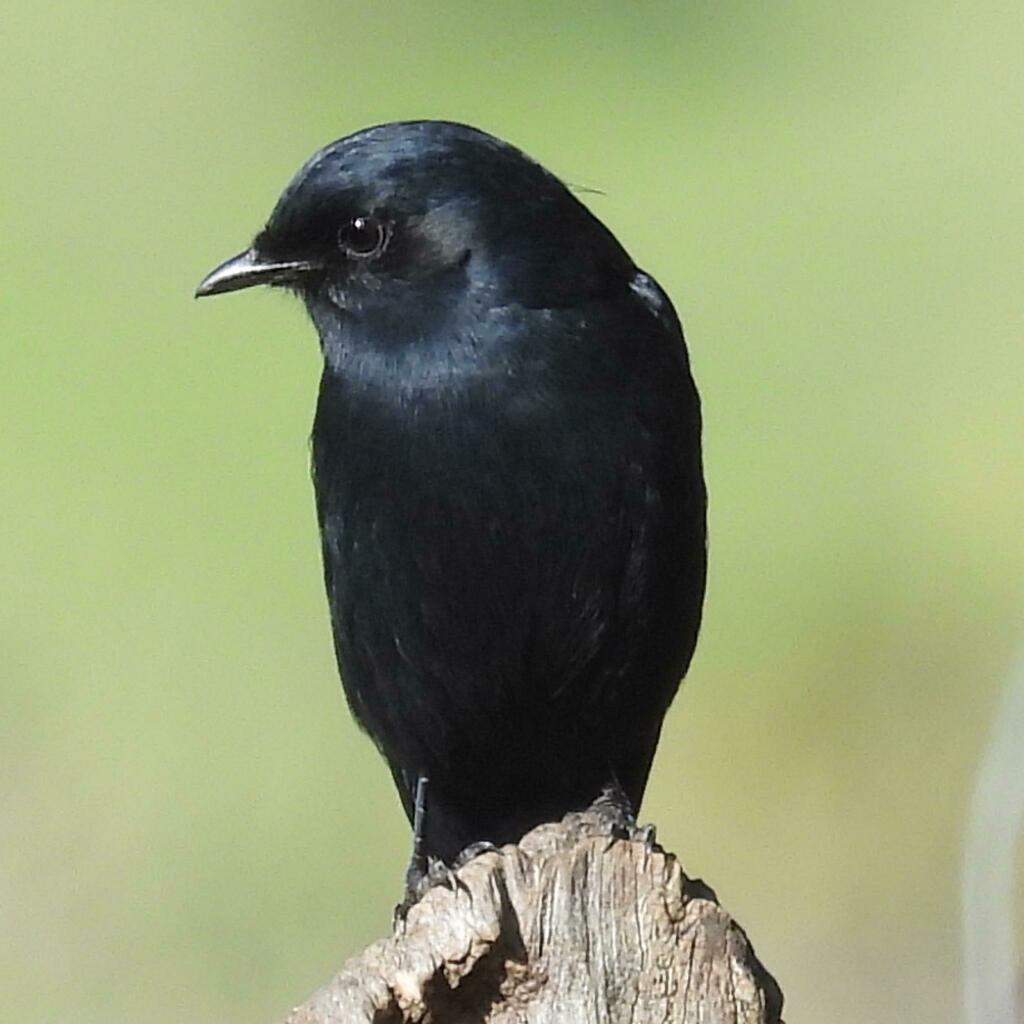
Southern Black Flycatcher
Photo © Henry de Lange
Photo © Henry de Lange — CC BY 4.0 — Source: iNaturalist #258539439Identification
The southern black flycatcher is a striking all-black passerine with a distinctive appearance that aids field identification. Every plumage element—from feathers to beak and legs—is uniformly black, while the eye features a characteristic brown iris. This combination of features is particularly useful for distinguishing it from the superficially similar fork-tailed drongo, which shares the black coloration but possesses a red iris and a long, deeply forked tail. The southern black flycatcher's square-cut tail provides an additional reliable field mark.
Range & Habitat
This species is native to eastern and southern Africa, with a vast range spanning approximately 4,000,000 square kilometres across multiple countries including Somalia, Kenya, Uganda, Tanzania, Rwanda, Burundi, Congo, the Democratic Republic of the Congo, Angola, Namibia, Eswatini, Botswana, Malawi, Mozambique, Zambia, Zimbabwe, Lesotho and South Africa. The southern black flycatcher favours open and lightly wooded habitats, thriving in riparian corridors, plantation edges, gardens, and woodlands dominated by miombo, acacia thorntrees, and mopane trees.
Behaviour & Diet
A primarily insectivorous hunter, the southern black flycatcher forages by perching alertly on low vantage points such as branches or fence posts, then pouncing on prey either in flight or on the ground. Its diet encompasses beetles, termites, locusts, worms, spiders and centipedes. Beyond insects, it opportunistically sips nectar from mountain aloe flowers and consumes black nightshade berries. Interestingly, this species often forages in small flocks and frequently associates with fork-tailed drongos—a behaviour believed to reduce predation risk and improve foraging success for both species.
Best Time & Places to See It
The southern black flycatcher is common across substantial portions of its extensive African range and is listed as Least Concern by the IUCN due to its stable population. Breeding occurs from May through January, peaking in September and October, making these months excellent for observing breeding behaviour and family groups. Look for this species in open woodlands, riparian zones, and cultivated areas throughout eastern and southern Africa where suitable habitat exists.
Photography Tips
The all-black plumage of this species presents both challenges and opportunities for photographers. In good light, aim to capture the brown iris, which provides essential contrast and aids identification in photographs. The bird's hunting behaviour—poised on prominent perches before aerial sallies—offers dynamic shooting opportunities. Position yourself to backlight the bird when possible to reveal subtle plumage texture against the dark coloration, and watch for interactions with fork-tailed drongos, which can create compelling compositional moments. Early morning light often provides the best contrast for rendering the bird's dark form against sky or vegetation.
Bwindi Impenetrable National Park
Lake Mburo National Park
Queen Elizabeth National Park
Aberdare National Park
Amboseli National Park
Arusha National Park
Bwabwata National Park
Chobe National Park
Chyulu Hills National Park
Nothing matches these filters.
No community photos yet. Log in to add the first one.
No community observations of this species yet.