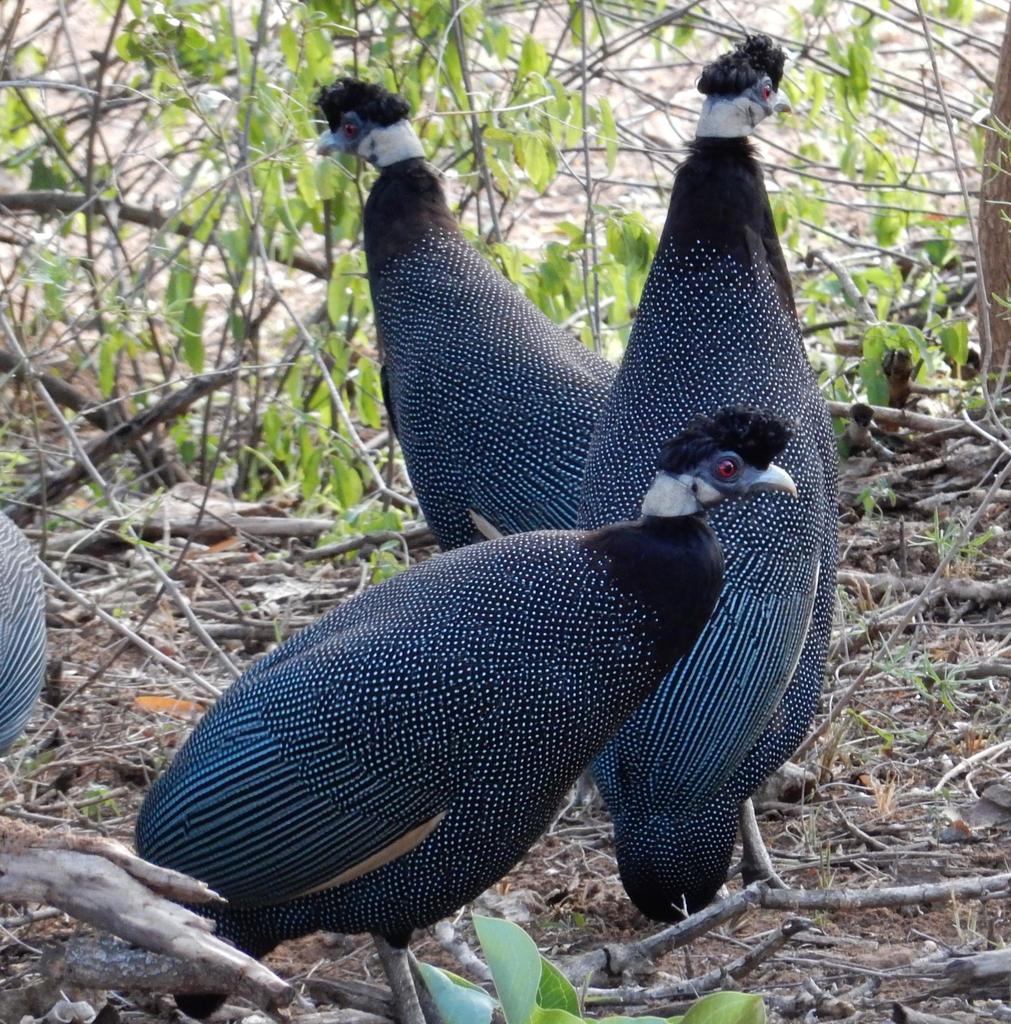
Southern Crested Guineafowl
Photo © Henry de Lange
Photo © Henry de Lange — CC BY 4.0 — Source: iNaturalist #95241650Identification
The Southern Crested Guineafowl is a medium-sized bird roughly 50 cm (20 inches) long, weighing between 721 and 1,543 grams. Its most distinctive feature is the prominent black crest adorning the top of its head, composed of curly feathers that immediately set it apart from other guineafowl species. The overall plumage is blackish with dense white spotting throughout, creating a speckled appearance that aids in identification at a distance. This striking combination of dark coloration, white spots, and characteristic crest makes the species unmistakable in its range.
Range & Habitat
The Southern Crested Guineafowl is native to sub-Saharan Africa, with its range extending from Tanzania southward to South Africa. Two subspecies are recognized: the Edward's Crested Guineafowl (G. e. edouardi), found from eastern Zambia through Mozambique to eastern South Africa, and the Malawi Crested Guineafowl (G. e. barbata), occurring from southeastern Tanzania through eastern Mozambique to Malawi.
This species favours open forest, woodland, and forest-savanna mosaics, preferring habitats that offer a mosaic of woodland and more open terrain. These intermediate habitats provide the bird with both cover and feeding opportunities, making such transitional zones ideal for locating the species.
Behaviour & Diet
Southern Crested Guineafowl are monogamous birds that form strong and long-lasting pair bonds. During courtship, males engage in the charming behaviour of courtship feeding, running several metres to their mate to present choice morsels of food—a tender display of affection in the avian world.
Breeding occurs on the ground, with pairs constructing well-hidden nests in the form of scrapes situated in long grass or beneath bushes. The eggs vary in colour from nearly white to buff, with clutches typically comprising four or five eggs, representing a relatively modest breeding investment compared to some other gamebirds.
Best Time & Places to See It
The Southern Crested Guineafowl's preference for specific habitat types—open woodland and forest-savanna mosaics—means that targeting these transitional zones offers the best chance of encounters. Birders and wildlife travellers should focus their efforts in suitable habitat across the species' range from Tanzania southward through Mozambique, Malawi, Zambia, and into South Africa. The bird's reliance on well-hidden nesting sites and ground-based behaviour means patience and careful observation of suitable habitats will yield the best results.
Photography Tips
The Southern Crested Guineafowl's striking black and white plumage and distinctive crest provide excellent photographic subjects, particularly in good natural light. The bird's tendency to remain on the ground and favour open woodland habitats means relatively unobstructed views are often possible. Early morning and late afternoon light can enhance the contrast between the bird's dark plumage and white spotting. Photographers should approach slowly and quietly through suitable habitat, as these ground-dwelling birds may flush if disturbed too suddenly, making patience and stealth essential for obtaining quality images.
Tsavo West National Park
Mwatate, Kenya
+513 birds+49 mammals
Where volcanic ridges and weathered lava flows meet the semi-arid lowlands of south-central Kenya, Tsavo West National Park unfolds across a landscape sculpted by fire and…
VIEW NATIONAL PARKMount Elgon National Park
Matumbei ward, Kenya
+164 birds+7 mammals
Where the volcanic slopes of Mount Elgon rise above the Trans-Nzoia landscape, a montane wilderness unfolds across multiple ecological zones, each harbouring distinct communities adapted to…
VIEW NATIONAL PARKKruger National Park
Ba-Phalaborwa Local Municipality, South Africa
+540 birds+91 mammals
Across the low-lying savanna of northeastern South Africa unfolds one of Africa's largest and most ecologically intact protected areas, where acacia woodlands merge into mopane scrub…
VIEW NATIONAL PARKIthala Game Reserve
uPhongolo Local Municipality, South Africa
+328 birds+26 mammals
Rolling thornbush savanna and acacia woodland dominate the landscape of this 494-square-kilometre national park in KwaZulu-Natal's uPhongolo Local Municipality, where granite outcrops punctuate grassland plateaus and…
VIEW NATIONAL PARKMarakele National Park
Modimolle Local Municipality, South Africa
+341 birds+36 mammals
Granite ridges and sprawling grasslands dominate this 1,176-square-kilometre reserve in Limpopo's heartland, where bushveld transitions between rocky outcrops and open savanna. The park's rugged topography creates…
VIEW NATIONAL PARKMeru National Park
Igembe Central, Kenya
+408 birds+38 mammals
Granite outcrops and acacia woodland rise across the northern reaches of Meru, where semi-arid savanna transitions into drier scrubland under the fierce equatorial sun. The park's…
VIEW NATIONAL PARKChyulu Hills National Park
Kibwezi East, Kenya
+232 birds+30 mammals
Volcanic cones rise abruptly from the Kenyan savanna floor, their flanks clothed in dense acacia woodland and grassland that transforms the Chyulu Hills into an ecological…
VIEW NATIONAL PARKArabuko Sokoke Forest Reserve
Kilifi, Kenya
+383 birds+29 mammals
Coastal forest rises from the Indian Ocean plains of Kilifi County, where sandy soils and seasonal rainfall have sculpted a woodland ecosystem unlike anywhere else on…
VIEW NATURE RESERVEWatamu Marine National Park
Dabaso ward, Kenya
+328 birds+12 mammals
Where mangrove channels meet coral gardens and sandy shallows blend into the warm waters of the Indian Ocean, Watamu Marine National Park unfolds across the Kilifi…
VIEW NATIONAL PARKNo community photos yet. Log in to add the first one.
No community observations of this species yet.