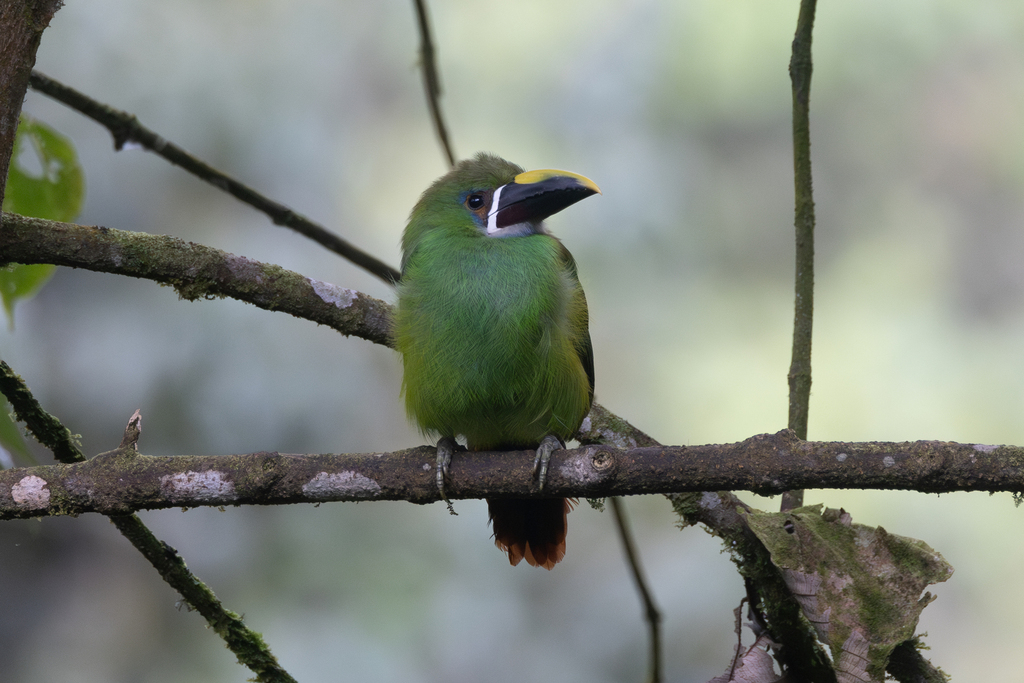
Southern Emerald Toucanet
Photo © Ryan F. Mandelbaum
Photo © Ryan F. Mandelbaum — CC BY 4.0 — Source: iNaturalist photo #652809836Identification
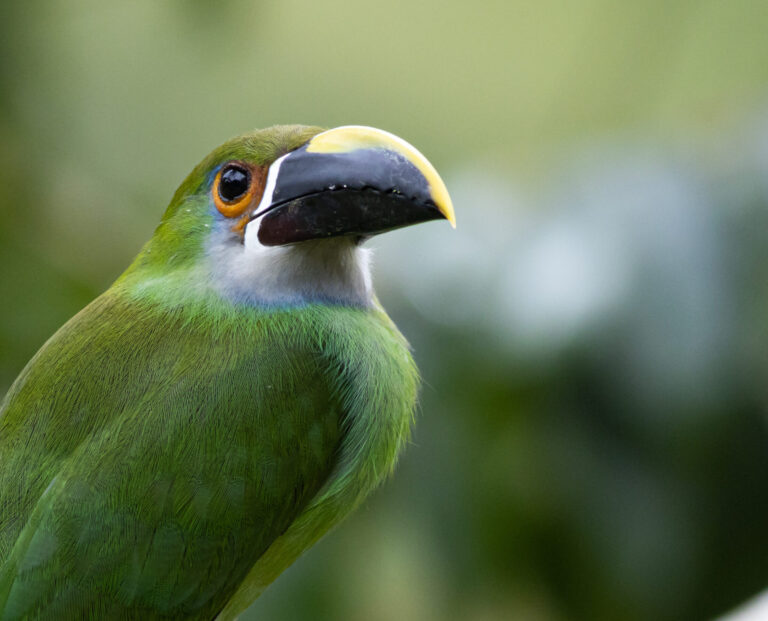
The southern emerald toucanet is a small, brightly coloured member of the toucan family, measuring 33 to 38 cm in length and weighing 160 to 230 g. Like all toucans, it boasts a distinctive large bill—black with a striking yellow stripe along the culmen and a white vertical strip at the base. Some subspecies show chestnut or maroon markings at the bill's base. The plumage is predominantly green, lighter below than above, with bare yellow to orange skin encircling the eye, surrounded by blue feathers. The nominate subspecies features a white throat, whilst other subspecies display pale grey, pale blue, or grey throats depending on their geographic origin. Both sexes are similar in appearance, though females tend to be slightly smaller and shorter-billed. All subspecies share olive-green legs and feet.
Range & Habitat
The southern emerald toucanet is found throughout the montane regions of Colombia, Ecuador, western Venezuela, Peru, and northern Bolivia, with seven recognised subspecies distributed across this range. The species primarily inhabits the interior of humid montane forests but also frequents forest edges, secondary growth, plantations, and clearings with scattered trees. It is non-migratory, remaining in its range year-round.
Behaviour & Diet
This is a gregarious species, regularly gathering in small groups as it forages through the middle and upper levels of the forest canopy, typically whilst perched. The southern emerald toucanet has an eclectic diet, gleaning a wide variety of fruits, terrestrial invertebrates, and small vertebrate prey. Its vocalizations vary geographically, from rapid series of short took or churt notes in Colombia to guttural grinding calls in Venezuela and persistent fast rek-rek-rek notes in Ecuador. In flight, its wings produce a distinctive whirring sound. Breeding occurs in tree cavities; nesting takes place from January to September in Colombia and Venezuela, and from September to November in Ecuador.
Best Time & Places to See It
The southern emerald toucanet can be encountered year-round throughout its montane range in the Andes of Colombia, Ecuador, Venezuela, Peru, and Bolivia. Search humid montane forests and forest edges at appropriate elevations within each subspecies' range. The species' gregarious nature means that locating one individual often leads to sightings of small groups. Listen for its distinctive vocalizations, which vary by region, to aid in detection.
Photography Tips
The toucanet's brilliant green plumage, striking bill pattern, and bare facial skin make it a rewarding photographic subject. Position yourself in the mid-to-upper forest canopy where the bird typically forages, keeping in mind that it favours perched positions over active flight. The yellow facial patches and blue eye-ring provide excellent colour contrast for compelling images. Early morning light often renders the green plumage most vividly. Because this species gathers in small groups, patience may reward you with multiple individuals in frame. The whirring sound of wing-beats provides an audio cue for approaching birds.
Guided Birding Tour
Río Negro-Sopladora National Park
Chontal, Ecuador
+84 birds
Where the eastern cordillera of Ecuador descends toward the Amazon basin, the Río Negro-Sopladora National Park sprawls across 615 square kilometers of montane forest and riverine…
VIEW NATIONAL PARKPodocarpus National Park
Zamora, Ecuador
+496 birds+6 mammals
Where the Andes descend toward the Amazon basin, Podocarpus National Park sprawls across nearly 2,800 square kilometres of the most biodiverse terrain in Ecuador's southern highlands.…
VIEW NATIONAL PARKSumaco Napo-Galeras National Park
Loreto, Ecuador
+563 birds+4 mammals
Where Ecuador's Amazon transitions into cloud forest, a massive shield volcano rises from the emerald lowlands of Orellana Province, anchoring one of the continent's most biodiverse…
VIEW NATIONAL PARKAntisana National Park
Quijos, Ecuador
+432 birds+21 mammals
Where the eastern Andean slopes descend into the Amazon basin, Antisana National Park sprawls across roughly 2,500 square kilometers of some of South America's most dramatic…
VIEW NATIONAL PARKNatural Munchique National Park
El Tambo, Colombia
+194 birds
Where the Western Cordillera rises steeply from the Pacific plains of southwestern Colombia, Natural Munchique National Park sprawls across 1,078 square kilometers of montane forest that…
VIEW NATIONAL PARKNatural Serranía de los Yariguíes National Park
El Carmen de Chucurí, Colombia
+320 birds+3 mammals
Where the northern cordilleras of Colombia rise toward cloud forest, the Serranía de los Yariguíes unfolds across nearly 1,820 square kilometers of some of the most…
VIEW NATIONAL PARKNatural Farallones de Cali National Park
Buenaventura, Colombia
+733 birds+27 mammals
Where the Pacific coastal plain meets the western slopes of the Andes, Farallones de Cali National Park sprawls across nearly 3,500 square kilometers of dramatic topography…
VIEW NATIONAL PARKNatural Chingaza National Park
Junín, Colombia
+285 birds+6 mammals
Where the Andes rise above three thousand metres in the Cundinamarca region, high-altitude grasslands and cloud forests converge in a landscape shaped by both geology and…
VIEW NATIONAL PARKPuracé National Natural Park
Puracé, Colombia
+327 birds+2 mammals
Where the Andes thrust upward across southwestern Colombia, Puracé National Natural Park spans nearly 2,631 square kilometers of some of South America's most dramatic montane terrain.…
VIEW NATIONAL PARKGuácharos Cave National Natural Park
Acevedo, Colombia
+359 birds
High in the Andean foothills of southern Huila, where mist-laden slopes rise above 1,600 metres, lies a landscape carved by underground rivers and crowned by karst…
VIEW NATIONAL PARKEl Tamá National Park
Toledo, Colombia
+435 birds
Where the Andes descend toward the Caribbean coastal lowlands of northern Colombia, El Tamá National Park sprawls across nearly 3,800 square kilometres of montane forest, cloud…
VIEW NATIONAL PARKNatural Nevado del Huila National Park
Planadas, Colombia
+117 birds
Where the Colombian Andes rise above 5,000 metres, tropical cloud forest yields to páramo and glaciated peaks, and the Planadas region of Tolima contains one of…
VIEW NATIONAL PARKYanachaga–chemillén National Park
Palcazu, Peru
+639 birds+6 mammals
Where the eastern slopes of Peru's central cordillera plunge into cloud forest, Yanachaga–Chemillén National Park protects nearly three thousand square kilometres of montane wilderness that few…
VIEW NATIONAL PARKManu National Park
Manu, Peru
+892 birds+26 mammals
Across the eastern slopes of the Peruvian Andes, tropical rainforest descends into the Amazon basin with a complexity that few terrestrial ecosystems match. Manu National Park…
VIEW NATIONAL PARKBahuaja Sonene National Park
San Pedro de Putina Punco, Peru
+602 birds+8 mammals
Where the Madre de Dios and Heath rivers converge in southeastern Peru rises one of South America's most biodiverse wilderness regions: a vast protected realm of…
VIEW NATIONAL PARKTingo Maria National Park
Mariano Dámaso Beraún, Peru
+423 birds
Where the eastern slopes of the Peruvian Andes descend toward the Amazon basin, the landscape fractures into a maze of limestone ridges, humid gorges, and cloud-wrapped…
VIEW NATIONAL PARKCordillera Azul National Park
Pampa Hermosa, Peru
+322 birds+1 mammals
Where the eastern Andes descend into the western Amazon basin, Cordillera Azul National Park sprawls across nearly 38,000 square kilometres of some of Peru's most pristine…
VIEW NATIONAL PARKNo community photos yet. Log in to add the first one.
No community observations of this species yet.