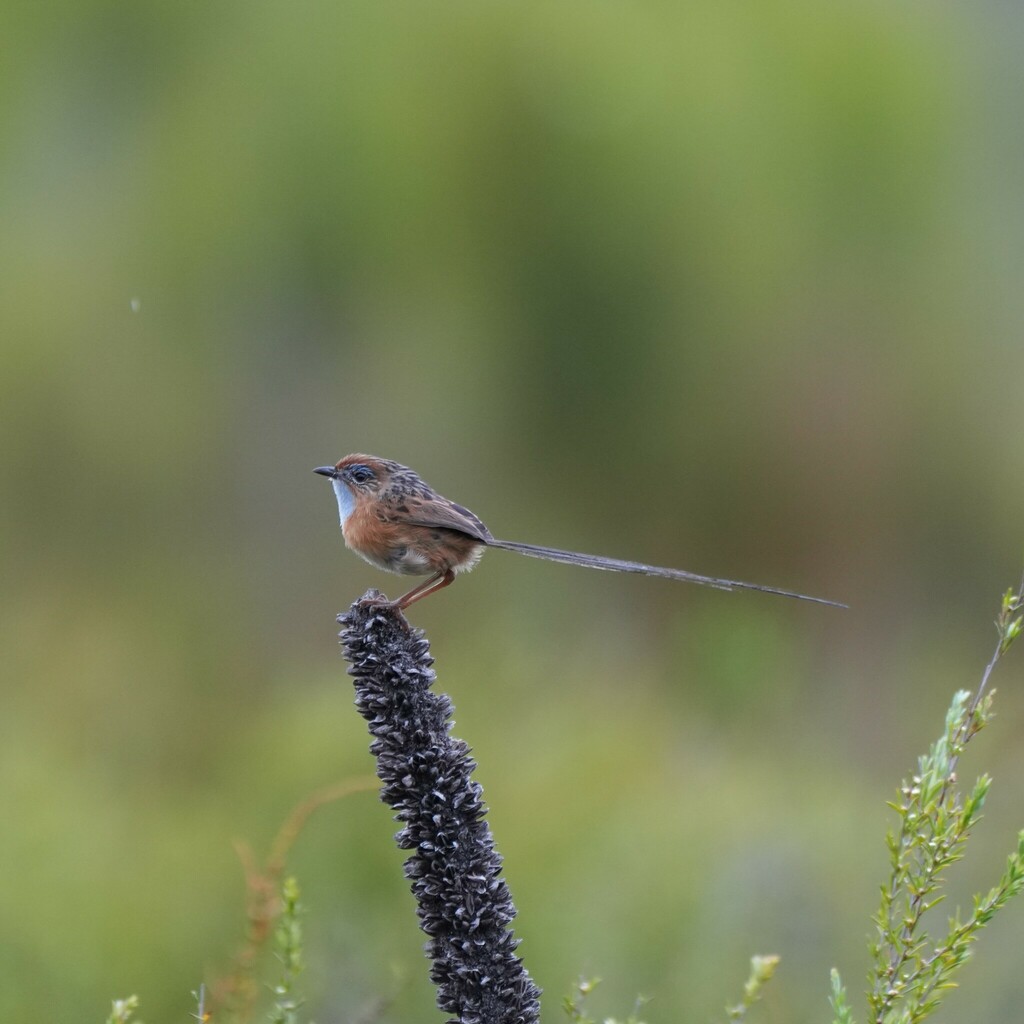
Southern Emu-wren
Photo © themaskedlapwing
Photo © themaskedlapwing — CC0 1.0 — Source: iNaturalist #253722886Identification
The southern emu-wren is a small Australasian wren with a distinctive long, filamentous tail that doubles its body length. Adult males display rusty-brown upperparts streaked with black, a reddish crown, and striking sky-blue plumage on the throat, upper chest, and eyebrow stripe. The tail comprises six soft feathers with the central pair extending noticeably longer than the lateral ones. Underparts are pale red-brown, fading to white on the belly. The bill is black with brown eyes and feet. Females are darker and more heavily streaked, lacking the male's vibrant blue markings and redder crown; their bill is brown with a pale grey base.
Range & Habitat
The southern emu-wren is endemic to Australia, with eight recognized subspecies distributed across temperate and Mediterranean regions of the continent. The nominate race occurs along the eastern seaboard from Noosa Heads in Queensland through New South Wales and Victoria to the Murray River mouth in South Australia, remaining east of the Great Dividing Range. Other subspecies inhabit Tasmania, south-central Australia, the Mount Lofty Ranges, Kangaroo Island, the Eyre Peninsula, and south-western Western Australia, including Dirk Hartog Island. Throughout its range, this wren favors marshes, low heathland, dune areas, and swamplands.
Behaviour & Diet
The southern emu-wren derives its common name from its soft, loosely-barbed tail feathers, which resemble the plumage of the much larger emu—an ironic contrast given that emu-wrens are among Australia's smallest birds. While specific dietary and behavioral details remain limited in available literature, the species is adapted to foraging within dense, low vegetation typical of its preferred habitats.
Best Time & Places to See It
Observing this secretive species requires patience and careful habitat selection. Look for populations in protected swamplands and heathland reserves throughout its range. The Mount Lofty Ranges subspecies, though endangered with fewer than 100 individuals, can be sought in its stronghold around the lower Finniss River swamps and Deep Creek Conservation Park in South Australia. Watchalunga Nature Reserve, opened in 2015, offers dedicated protection for this population. The larger Kangaroo Island race and western subspecies in south-western Western Australia may provide better opportunities for sightings.
Photography Tips
Photographing the southern emu-wren presents considerable challenges due to its preference for dense vegetation and secretive behavior. Early morning visits to marshes and swampland edges offer the best light and activity levels. A telephoto lens (at least 400–600mm) is essential for capturing this small, skulking bird without disturbance. The male's brilliant sky-blue plumage and elongated tail feathers make for striking subjects when successfully located. Remain patient and motionless near suitable habitat; the bird's movements through low vegetation may provide brief photographic opportunities.
Barrington Tops National Park
Ben Boyd National Park
Blue Mountains National Park
Bouddi National Park
Coffin Bay National Park
Coorong National Park
Fitzgerald River National Park
Flinders Chase National Park
Grampians National Park
Nothing matches these filters.
No community photos yet. Log in to add the first one.
No community observations of this species yet.