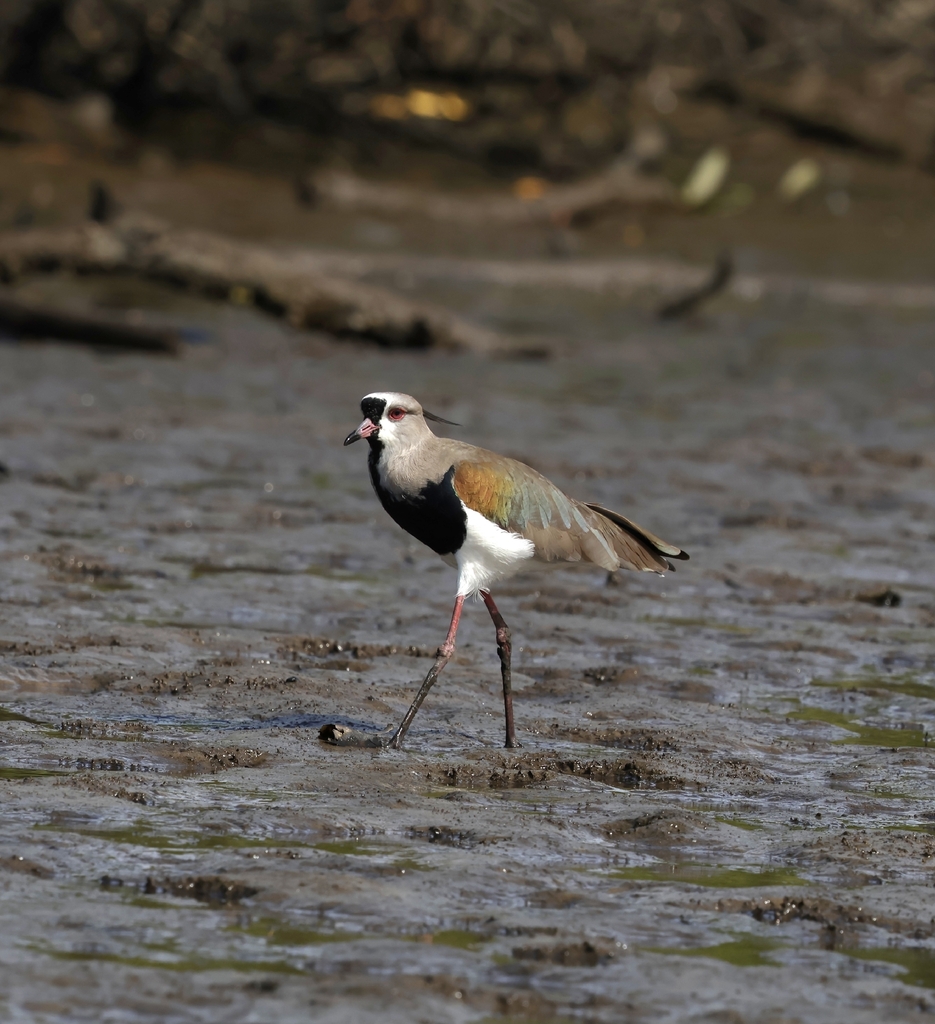
Southern Lapwing
Photo © Miguel
Photo © Miguel — CC BY-SA 4.0 — Source: iNaturalist #361869863Identification
The Southern Lapwing is the only crested wader in South America, making it relatively distinctive in its range. Measuring 32 to 38 cm in length and weighing 250 to 425 grams, it is a striking bird with a particularly eye-catching head pattern. The upperparts are brownish grey with bronze glossing on the shoulders, while the head is mainly grey with a distinctive black forehead and throat patch that extends onto the black breast. A white border separates the black facial markings from the grey head and crest, creating a bold pattern. The rest of the underparts are white, and the eye ring, legs, and most of the bill are pink. In flight, a broad white wing bar separates the grey-brown back and wing coverts from the black flight feathers, while the rump is white and the tail black.
This lapwing is equipped with red bony extensions under the wings—called spurs—which it uses to intimidate rivals and fight off birds of prey. The call is a very loud and harsh keek-keek-keek, which often alerts observers to the bird's presence before it is seen. Several subspecies occur across the range, with slight variations in head coloration and voice; northern birds tend to have a browner head than their southern counterparts.
Range & Habitat
The Southern Lapwing is a common and widespread resident throughout South America, avoiding only densely forested regions such as most of the Amazon, the higher parts of the Andes, and the arid coast of much of western South America. It is particularly common in the basin of the Río de la Plata. In recent decades, the species has been spreading through Central America and the Caribbean, reaching Trinidad in 1961, Tobago in 1974, and occasionally appearing as far north as Barbados, where a pair successfully nested and produced chicks in 2007.
This is a lapwing of lake and river banks and open grassland. The species has benefited considerably from the expansion of grassland habitats created by widespread cattle ranching across South America. It frequents a variety of open and semi-open environments and has even adapted to urban settings, being seen in parks and on floodlit soccer pitches in major cities.
Behaviour & Diet
The Southern Lapwing hunts primarily at night, using a run-and-wait technique, often in flocks. Its diet consists mainly of insects such as grasshoppers, along with other small invertebrates including earthworms and cutworms, as well as small fish. In urban areas like Rio de Janeiro, Montevideo, Buenos Aires, and La Plata, the bird has adapted remarkably well to human presence and can be observed feeding or walking in parks and on floodlit soccer pitches during televised matches.
This species breeds cooperatively in social groups consisting of a breeding pair with one or two young from the previous season. Birds breed on grassland and sometimes on ploughed fields, and are known for their aerobatic flapping display flight. They lay 2–3 eggs (rarely 4) in an olive-brown colour in a bare ground scrape. The nest and young are defended noisily and aggressively against all intruders, including humans, using threats, vocalizations, and low flights. After breeding, birds disperse into wetlands and seasonally-flooded tropical grassland.
Best Time & Places to See It
The Southern Lapwing is a resident species throughout much of South America, meaning it can be found year-round across its range. However, it is particularly common in the basin of the Río de la Plata region. Given its adaptability to human-modified landscapes, the species is accessible to travellers visiting urban parks and open grasslands across Argentina, Uruguay, Paraguay, Brazil, and Chile. Open wetlands and seasonally-flooded grasslands are reliable habitats, especially after the breeding season.
Urban areas offer surprisingly good opportunities to observe this species. Parks in major cities such as Buenos Aires, Montevideo, and Rio de Janeiro regularly host Southern Lapwings, making it an excellent choice for wildlife watchers without access to remote locations. Listen for its distinctive loud and harsh keek-keek-keek call, which often betrays the bird's presence before it comes into view.
Photography Tips
The Southern Lapwing's striking head pattern and distinctive crest make it a rewarding photographic subject. The bold contrast between the black facial markings, white border, and grey head provides good detail for close-up portrait shots. Capture the bird's characteristic posture on open ground, where it often stands alert and upright. The pink eye ring and legs add splashes of colour that can be emphasized with careful exposure and lighting.
In-flight photography will showcase the broad white wing bar and the contrasting black flight feathers—aim to capture the bird during its slow, aerobatic flapping flight. The red bony spurs under the wings are difficult to photograph but distinctive when visible. Dawn and dusk, when birds are most active in feeding, offer good light for photography, and urban parks provide accessible locations where the bird is habituated to human presence and less likely to flush at close range.
Alerce Costero National Park
Amacayacu National Park
Amazônia National Park
Anavilhanas National Park
Antisana National Park
Araucárias National Park
Archipiélago Juan Fernández National Park
Arenal Volcano National Park
Bahuaja Sonene National Park
Nothing matches these filters.
No community photos yet. Log in to add the first one.
No community observations of this species yet.