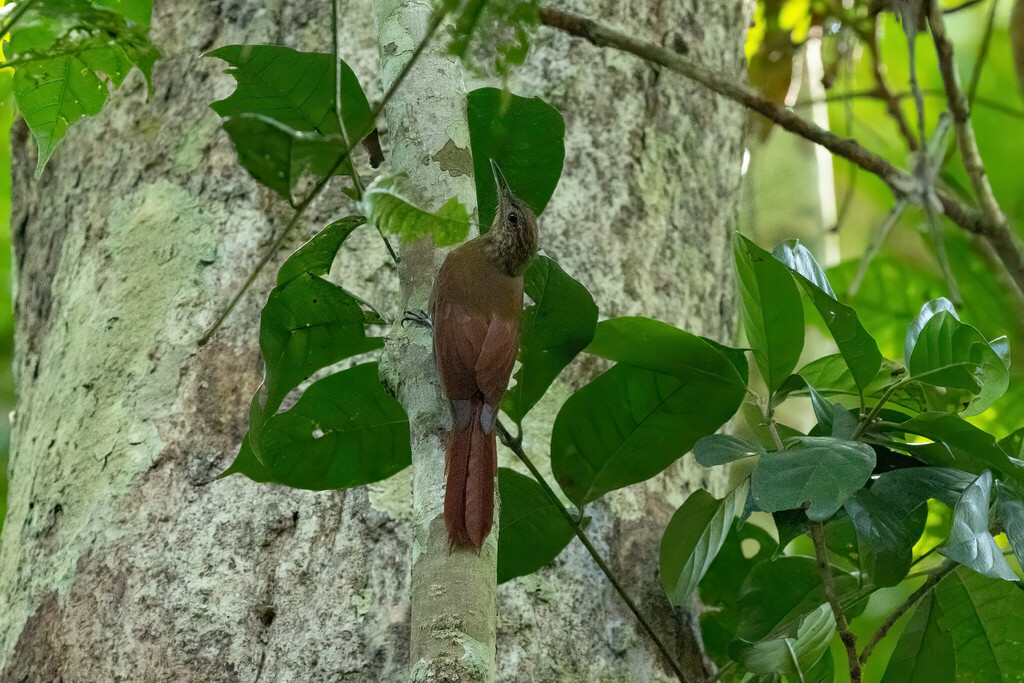
Southern Long-tailed Woodcreeper
Photo © Thibaud Aronson
Photo © Thibaud Aronson — CC BY-SA 4.0 — Source: iNaturalist #194299826Identification
The Southern Long-tailed Woodcreeper is a medium-sized member of the woodcreeper family, measuring 16 to 21 cm in length and weighing 24 to 32 grams. Males are larger than females. The bird has a distinctive slim body, long wings and tail, and a straight medium-length bill. Its plumage is mostly olive-brown with a darker crown and nape finely streaked with buff. The lores and supercilium are whitish to buffy, while the wings, uppertail coverts, and tail are rufous-chestnut with dusky-tipped primaries. The throat ranges from whitish buff to ochraceous, the breast is olive-brown with buff streaks, and the belly and flanks are plain olive-brown. Rufous undertail coverts and cinnamon-rufous underwing coverts are visible in flight. The iris is brown, the bill gray or black, and the legs and feet gray or gray-black. Juveniles closely resemble adults with a slightly darker head and fewer pale breast streaks.
Range & Habitat
This species is found throughout much of the Amazon Basin, distributed across Bolivia, Brazil, Colombia, Ecuador, Peru, and Venezuela. Three recognized subspecies occupy different regions: D. p. connectens inhabits the Amazon north of the main river from eastern Colombia and southern Venezuela to eastern Ecuador, eastern Peru, and the upper Rio Negro basin; D. p. pallida occurs south of the Amazon from southeastern Peru and northern Bolivia across Brazil; and D. p. zimmeri is found in eastern Brazil from the Rio Tocantins to the Atlantic coast. The species favors the interior of humid primary forest, though it also occurs at forest edges and in mature secondary forest. In Amazonia it is mostly found in terra firme and várzea forest up to about 500 meters, with higher elevations reached in other regions—up to 1,700 meters in Ecuador.
Behaviour & Diet
The Southern Long-tailed Woodcreeper is a year-round resident throughout its range. It forages from the understory to the canopy, typically between 3 and 20 meters above the ground, hitching up trunks and vines in typical woodcreeper fashion. It forages singly, in pairs, or within mixed-species feeding flocks, mostly picking or gleaning prey from bark and foliage, though it occasionally makes short aerial sallies to capture insects in flight. Its diet consists primarily of arthropods, with a preference for adults over larvae. The species produces a characteristic song—a clearly descending series of 6 to 8 mainly flat-pitched whistles, sometimes reaching up to 12 notes. It sings at any time of day but is most vocal during early morning and late afternoon hours, and playback of local song elicits strong territorial responses. Almost nothing is known about its breeding biology, though evidence suggests breeding seasons vary geographically.
Best Time & Places to See It
The Southern Long-tailed Woodcreeper is a permanent resident, making it potentially viewable year-round throughout its range. However, abundance varies considerably by location: it is generally uncommon to fairly common in eastern Colombia and southeastern Peru, fairly common to common in parts of Amazonian Brazil, but rare and local in Ecuador. The species occurs in several protected areas across its range, which may offer the best opportunities for observation. Early mornings and late afternoons are optimal times for locating birds by their vocalizations, as these periods coincide with peak singing activity.
Photography Tips
Photographing this species requires patience and knowledge of forest canopy structure, as the bird forages between 3 and 20 meters above ground. Look for birds working along vines and tree trunks, where their movement creates characteristic silhouettes against the forest background. Early morning light, when birds are most vocal and active, offers the best photography conditions. Use the bird's descending whistled song as an audio cue to locate individuals, then position yourself carefully to avoid startling the bird. The rufous-chestnut wings and tail are distinctive field marks that should be captured when possible, and watching mixed-species feeding flocks may increase encounter chances.
Amacayacu National Park
Amazônia National Park
Bahuaja Sonene National Park
Campos Amazónicos National Park
Jaú National Park
Manu National Park
Mapinguari National Park
Serra do Divisor National Park
Sumaco Napo-Galeras National Park
Nothing matches these filters.
No community photos yet. Log in to add the first one.
No community observations of this species yet.