Southern Nutcracker
Photo © Stefan C
Photo © Stefan C — CC0 1.0 — Source: iNaturalist #270638927Identification
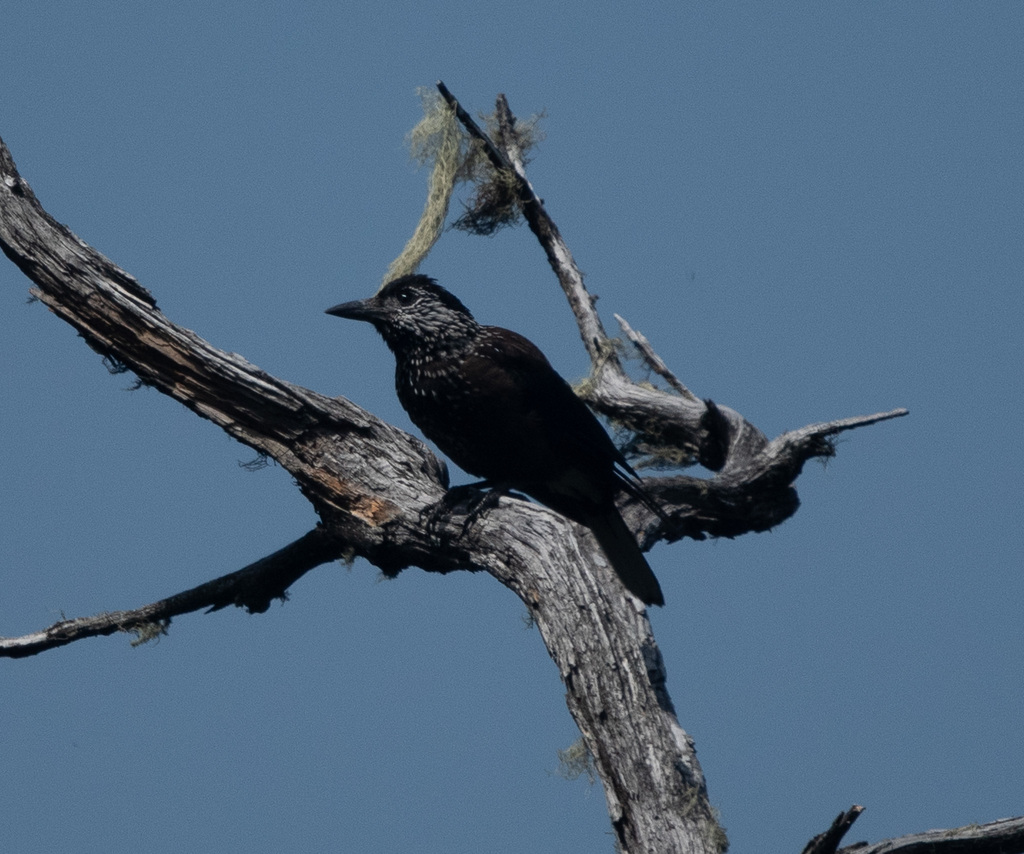
The southern nutcracker is a stocky corvid measuring approximately 33 cm in length, similar in size to its northern relative. Unlike the heavily spotted northern nutcracker and Kashmir nutcracker, this species exhibits a more restrained plumage pattern. It is predominantly brown across much of its body, with limited white spotting confined to the face and upper breast. The lower breast and back are plain brown and unmarked, while the wings are solid black. A distinctive white belly and white under-tail coverts provide contrast to the darker upperparts. The tail is black with striking white outer corners. The southern nutcracker has a characteristic stout, black bill and black legs, built for its specialized dietary habits.
Range & Habitat
The southern nutcracker is found across a broad geographical range spanning the Himalayas from northwest to central regions, the eastern Himalayas, central and southern China, northern Myanmar, northern China, and Taiwan. Four recognized subspecies occupy different portions of this range. This species shows a strong ecological preference for pine forests, with particular affinity for Chinese white pine and blue pine, as well as other related white pines in the Strobus subgenus. In times of cone crop failure in these preferred species, it demonstrates flexibility by utilizing other conifers such as spruce.
Behaviour & Diet
Like other nutcrackers, the southern nutcracker has evolved specialized behaviors centered on conifer seed exploitation and distribution. It caches and distributes pine seeds in a manner analogous to its congeners, playing an important ecological role in forest regeneration and seed dispersal. This caching behavior, combined with the bird's ability to remember cache locations, makes it a keystone species in the conifer forests it inhabits. The bird's stout bill is perfectly adapted for extracting seeds from pine cones and cracking open nuts, behaviors that define the nutcracker genus.
Best Time & Places to See It
The southern nutcracker is best encountered in pine-dominated forests throughout its Himalayan and Asian range. Visitors should focus on areas with healthy stands of white pine and blue pine, where the birds are most likely to be actively foraging and caching seeds. The Shimla and Almora districts of northern India, where the species was first formally described, represent accessible locations within the northwestern Himalayas. Taiwan, the eastern Himalayas, and the coniferous forests of central and southern China offer additional opportunities to observe this species in its natural habitat.
Photography Tips
Photographing the southern nutcracker requires patience and positioning near productive pine forests during peak foraging periods. The bird's preference for dense coniferous habitat means photographers should be prepared for challenging lighting conditions beneath forest canopies. Focus on capturing the distinctive features that differentiate this species from its relatives: the limited white spotting pattern, plain brown back and lower breast, and the characteristic white-cornered black tail. Early morning light filtering through pines can effectively highlight the subtle plumage details and the bird's active behavior as it moves between trees and ground in search of cones and seeds.
Langtang National Park
Helambu, Nepal
+364 birds+14 mammals
Where the southern slopes of the Himalayan highlands descend toward the subtropical valleys of central Nepal, Langtang National Park sprawls across one of the subcontinent's most…
VIEW NATIONAL PARKGangotri National Park
Bhatwari, India
+119 birds+1 mammals
Where the Bhagirathi River carves through the western Himalayas in northern Uttarakhand, Gangotri National Park rises across steep alpine terrain that defines the boundary between temperate…
VIEW NATIONAL PARKSagarmatha National Park
Khumjung, Nepal
+219 birds+7 mammals
Soaring peaks and deep glacial valleys define this alpine wilderness in northeastern Nepal, where the terrain rises from forested foothills into a realm of high-altitude tundra…
VIEW NATIONAL PARKKhangchendzonga National Park
Sakkyong, India
+290 birds+1 mammals
Where the eastern Himalayas surge toward their crowning peaks, Khangchendzonga National Park embraces a landscape of almost overwhelming vertical drama. Rising from subtropical river valleys into…
VIEW NATIONAL PARKGiant Panda National Park
Mianyang, China
+447 birds+47 mammals
Where the eastern slopes of China's Sichuan plateau descend into cloud-wrapped valleys, one of Asia's most biodiverse landscapes unfolds across more than 350,000 square kilometres. This…
VIEW NATIONAL PARKJiuzhai Valley
Jiuzhaigou County, China
+226 birds+7 mammals
Where crystalline alpine streams cascade through limestone gorges and karst terrain rises in dramatic vertical walls, Jiuzhai Valley unfolds across nearly 1,300 square kilometers of southwestern…
VIEW NATURAL MONUMENTHuanglong Scenic and Historic Interest Area
Ngawa Tibetan and Qiang Autonomous Prefecture, China
+194 birds+7 mammals
Across the high plateau of northwestern Sichuan, a geological wonder unfolds where limestone terraces and mineral-rich springs have sculpted one of China's most distinctive natural monuments.…
VIEW NATURAL MONUMENTNanda Devi National Park
Garpak, India
+218 birds+5 mammals
Where the Himalayas surge into their most dramatic alpine amphitheater, a wilderness of raw geological power unfolds across 624 square kilometers of pristine terrain. Nanda Devi,…
VIEW NATIONAL PARKValley of Flowers National Park
Ghangaria, India
+117 birds+1 mammals
Where alpine meadows explode with color each monsoon season, the Himalayan slopes of Uttarakhand rise to create one of Earth's most extraordinary floral displays. Perched between…
VIEW NATIONAL PARKWolong National Nature Reserve
Wenchuan County, China
+333 birds+17 mammals
Where the Qingyi River cuts through the eastern flanks of the Minshan Range, a temperate montane forest cloaks steep valleys in dense canopy that thins dramatically…
VIEW NATURE RESERVEGaoligong Mountain National Nature Reserve
Nujiang Lisu Autonomous Prefecture, China
+443 birds+13 mammals
VIEW NATURE RESERVEBaima Snow Mountain National Nature Reserve
Diqing Tibetan Autonomous Prefecture, China
+204 birds+3 mammals
High-altitude ridges and steep-sided valleys define this reserve in northwestern Yunnan, where elevations surge from around 3,000 metres to peaks above 4,100 metres. The terrain supports…
VIEW NATURE RESERVENo community photos yet. Log in to add the first one.
No community observations of this species yet.