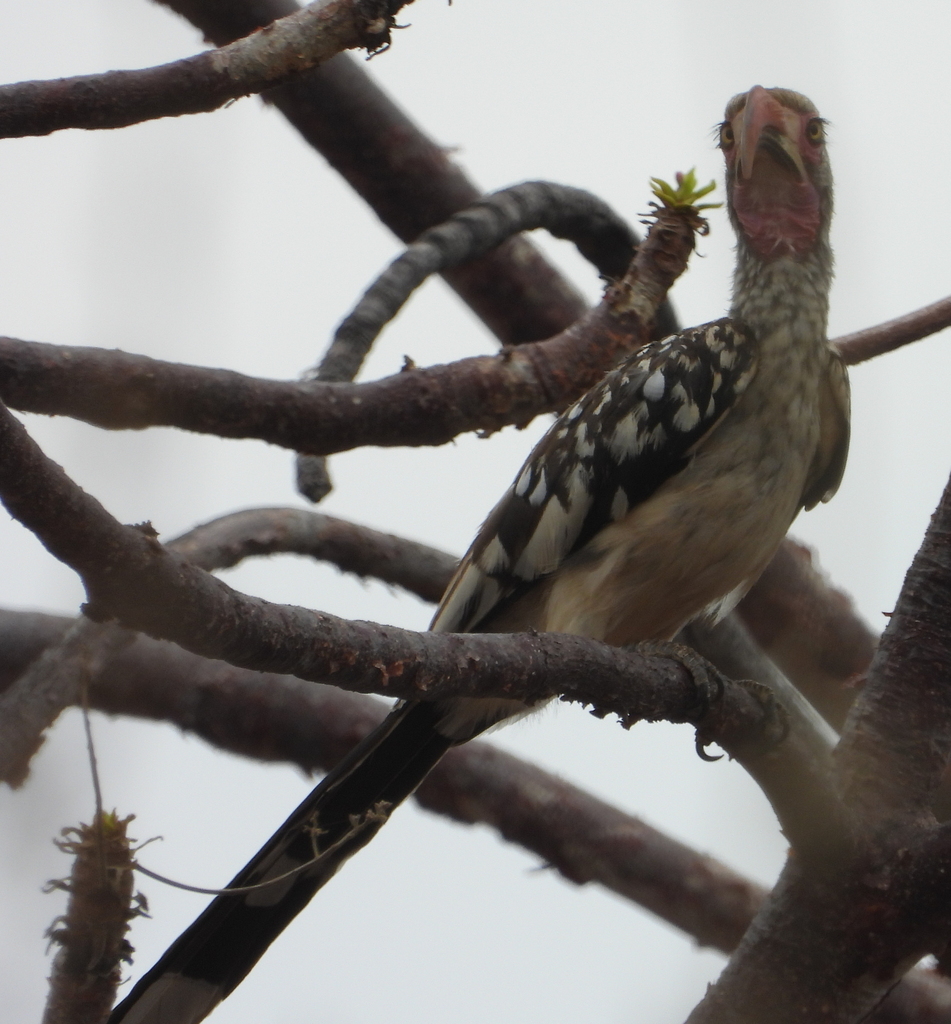
Southern Red-billed Hornbill
Photo © Timothy Whitehead
Photo © Timothy Whitehead — CC BY 4.0 — Source: iNaturalist #252009560Identification
The Southern red-billed hornbill is a distinctive bird characterized by its bright red bill and striking facial features. The sexes are similar in appearance, though males are noticeably larger and heavier, with somewhat longer bills where the lower mandible is coloured black to a variable extent. A reliable identifying feature is the combination of a yellow iris and pale orbital skin ranging from pink to greyish. The species is further distinguished by ample blackish plumage streaking that runs from the ear coverts to the side of the neck, contrasting with a white throat. The wing coverts are clearly spotted, providing additional visual markers for field identification.
Among the red-billed hornbills, this species stands out from its relatives through this particular combination of features. Geographic variation exists across its range: the eastern lowveld subspecies (T. r. degens) is notably the smallest in size, while the northern subspecies (T. r. ngamiensis) displays browner plumage and a more distinct tail bar, though differences between populations are clinal in nature.
Range & Habitat
The Southern red-billed hornbill is native to the savannas and drier bushlands of southern Africa, where it has adapted to these semi-arid environments. Its range extends from Malawi and Zambia southward to southern Angola, northeastern Namibia, Botswana, and Zimbabwe, with populations also found in eastern Eswatini and northern South Africa, specifically in the Transvaal and northern KZN province. The species also occurs in the upper Zambezi valley of Mozambique.
While widespread across much of southern Africa, the species is mostly absent from the eastern lowlands. In the arid woodlands of western Namibia, it is replaced by a near relative, the Damara red-billed hornbill, reflecting a clear ecological separation between these closely related species.
Behaviour & Diet
The Southern red-billed hornbill has a distinctive and recognizable call that consists of an accelerating series of notes—kuk kuk kuk—which builds toward a crescendo of double notes, kuk-we kuk-we. This vocalisation is an important way to locate and identify the species in the field. A notable behavioural difference from other red-billed hornbills is that the Southern red-billed hornbill does not raise its wings in display, setting it apart from its congeners in this respect.
Best Time & Places to See It
For travellers and birdwatchers seeking the Southern red-billed hornbill, the savannas and bushland habitats of southern Africa offer the best opportunities. Key regions include Botswana, Zimbabwe, and northern South Africa, where the species is fairly common in suitable habitat. The upper Zambezi valley in Mozambique also supports populations, though the species is less reliable in eastern lowland areas.
Photography Tips
Photographers should focus on capturing the bird's distinctive facial features—particularly the yellow iris, pale orbital skin, and the striking contrast between the red bill and dark plumage streaking on the neck. The clearly spotted wing coverts provide fine detail worth documenting. Listen for the characteristic accelerating call to locate birds, which will help position you for optimal shooting angles in the open savanna and bushland habitats where this species is typically found.
Mapungubwe National Park
Musina Local Municipality, South Africa
+358 birds+29 mammals
Where the Limpopo River cuts through sandstone ridges at the convergence of South Africa, Botswana, and Zimbabwe, Mapungubwe National Park preserves a landscape of profound ecological…
VIEW NATIONAL PARKChobe National Park
Botswana
+446 birds+45 mammals
Where the Chobe River cuts a sinuous path through northern Botswana, the landscape transforms into one of Africa's most dynamic wetland-savanna mosaics. This national park encompasses…
VIEW NATIONAL PARKNxai Pan National Park
Botswana
+226 birds+16 mammals
Across the northwestern reaches of Botswana stretches a landscape of profound seasonal transformation—a sprawling pan system where shallow depressions fill and empty with the rains, creating…
VIEW NATIONAL PARKKhaudum National Park
Botswana
+213 birds+13 mammals
Where the Okavango's northern tributaries meander through miombo woodland and riverine forest, Khaudum National Park unfolds across a landscape of profound ecological richness and isolation. This…
VIEW NATIONAL PARKTsavo East National Park
Athi ward, Kenya
+468 birds+50 mammals
Across the semi-arid lowlands of southeastern Kenya, where acacia woodland fragments into scrubland and the landscape rolls toward the Indian Ocean horizon, lies one of Africa's…
VIEW NATIONAL PARKTsavo West National Park
Mwatate, Kenya
+513 birds+49 mammals
Where volcanic ridges and weathered lava flows meet the semi-arid lowlands of south-central Kenya, Tsavo West National Park unfolds across a landscape sculpted by fire and…
VIEW NATIONAL PARKPilanesberg National Park
Moses Kotane Local Municipality, South Africa
+364 birds+49 mammals
Granite peaks and volcanic ridges rise unexpectedly from the savanna floor across this 734-square-kilometre expanse in the North West province, creating a landscape of profound ecological…
VIEW NATIONAL PARKKruger National Park
Ba-Phalaborwa Local Municipality, South Africa
+540 birds+91 mammals
Across the low-lying savanna of northeastern South Africa unfolds one of Africa's largest and most ecologically intact protected areas, where acacia woodlands merge into mopane scrub…
VIEW NATIONAL PARKMarakele National Park
Modimolle Local Municipality, South Africa
+341 birds+36 mammals
Granite ridges and sprawling grasslands dominate this 1,176-square-kilometre reserve in Limpopo's heartland, where bushveld transitions between rocky outcrops and open savanna. The park's rugged topography creates…
VIEW NATIONAL PARKKhaudum National Park
Namibia
+221 birds+13 mammals
Where the Kavango River flows through northeastern Namibia, vast miombo woodlands and riverine forests create one of southern Africa's most remote and biodiverse wilderness corridors. Khaudum…
VIEW NATIONAL PARKNkasa Rupara National Park
Namibia
+283 birds+17 mammals
Where the Zambezi's floodplains spill across the border between Namibia and Botswana, Nkasa Rupara National Park unfolds across 518 square kilometers of wetland and woodland mosaic.…
VIEW NATIONAL PARKBwabwata National Park
Namibia
+377 birds+35 mammals
Where the Kavango River winds through northeastern Namibia, vast floodplains and dense riparian woodland create one of southern Africa's most ecologically dynamic protected landscapes. Spanning 14,249…
VIEW NATIONAL PARKEtosha National Park
Namibia
+356 birds+58 mammals
Across northern Namibia's stark semi-arid plateau, a vast shallow depression transforms seasonally into one of Africa's most dramatic wildlife theaters. Etosha National Park, encompassing more than…
VIEW NATIONAL PARKWaterberg Plateau National Park
Okambukonde, Namibia
+198 birds+27 mammals
Where ancient sandstone cliffs rise 200 metres above the surrounding bushveld, a fortress of geology creates one of southern Africa's most compelling ecosystems. The plateau's steep…
VIEW NATIONAL PARKMakgadikgadi Pans National Park
Gucta, Botswana
+272 birds+27 mammals
Where salt-crusted flatlands stretch endlessly toward a shimmering horizon, one of Africa's most extraordinary ecosystems awakens with the rains. The Makgadikgadi Pans comprise vast mineral-rich basins…
VIEW NATIONAL PARKMeru National Park
Igembe Central, Kenya
+408 birds+38 mammals
Granite outcrops and acacia woodland rise across the northern reaches of Meru, where semi-arid savanna transitions into drier scrubland under the fierce equatorial sun. The park's…
VIEW NATIONAL PARKSamburu National Reserve
Samburu, Kenya
+430 birds+42 mammals
Across the arid plains of northern Kenya, where scattered acacia woodland gives way to rocky outcrops and dry riverbeds, Samburu National Park unfolds as one of…
VIEW NATURE RESERVENo community photos yet. Log in to add the first one.
No community observations of this species yet.