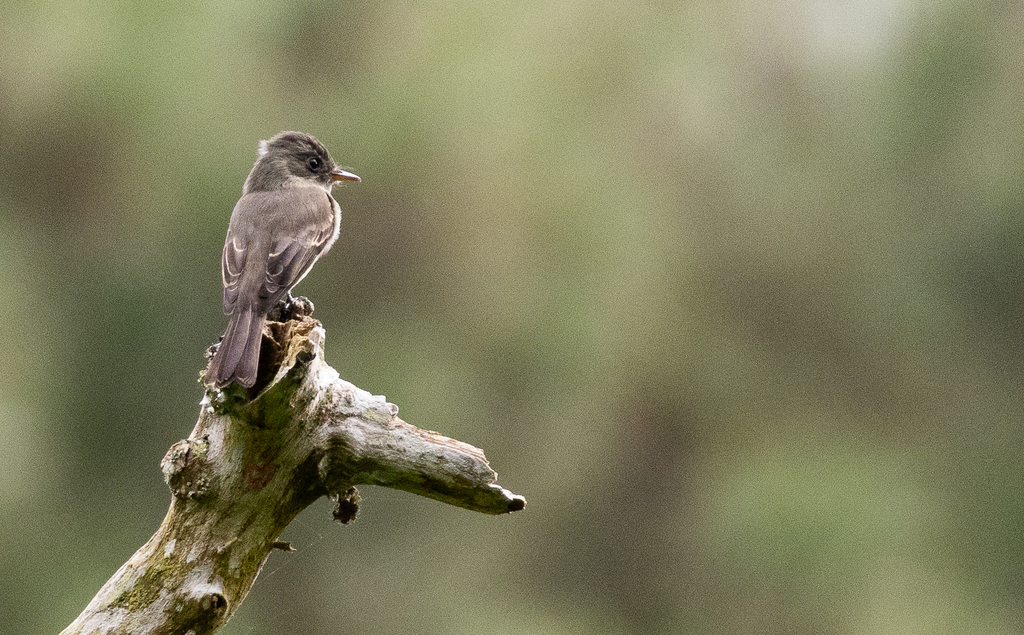
Southern Tropical Pewee
Photo © Gabriel Lobo Gusson
Photo © Gabriel Lobo Gusson — CC BY-SA 4.0 — Source: iNaturalist photo #658306062Identification
The Southern Tropical Pewee is a small passerine measuring 13.5–14.5 cm in length and weighing just 10–15 g. Both sexes are identical in plumage. Adults are characterized by a dark blackish-gray crown with a slight crest, white to grayish-white lores, and a thin white eye-ring set against a grayish-olive face. The back is sooty olive-gray, while the wings display dusky tones with white to brownish-gray edges on the secondaries and two thin, pale wing bars formed by the wing coverts. The tail is olive-gray. The underparts are predominantly white, with the upper breast tinged gray and the lower belly faintly yellowish-white. Juveniles show browner upperparts with buff to cinnamon-buff edges on feathers and wider pale tips on the wing coverts. The two recognized subspecies differ subtly: pallescens has a darker crown than the nominate cinereus but is otherwise similar.
Range & Habitat
The Southern Tropical Pewee is found in Argentina, Bolivia, Brazil, and Paraguay, with the northern subspecies (pallescens) ranging from central and eastern Brazil through eastern Bolivia and northern Paraguay into northwestern Argentina. The southern subspecies (cinereus) occupies southeastern Brazil from Bahia to Santa Catarina, extending south through central and southeastern Paraguay into Misiones Province. The species occasionally appears as a rare migrant in southeastern Peru. It inhabits a variety of semi-open landscapes including light woodlands, secondary woodlands, plantations, and forest edges, typically occurring below 1,300 m elevation, though reaching up to 2,850 m exceptionally in Bolivia.
Behaviour & Diet
The Southern Tropical Pewee is predominantly a year-round resident, though the northwestern Argentine population shows partial migratory tendencies. It feeds exclusively on insects, foraging singly or in pairs from an erect posture on somewhat exposed perches in the forest mid-story. Using a classic flycatcher technique, it hawks insects in mid-air, typically returning to the same perch and characteristically shivering its tail upon landing. It rarely participates in mixed-species feeding flocks. During breeding season (July to November), males perform elaborate courtship displays involving squatting, jumping, and flicking their wings and tail. Nests are shallow open cups constructed from lichens, seed down, plant fibers, and green moss, bound together with spider silk. Clutches consist of two dull-white eggs with brown and lilac spots. Both parents vigorously defend the nest against larger birds.
Best Time & Places to See It
The Southern Tropical Pewee can be encountered year-round throughout its extensive range, which encompasses numerous national parks and protected areas. Look for this species in light woodlands and semi-open habitats, particularly at forest edges where it perches in the mid-story vegetation. Early morning is the best time to locate it, as it vocalizes more frequently then. Its distinctive presence in secondary growth and plantation edges makes it accessible to patient birders exploring lowland and foothill regions of central and eastern South America.
Photography Tips
The Southern Tropical Pewee's small size and preference for mid-story perches demand patience and careful positioning. Scout forest edges and light woodlands where it typically hunts from exposed branches—these vantage points offer better photographic opportunities than dense forest interiors. Early morning light and the bird's habit of returning repeatedly to the same perch allow for predictable compositions. Capture its diagnostic features: the slight crest, thin wing bars, and characteristic tail-shivering behavior. The species' erect posture and hawking sorties provide dynamic action shots; position yourself to backlight the bird against open sky to emphasize its silhouette and wing details.
Tijuca National Park
Brazil
+317 birds+13 mammals
Where the Atlantic forest rises steeply from Rio de Janeiro's urban edge, Tijuca National Park encompasses a landscape of dramatic granite peaks, cascading waterfalls, and closed-canopy…
VIEW NATIONAL PARKEmas National Park
Brazil
+333 birds+23 mammals
Across the high plateaux of central Brazil, where the cerrado grasslands roll toward distant horizons under an immense sky, Emas National Park anchors one of South…
VIEW NATIONAL PARKSerra do Cipó National Park
Brazil
+379 birds+5 mammals
Where granite escarpments rise above the Atlantic Forest transition zone in southeastern Brazil, Serra do Cipó National Park unfolds across a landscape of dramatic ridges, cascading…
VIEW NATIONAL PARKNatural Serranía de los Yariguíes National Park
El Carmen de Chucurí, Colombia
+320 birds+3 mammals
Where the northern cordilleras of Colombia rise toward cloud forest, the Serranía de los Yariguíes unfolds across nearly 1,820 square kilometers of some of the most…
VIEW NATIONAL PARKNatural Farallones de Cali National Park
Buenaventura, Colombia
+733 birds+27 mammals
Where the Pacific coastal plain meets the western slopes of the Andes, Farallones de Cali National Park sprawls across nearly 3,500 square kilometers of dramatic topography…
VIEW NATIONAL PARKItatiaia National Park
Brazil
+519 birds+12 mammals
Where granite peaks pierce the Atlantic rainforest canopy in southeastern Brazil, Itatiaia National Park rises as one of the country's oldest and most ecologically vital protected…
VIEW NATIONAL PARKSaint-Hilaire/Lange National Park
Brazil
+225 birds
Subtropical Atlantic forests rise and fall across the plateaus of inland Paraná, where Saint-Hilaire/Lange National Park protects nearly 578 square kilometres of Brazil's most biodiverse woodland…
VIEW NATIONAL PARKSerra do Itajaí National Park
Brazil
+227 birds+2 mammals
Where the Atlantic rainforest rises steeply from the coastal plains of Santa Catarina, Serra do Itajaí National Park spreads across 1,136 square kilometres of montane wilderness…
VIEW NATIONAL PARKSerra da Bocaina National Park
Brazil
+441 birds+5 mammals
Where the escarpment of the Serra da Bocaina rises sharply from the Atlantic coastal plain, tropical rainforest cloaks steep mountainsides that climb toward peaks exceeding 2,000…
VIEW NATIONAL PARKIguaçu National Park
Brazil
+387 birds+17 mammals
Where the Paraná Plateau plunges toward the Atlantic watershed, six thousand square kilometers of subtropical rainforest cling to steep gorges and river valleys in this corner…
VIEW NATIONAL PARKSerra dos Órgãos National Park
Brazil
+446 birds+13 mammals
Granite peaks thrust skyward through the Atlantic Forest canopy in the mountains immediately north of Rio de Janeiro, their bare rock faces rising above a landscape…
VIEW NATIONAL PARKChapada dos Guimarães National Park
Brazil
+450 birds+1 mammals
Where weathered sandstone plateaus rise above the cerrado grasslands of central Brazil, Chapada dos Guimarães National Park protects 624 square kilometres of ecological transition zone that…
VIEW NATIONAL PARKChapada dos Veadeiros National Park
Brazil
+324 birds+6 mammals
Where granite plateaus rise above the cerrado savanna in central Brazil, Chapada dos Veadeiros National Park unfolds across 6,665 square kilometres of some of the world's…
VIEW NATIONAL PARKChapada Diamantina National Park
Brazil
+346 birds+5 mammals
Where granite peaks and sandstone cliffs rise abruptly from the Brazilian interior, Chapada Diamantina National Park sprawls across 4,215 square kilometers of some of Brazil's most…
VIEW NATIONAL PARKSerra do Gandarela National Park
Brazil
+333 birds+3 mammals
Where granite massifs rise through Atlantic Forest in southeastern Brazil's highlands, Serra do Gandarela National Park protects nearly 1,000 square kilometres of montane terrain that few…
VIEW NATIONAL PARKBrasília National Park
Plano Piloto, Brazil
+338 birds+15 mammals
Cerrado grassland and scattered woodland sweep across the central Brazilian plateau where this national park sprawls across more than a thousand square kilometres of the Federal…
VIEW NATIONAL PARKIguazú National Park
Puerto Iguazú, Argentina
+346 birds+15 mammals
Where the Paraná Plateau plunges toward the Atlantic watershed, nearly 800 square kilometers of subtropical rainforest drape across Misiones Province in a landscape carved by millennia…
VIEW NATIONAL PARKEl Rey National Park
Municipio de Las Lajitas, Argentina
+317 birds+4 mammals
Where the eastern slopes of the Andes descend into northwestern Argentina's subtropical transition zone, El Rey National Park unfolds across 841 square kilometers of dramatically varied…
VIEW NATIONAL PARKNo community photos yet. Log in to add the first one.
No community observations of this species yet.