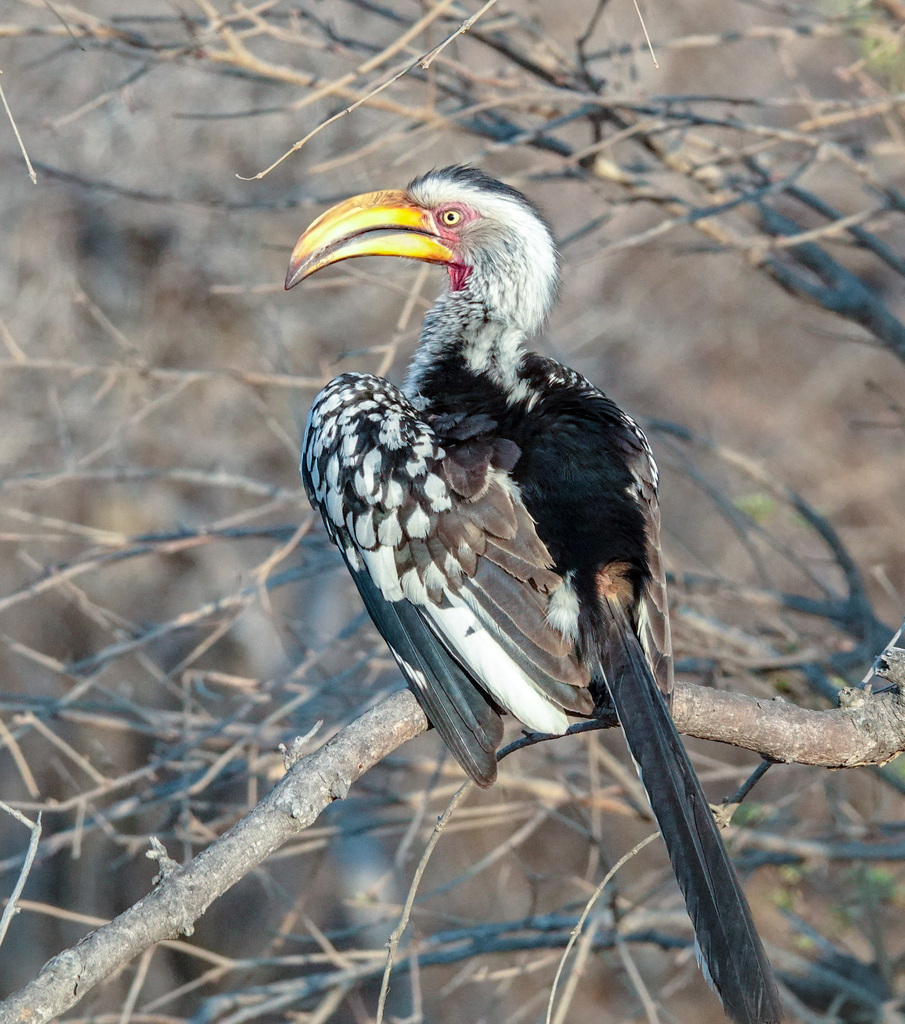
Southern Yellow-billed Hornbill
Photo © Sevin Dee
Photo © Sevin Dee — CC BY 4.0 — Source: iNaturalist #253990295Identification
The Southern Yellow-billed Hornbill is a medium-sized bird measuring 48–60 cm in length, instantly recognizable by its long, yellow, down-curved beak that can account for up to one-sixth of its entire body length. Male beaks average 90 mm long, while females average 74 mm, making beak size a reliable way to distinguish sex in the field. Males are generally larger than females overall. The bird's modest casque (the helmet-like structure on the head) is small but covers almost the entire length of the beak in males.
The plumage is striking in its simplicity: a white belly contrasts with a grey neck and black back adorned with abundant white spots and stripes. The chest is lightly striated with black, and the neck displays grey spotting. Like all hornbills, they have a long tail, prominent eyelashes, stubby legs and toes, and the first two neck vertebrae are fused together. The eyes are typically yellow, though brown has occasionally been recorded, and pinkish skin encircles the eyes and malar stripe.
Range & Habitat
The Southern Yellow-billed Hornbill is nearly endemic to the dry savannas of southern Africa, ranging from Angola and Namibia in the west through Botswana and Zimbabwe to Mozambique and KwaZulu-Natal in the east. They inhabit dry, open savannas and are particularly partial to acacia and broad-leafed woodlands when available. The highest concentrations are found in open mopane scrub, where conditions suit their ground-foraging lifestyle.
These birds are common and widespread residents of their range, and can often be spotted along roads and water courses where they search for food and water during the hot, dry months.
Behaviour & Diet
Southern Yellow-billed Hornbills are active throughout morning, day, and evening, roosting high in trees at night for safety. They are typically solitary or found in pairs, though small groups gather during breeding season and sometimes during local migrations in the dry season. They are generally sedentary and territorial, defending their territories with elaborate displays and piercing calls used for territorial delimitation and long-distance communication.
These birds are primarily ground foragers, feeding on seeds, small insects, spiders, and scorpions. They hunt by overturning debris and hopping heavily after insects, using their beaks as forceps to grasp food before tossing it back to their short, stubby tongues for swallowing. Their diet includes termites, beetles, larvae, grasshoppers, caterpillars, centipedes, scorpions, small mammals, berries, fruits, nuts, and occasionally eggs from other species. The inner cutting edges of their beaks are serrated to crush and fragment food effectively.
Best Time & Places to See It
Southern Yellow-billed Hornbills are easiest to observe in open mopane scrub and dry thornveldt, where they forage conspicuously on the ground during daylight hours. They are common residents throughout southern Africa, making them reliably found in suitable habitat across Angola, Namibia, Botswana, Zimbabwe, northern South Africa, and Mozambique. Scan along roads and water courses, particularly during the cooler morning and late afternoon hours when they are most active.
Photography Tips
The bird's striking yellow beak and contrasting black-and-white plumage make it highly photogenic. Ground-foraging behaviour offers excellent opportunities for low-angle shots that emphasize the bird's distinctive beak and posture. The diagnostic yellow eyes and pinkish facial skin provide sharp points of focus. Photograph during golden hour to capture the warm tones of the beak and the subtle grey neck markings. Their powerful, heavy-winged flight alternating with gliding provides dynamic action shots, though their lack of underwing coverts may appear unusual in flight photography. Territory displays with conspicuous physical movements offer behavioural photography opportunities, particularly when accompanied by their distinctive piercing calls.
Chobe National Park
Botswana
+446 birds+45 mammals
Where the Chobe River cuts a sinuous path through northern Botswana, the landscape transforms into one of Africa's most dynamic wetland-savanna mosaics. This national park encompasses…
VIEW NATIONAL PARKKhaudum National Park
Botswana
+213 birds+13 mammals
Where the Okavango's northern tributaries meander through miombo woodland and riverine forest, Khaudum National Park unfolds across a landscape of profound ecological richness and isolation. This…
VIEW NATIONAL PARKPilanesberg National Park
Moses Kotane Local Municipality, South Africa
+364 birds+49 mammals
Granite peaks and volcanic ridges rise unexpectedly from the savanna floor across this 734-square-kilometre expanse in the North West province, creating a landscape of profound ecological…
VIEW NATIONAL PARKKruger National Park
Ba-Phalaborwa Local Municipality, South Africa
+540 birds+91 mammals
Across the low-lying savanna of northeastern South Africa unfolds one of Africa's largest and most ecologically intact protected areas, where acacia woodlands merge into mopane scrub…
VIEW NATIONAL PARKIthala Game Reserve
uPhongolo Local Municipality, South Africa
+328 birds+26 mammals
Rolling thornbush savanna and acacia woodland dominate the landscape of this 494-square-kilometre national park in KwaZulu-Natal's uPhongolo Local Municipality, where granite outcrops punctuate grassland plateaus and…
VIEW NATIONAL PARKMarakele National Park
Modimolle Local Municipality, South Africa
+341 birds+36 mammals
Granite ridges and sprawling grasslands dominate this 1,176-square-kilometre reserve in Limpopo's heartland, where bushveld transitions between rocky outcrops and open savanna. The park's rugged topography creates…
VIEW NATIONAL PARKKhaudum National Park
Namibia
+221 birds+13 mammals
Where the Kavango River flows through northeastern Namibia, vast miombo woodlands and riverine forests create one of southern Africa's most remote and biodiverse wilderness corridors. Khaudum…
VIEW NATIONAL PARKDorob National Park
Henties Bay, Namibia
+230 birds+13 mammals
Where the Skeleton Coast meets the Namib Desert's inland reaches, Dorob National Park sprawls across 34,021 square kilometres of one of southern Africa's most austere and…
VIEW NATIONAL PARKSkeleton Coast Park
Barcelona, Namibia
+143 birds+7 mammals
Where the Atlantic's cold Benguela Current collides with one of Africa's most hostile coastlines, the Skeleton Coast Park sprawls across more than 104,000 square kilometres of…
VIEW OBSERVATION POINTNamib-Naukluft National Park
Namibia
+217 birds+33 mammals
Across nearly 94,000 square kilometers of southwestern Namibia, a landscape of extremes unfolds where towering sand dunes meet rugged mountain ranges, and ancient riverbeds carve through…
VIEW NATIONAL PARKNkasa Rupara National Park
Namibia
+283 birds+17 mammals
Where the Zambezi's floodplains spill across the border between Namibia and Botswana, Nkasa Rupara National Park unfolds across 518 square kilometers of wetland and woodland mosaic.…
VIEW NATIONAL PARKBwabwata National Park
Namibia
+377 birds+35 mammals
Where the Kavango River winds through northeastern Namibia, vast floodplains and dense riparian woodland create one of southern Africa's most ecologically dynamic protected landscapes. Spanning 14,249…
VIEW NATIONAL PARKEtosha National Park
Namibia
+356 birds+58 mammals
Across northern Namibia's stark semi-arid plateau, a vast shallow depression transforms seasonally into one of Africa's most dramatic wildlife theaters. Etosha National Park, encompassing more than…
VIEW NATIONAL PARKWaterberg Plateau National Park
Okambukonde, Namibia
+198 birds+27 mammals
Where ancient sandstone cliffs rise 200 metres above the surrounding bushveld, a fortress of geology creates one of southern Africa's most compelling ecosystems. The plateau's steep…
VIEW NATIONAL PARKMakgadikgadi Pans National Park
Gucta, Botswana
+272 birds+27 mammals
Where salt-crusted flatlands stretch endlessly toward a shimmering horizon, one of Africa's most extraordinary ecosystems awakens with the rains. The Makgadikgadi Pans comprise vast mineral-rich basins…
VIEW NATIONAL PARKNo community photos yet. Log in to add the first one.
No community observations of this species yet.