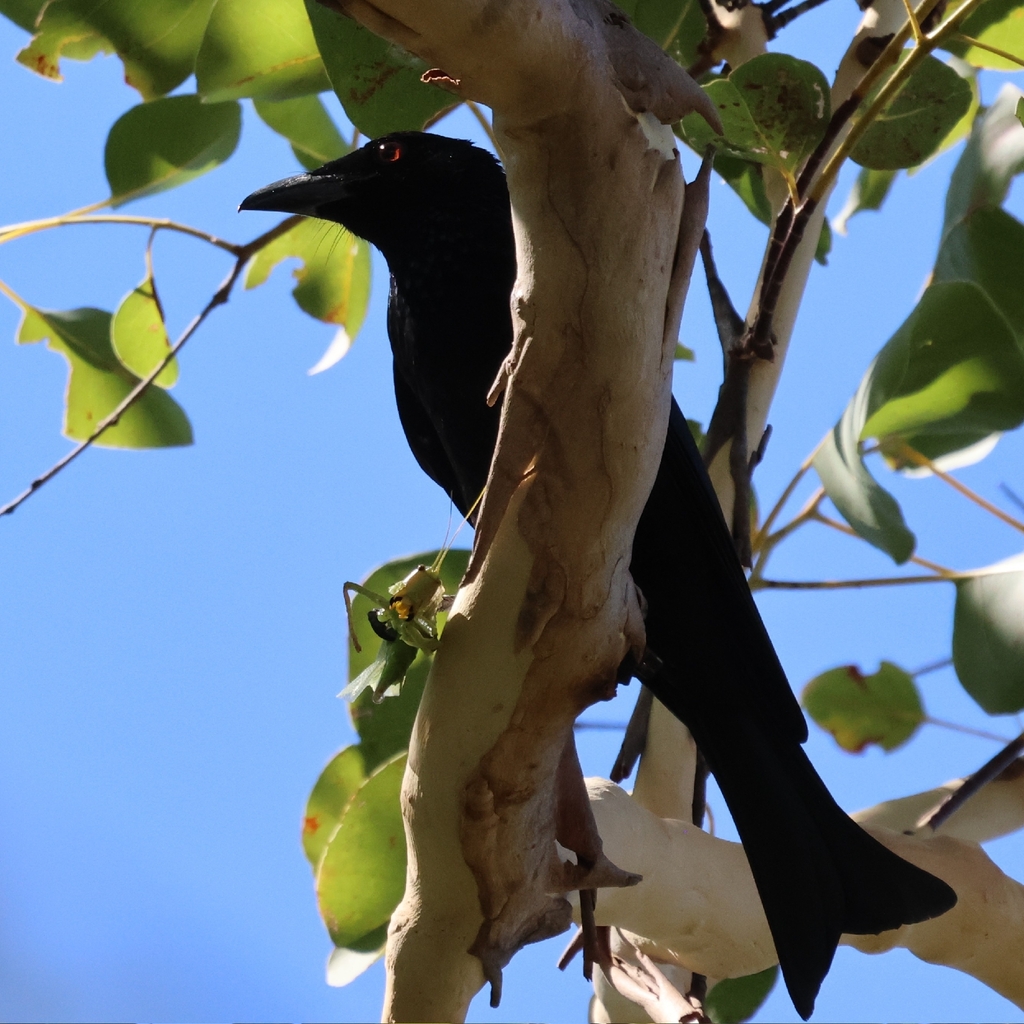
Spangled Drongo
Photo © Luke Lythgoe
Photo © Luke Lythgoe — CC BY 4.0 — Source: iNaturalist #358265041Identification
The spangled drongo is Australia's only drongo species, unmistakable with its entirely black plumage adorned with iridescent blue and purple highlights. Its most striking feature is the long, deeply forked tail with outcurved feathers that appear to cross over one another like interlaced fingers. The eyes are a distinctive crimson red. Juveniles lack the iridescent sheen and spots of adults, with dark brown eyes instead.
Range & Habitat
This species is found exclusively in Australia, where it is an altitudinal and latitudinal migrant. Populations in the high-altitude areas around Brisbane, Queensland arrive in late spring and depart in midsummer after breeding. The birds favour isolated, tall trees for nesting and breeding activities.
Behaviour & Diet
The spangled drongo is an active, often comical forager, swooping and perching energetically as it hunts for insects, small birds, and occasionally small skinks. It is frequently silent, but when vocal, produces astonishingly loud, complex, and entertaining calls—sometimes sounding like a sharp sneeze. Remarkably, this bird is an exceptional mimic, incorporating much of its vocabulary from ambient sounds in its environment and weaving them into song. In urban areas, it becomes easily tamed and will accurately snatch small pieces of raw meat from the air.
Best Time & Places to See It
Late spring through midsummer is the prime season to encounter spangled drongos in Queensland's high-altitude regions around Brisbane. Urban parks and gardens may also host visiting birds during this period, where they are particularly approachable and entertaining to observe.
Photography Tips
The iridescent plumage requires careful lighting to capture the full blue and purple highlights against the black feathers—backlighting or side-lighting works well. The distinctive forked tail is diagnostic and should be a focal point. Active aerial feeding behaviour provides dynamic shooting opportunities; fast shutter speeds and continuous shooting modes will help capture these acrobatic swoops. The vivid crimson eyes are worth isolating in close-up shots.
Aketajawe Lolobata National Park
Annan River (Yuku Baja-Muliku) National Park
Bald Rock National Park
Ben Boyd National Park
Blue Mountains National Park
Bouddi National Park
Bribie Island National Park
Bunya Mountains National Park
Cania Gorge National Park
Nothing matches these filters.
No community photos yet. Log in to add the first one.
No community observations of this species yet.