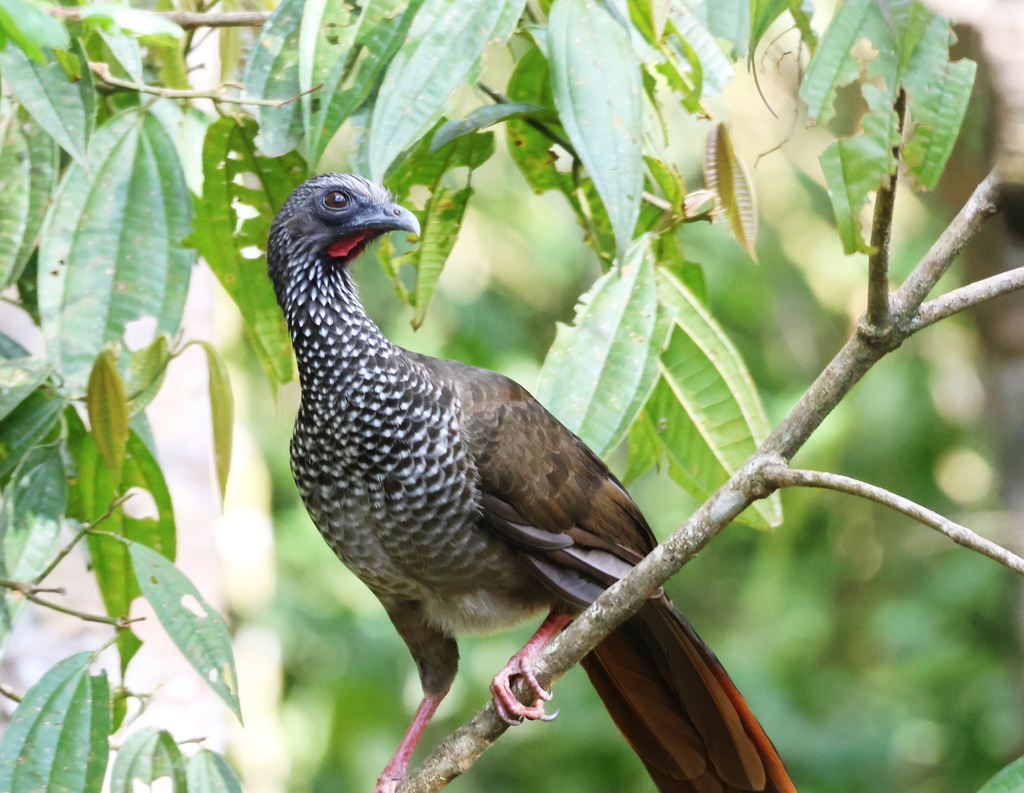
Speckled Chachalaca
Photo © Susan Blayney
Photo © Susan Blayney — CC BY 4.0 — Source: iNaturalist photo #599598414Identification
The speckled chachalaca is a medium-sized bird measuring 49 to 55 cm in length, belonging to the family Cracidae. The nominate subspecies is predominantly brown above with a distinctive darker, grayer head and neck. Its mantle displays a chestnut wash, while the tail has a bronze gloss with rufous outer feathers. The throat and breast are dark brown marked with the characteristic white speckles that give the species its name. The lower breast and belly are light grayish brown, contrasting with a bright rufous vent. A striking feature is the dark brown to reddish-brown eye surrounded by bare slate-blue skin, which gives the bird a distinctive facial expression. The subspecies O. g. subaffinis is overall lighter and browner, with more scalloped rather than speckled throat and breast markings, while O. g. remota is paler and more olive above with a rufescent crown.
Range & Habitat
The speckled chachalaca is found across the Amazonian regions of Bolivia, Brazil, Colombia, Ecuador, and Peru, with an isolated subspecies in southeastern Brazil. The two Amazonian subspecies typically inhabit low or open forest, thickets, forest islands within savanna, várzea, and riparian and floodplain areas, notably avoiding the interior of dense terra firme forest. They are generally found up to 2,000 m elevation in Bolivia, 1,100 m in Ecuador, and 1,700 m in Peru, though locally higher in all three countries. The geographically isolated O. g. remota inhabits only secondary woodland and gallery forest edges in Mato Grosso do Sul and São Paulo states.
Behaviour & Diet
Speckled chachalacas are social birds that forage in small flocks of up to seven individuals, primarily in the subcanopy and understory, only rarely descending to the ground. Their diet consists of fruits and other plant material, though their feeding ecology has not been extensively studied. The species produces a distinctive rhythmic five-syllable call rendered as "ha-ga-GAA-gogok," repeated rapidly, with similar vocalizations across subspecies. Breeding phenology varies across their range, with the Peruvian population showing a nesting season spanning at least November through March. Nests are constructed from leaves on beds of dry ferns, with typical clutch sizes of three to four eggs.
Best Time & Places to See It
The two Amazonian subspecies are generally common throughout their range and well-represented in protected areas across all countries where they occur. They tolerate human activity reasonably well, making them accessible to travellers exploring Amazonian habitats. For the best viewing opportunities, focus on lowland and open forest edges, thickets, and riparian zones rather than dense forest interiors. The breeding season in Peru (November to March) may offer enhanced viewing opportunities as birds are more active.
Photography Tips
The speckled chachalaca's preference for the subcanopy and understory means patience and careful scanning of mid-level vegetation will reward photographers. The striking bare blue facial skin and contrasting plumage provide excellent detail shots when birds can be approached. Early morning hours, when flocking behaviour is most active, offer the best opportunities for capturing multiple individuals. The bird's relatively tolerant attitude toward human presence, combined with its vocal nature, means listening for their distinctive rhythmic call can help locate flocks for photography.
Yasuní National Park
Aguarico, Ecuador
+601 birds+43 mammals
Where the western Amazon basin converges with Ecuador's Orellana Province, lowland rainforest reaches toward the horizon in an unbroken canopy of staggering botanical density. Yasuní National…
VIEW NATIONAL PARKPodocarpus National Park
Zamora, Ecuador
+496 birds+6 mammals
Where the Andes descend toward the Amazon basin, Podocarpus National Park sprawls across nearly 2,800 square kilometres of the most biodiverse terrain in Ecuador's southern highlands.…
VIEW NATIONAL PARKSumaco Napo-Galeras National Park
Loreto, Ecuador
+563 birds+4 mammals
Where Ecuador's Amazon transitions into cloud forest, a massive shield volcano rises from the emerald lowlands of Orellana Province, anchoring one of the continent's most biodiverse…
VIEW NATIONAL PARKNatural Sierra de Chiribiquete National Park
Solano, Colombia
+359 birds+27 mammals
Massive table-top mountains rise abruptly from the lowland rainforest of southeastern Colombia, their sheer sandstone cliffs and isolated summits creating some of the most dramatic topography…
VIEW NATIONAL PARKNatural la Paya National Park
Puerto Leguízamo, Colombia
+262 birds+4 mammals
Where the Amazon's western reaches fold into the Andes foothills, La Paya National Park sprawls across more than 8,500 square kilometers of pristine Amazonian rainforest in…
VIEW NATIONAL PARKNatural el Cocuy National Park
Güicán, Colombia
+313 birds+3 mammals
Where the Andes rise to their highest peaks in Colombia's eastern cordillera, El Cocuy National Park sprawls across more than 6,600 square kilometers of some of…
VIEW NATIONAL PARKNatural Sumapaz National Park
Cubarral, Colombia
+368 birds+1 mammals
Where the Andes descend toward the Amazon basin, the high páramo grasslands of Sumapaz National Park sprawl across more than five thousand square kilometers of Meta…
VIEW NATIONAL PARKNatural Sierra de la Macarena National Park
Vista Hermosa, Colombia
+566 birds+15 mammals
Across nearly 20,000 square kilometres of Colombia's Meta Department, the terrain rises from lowland savanna into Andean foothills through a mosaic of gallery forests, palm-fringed wetlands,…
VIEW NATIONAL PARKAmacayacu National Park
Leticia, Colombia
+567 birds+25 mammals
Where the Rio Amazonas curves through the tri-border region where Colombia, Peru, and Brazil converge, Amacayacu National Park sprawls across more than 5,250 square kilometres of…
VIEW NATIONAL PARKChapada dos Guimarães National Park
Brazil
+450 birds+1 mammals
Where weathered sandstone plateaus rise above the cerrado grasslands of central Brazil, Chapada dos Guimarães National Park protects 624 square kilometres of ecological transition zone that…
VIEW NATIONAL PARKAmazônia National Park
Brazil
+439 birds+6 mammals
Where the Rio Amazonas and its tributaries weave through the heart of Pará state, a vast tapestry of rainforest stretches across 23,611 square kilometers of unbroken…
VIEW NATIONAL PARKMapinguari National Park
Brazil
+354 birds
Vast tracts of western Amazonian rainforest blanket the remote terrain of this 56,827 square kilometre national park in Amazonas state, where seasonal rivers wind through dense…
VIEW NATIONAL PARKCampos Amazónicos National Park
Amazonas, Brazil
+434 birds+7 mammals
Sprawling across the southwestern Amazon basin in Amazonas state, this 27,263-square-kilometre national park encompasses some of the region's most pristine lowland rainforest, where terra firme forest…
VIEW NATIONAL PARKSerra do Divisor National Park
Brazil
+448 birds+10 mammals
Where the western Amazon meets the Andes foothills, Serra do Divisor National Park sprawls across one of South America's most biodiverse and least accessible frontiers. Spanning…
VIEW NATIONAL PARKYanachaga–chemillén National Park
Palcazu, Peru
+639 birds+6 mammals
Where the eastern slopes of Peru's central cordillera plunge into cloud forest, Yanachaga–Chemillén National Park protects nearly three thousand square kilometres of montane wilderness that few…
VIEW NATIONAL PARKManu National Park
Manu, Peru
+892 birds+26 mammals
Across the eastern slopes of the Peruvian Andes, tropical rainforest descends into the Amazon basin with a complexity that few terrestrial ecosystems match. Manu National Park…
VIEW NATIONAL PARKSierra del Divisor National Park
Alto Tapiche, Peru
+298 birds+2 mammals
Where the western Amazon meets the Andes foothills, nearly 41,000 square kilometres of pristine rainforest rise across Peru's Alto Tapiche region in a landscape of extraordinary…
VIEW NATIONAL PARKIchigkat Muja – Cordillera del Cóndor National Park
Río Santiago, Peru
+101 birds
Where the Andes descend into the western Amazon, the Río Santiago carves through a landscape of profound biological complexity. Ichigkat Muja – Cordillera del Cóndor National…
VIEW NATIONAL PARKTingo Maria National Park
Mariano Dámaso Beraún, Peru
+423 birds
Where the eastern slopes of the Peruvian Andes descend toward the Amazon basin, the landscape fractures into a maze of limestone ridges, humid gorges, and cloud-wrapped…
VIEW NATIONAL PARKCordillera Azul National Park
Pampa Hermosa, Peru
+322 birds+1 mammals
Where the eastern Andes descend into the western Amazon basin, Cordillera Azul National Park sprawls across nearly 38,000 square kilometres of some of Peru's most pristine…
VIEW NATIONAL PARKNo community photos yet. Log in to add the first one.
No community observations of this species yet.