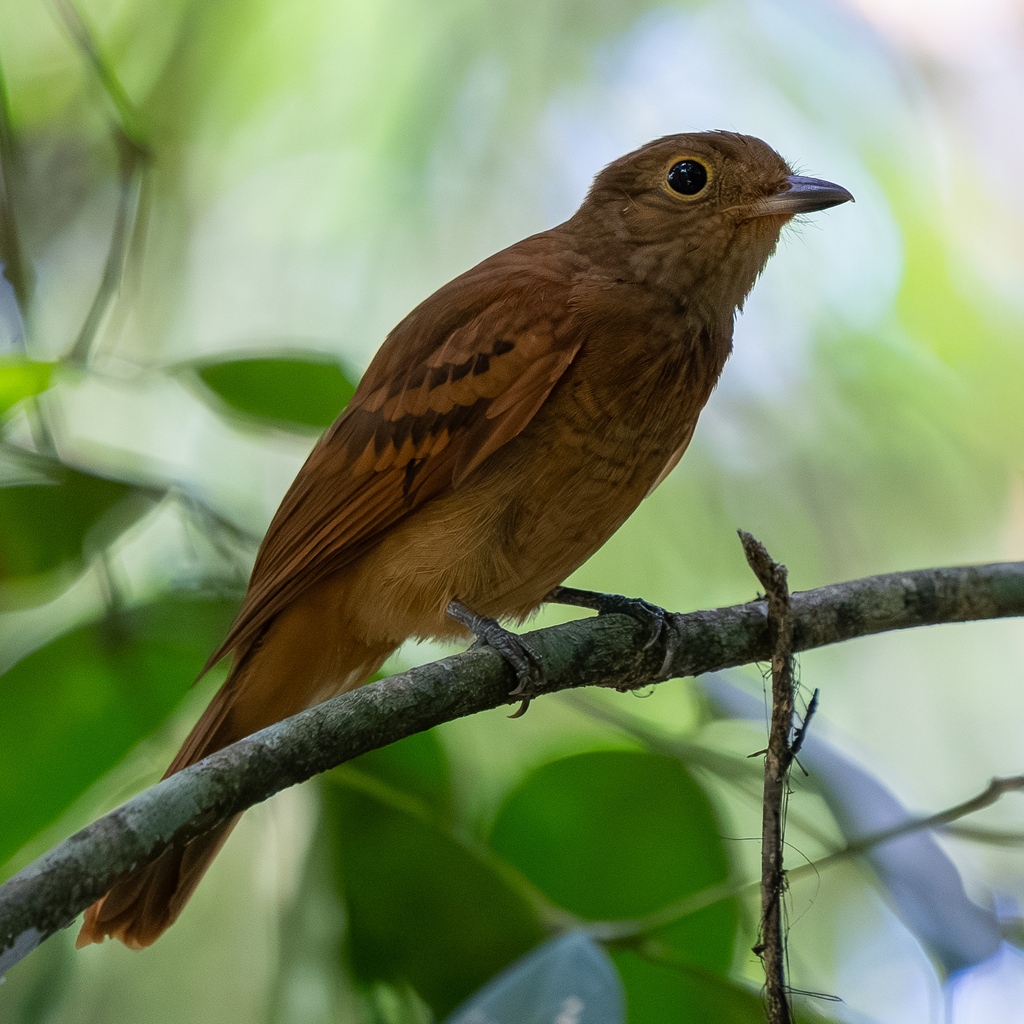
Speckled Mourner
Photo © Anthony Batista
Photo © Anthony Batista — CC BY 4.0 — Source: iNaturalist photo #597315021Identification
The speckled mourner is a small bird, measuring 19 to 21.5 cm long and weighing 38.6 to 56 g. Both sexes share nearly identical plumage. Adults display a thin orange eye-ring, with rufous-brown coloring on the head, back, wings, and tail. The wing coverts are dusky with large rufous spots on their tips, creating two or three faint wing bars—a useful field mark. The throat and underparts are paler cinnamon-brown than the upperparts, often with thin dusky scallops on the breast. Males possess pale yellow to orange pectoral tufts that are usually concealed; females typically lack these. All birds have a brown to dark brown iris, a blackish bill with a grayish-pink base, and brownish-gray legs. Three subspecies exist, with variation in overall darkness and tone. The speckled mourner can be confused with the similarly distributed rufous piha, which has a heavier bill, plain breast without pectoral tufts, and critically, no wing bars.
Range & Habitat
The speckled mourner's range extends from northern Oaxaca and Chiapas in southeastern Mexico southward along the Caribbean slope through Central America to northwestern Colombia and Ecuador. The nominate subspecies covers the largest range, while two additional subspecies occupy northwestern Colombia and southwestern Colombia into Ecuador respectively. This species is a year-round resident throughout its range. It inhabits humid evergreen forest in tropical zones, showing a preference for wetter areas near swamps and along streams. Elevational range varies by region: generally sea level to 750 m, reaching 800 m in Costa Rica and 1,000 m in Colombia, though only 500 m in Ecuador.
Behaviour & Diet
The speckled mourner forages primarily on arthropods, small lizards, and fruit, moving through the forest understory and midstory typically as a solitary bird, though it occasionally joins mixed-species feeding flocks. Its hunting technique involves perching silently and making short sallies, sometimes with brief hovering, to glean food from foliage and branches. Males are vocal singers, tirelessly repeating a distinctive ringing, ventriloquial call: tleeyr, tlee-yeeí, tlee-yeeí, tlee-yeeí, repeated up to 15 times before pausing and restarting. The species also produces a plaintive, drawn-out, slightly mewing call. Little is known about breeding biology beyond observations of breeding activity in Colombia during May.
Best Time & Places to See It
As a year-round resident, the speckled mourner can be encountered throughout the year within its range. However, the species is considered rare in northern Central America and Costa Rica, uncommon in Colombia, and scarce in Ecuador, so patience and persistence are essential. The bird is found in a few protected areas, making such locations potentially productive. Humid evergreen forests near water sources—swamps, streams, and forest wetlands—offer the best chances of encounter. Early morning hours when males are most vocal may increase detection probability.
Photography Tips
Photographing the speckled mourner presents challenges due to its preference for understory and midstory forest habitat and generally silent, solitary behavior—though vocalization from males can help locate individuals. Look for the distinctive faint wing bars and eye-ring, which may appear subtle in forest shadows. Position yourself near swamps or streams within humid evergreen forest, and listen for the characteristic ringing call. The bird's habit of making short sallies from perches offers fleeting photo opportunities. Soft, available light is preferable to harsh flashes in dense forest; focus on capturing the rufous-brown plumage, wing bars, and subtle breast scallops that distinguish this species from the similar rufous piha.
Guanacaste National Park
Santa Elena, Costa Rica
+461 birds+17 mammals
Where the Pacific slopes of northwestern Costa Rica rise toward the Continental Divide, dry tropical forest gives way to cloud-laden peaks and misty ridges—a landscape that…
VIEW NATIONAL PARKNatural Utría National Park
Alto Baudó (Pie de Pató), Colombia
+372 birds+11 mammals
Where the Chocó's coastal mountains plunge toward the Pacific, Utría National Park preserves one of Colombia's most biodiverse and least-visited wilderness expanses. Sprawling across 1,287 square…
VIEW NATIONAL PARKNatural Farallones de Cali National Park
Buenaventura, Colombia
+733 birds+27 mammals
Where the Pacific coastal plain meets the western slopes of the Andes, Farallones de Cali National Park sprawls across nearly 3,500 square kilometers of dramatic topography…
VIEW NATIONAL PARKSoberanía National Park
Cristóbal, Panama
+495 birds+34 mammals
Rainforest and riverine woodland blanket the rolling terrain of this 714-square-kilometre national park in Colón Province, where the Caribbean watershed feeds a maze of streams and…
VIEW NATIONAL PARKChagres National Park
Caimitillo, Panama
+486 birds+19 mammals
Where the Chagres River carves through the humid tropics of central Panama, a vast montane and lowland forest sprawls across more than 2,300 square kilometers, anchoring…
VIEW NATIONAL PARKDarién National Park
Tucutí, Panama
+534 birds+13 mammals
Where the spine of Central America crumbles into wetland and rainforest, Darién National Park sprawls across more than 20,000 square kilometres of some of the tropics'…
VIEW NATIONAL PARKMontes Azules
Candelaria, Mexico
+395 birds+47 mammals
Where jungle-clad limestone plateaus plunge into canyon systems carved by the Usumacinta River, Mexico's most pristine rainforest reserve unfolds across the Lacandón region of Chiapas. Montes…
VIEW BIOSPHERE RESERVETikal National Park
Tikal, Guatemala
+399 birds+16 mammals
Dense rainforest canopy rises above the limestone plateau of Petén, where archaeological wonder and ecological richness merge seamlessly across one of Central America's most biodiverse landscapes.…
VIEW NATIONAL PARKNo community photos yet. Log in to add the first one.
No community observations of this species yet.