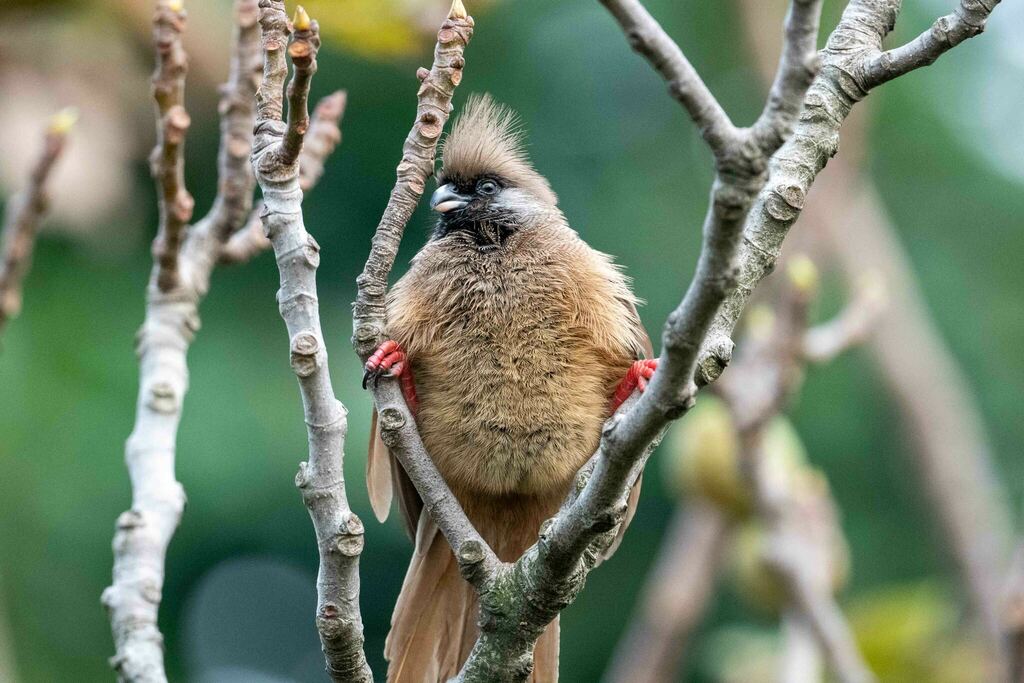
Speckled Mousebird
Photo © Jonathan Eisen
Photo © Jonathan Eisen — CC BY 4.0 — Source: iNaturalist photo #437691530Identification
The Speckled Mousebird is the largest species of mousebird, measuring about 35 cm (14 in) long, with the tail comprising approximately half its length and weighing around 57 g (2.0 oz). It is well-named for its dull-mousy brown coloration on the back and head, which includes a prominent crest. The bill is distinctively two-toned: black on the upper part and pinkish on the lower part. Among the seventeen recognized subspecies, birds mainly differ in head contrast, throat colour, the amount of barring, and iris colour. The Speckled Mousebird can be distinguished from the rare white-headed mousebird by its differently colored mandibles and the lack of a bare grey orbital patch.
Range & Habitat
This species is one of the most common mousebirds and is found throughout most of Central, Eastern and Southern Africa, ranging from Cameroon east to Eritrea and Ethiopia, and south through eastern Africa to southern South Africa. Most habitats suit this adaptable bird, except rainforests and more arid areas. The Speckled Mousebird shows a strong preference for open bushveld habitats, savanna, and open woodlands with tangled thickets. It has become a common "backyard bird," frequently seen in urban areas with gardens and orchards.
Behaviour & Diet
These are conspicuously social birds, feeding together and engaging in mutual preening. They travel in groups to dust bathe on the ground and occasionally swallow pebbles to assist in grinding vegetation during digestion. At nightfall, they roost in tight groups of about 20 birds, and on cold nights they can enter a torpid state—a vulnerability offset by the apparent effectiveness of large groups in deterring nocturnal predators. The Speckled Mousebird is a frugivore, subsisting primarily on fruits, berries, leaves, seeds, and nectar, with fairly strict food preferences that vary by location.
Best Time & Places to See It
The Speckled Mousebird may breed at any time of year, making it potentially visible year-round throughout its range. Its preference for open bushveld, savanna, and gardens makes it relatively easy to locate in suitable habitat across Central, Eastern, and Southern Africa. Urban gardens and orchards, particularly in areas with tangled vegetation, offer reliable viewing opportunities.
Photography Tips
The bird's dull-mousy plumage and prominent head crest are distinctive features worth capturing. Its social nature means multiple birds often appear together, offering opportunities for group compositions. The contrasting bill coloration—black above and pinkish below—merits close-up detail shots. Watch for birds in flight, when they produce a characteristic warbling tsu-tsu call, or during dust-bathing sessions on the ground, which provide engaging behavioral photography opportunities.
Lake Mburo National Park
Mabamba Swamp
Murchison Falls National Park
Queen Elizabeth National Park
Aberdare National Park
Abijata-Shalla Lakes National Park
Addo Elephant National Park
Agulhas National Park
Amboseli National Park
Nothing matches these filters.
No community photos yet. Log in to add the first one.
No community observations of this species yet.