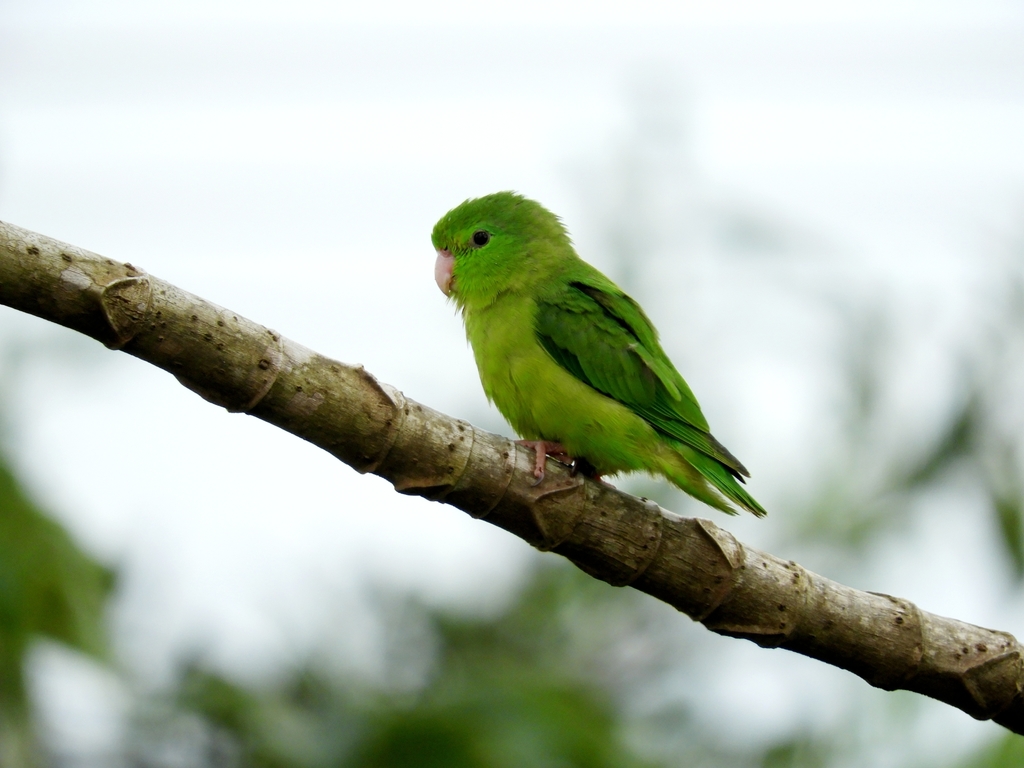
Spectacled Parrotlet
Photo © José Gabriel Julio Guzmán
Photo © José Gabriel Julio Guzmán — CC BY 4.0 — Source: iNaturalist photo #51769953Identification
The Spectacled Parrotlet is a small parrot species characterized by distinctive green and blue plumage that provides excellent camouflage among tropical foliage. The species takes its name from the striking eye-ring markings that resemble spectacles. Males are notably brighter than females and play a key role in courtship displays with their vibrant coloring and specific mating calls. While color mutations such as yellow pied varieties occur in captivity, they remain extremely rare in the wild, as brighter plumage compromises the bird's ability to evade predators.
Range & Habitat
Spectacled Parrotlets are endemic to Middle and South America, with populations found across northern and central Colombia, Venezuela, and eastern Panama. Three distinct subspecies are recognized: F. c. conspicillatus, the Cauca Spectacled Parrotlet (F. c. caucae), and the Venezuelan Spectacled Parrotlet (F. c. metae), each occupying specific regional ranges. These birds inhabit lowland evergreen forest edges, thorn scrub, llanos, gallery woodland, and degraded former forest or low-density woodland, never venturing above 1,600 metres in elevation. Notably, their populations have remained stable and possibly increased due to habitat preferences favoring open areas over dense forest, making them well-suited to deforestation and land development patterns.
Behaviour & Diet
Spectacled Parrotlets are highly social birds living in small flocks, though gatherings of up to 100 individuals congregate at clay mounds to drink mineral-rich runoff or consume clay—a behavior providing essential minerals like calcium. In the wild, they feed on seeds, nuts, leaves, berries, cactus, tamarind, and other fruits, occasionally supplementing their diet with small insects. These monogamous birds typically breed between January and March, with males attracting females through bright displays and distinctive calls. Females nest in tree cavities or abandoned nests created by other species, incubating 4–6 eggs for approximately 18 days while males guard and provision the nest. Chicks fledge at five weeks and maintain sibling bonds through specific vocalizations and mutual feeding until self-sufficiency.
Best Time & Places to See It
Breeding season from January through March offers prime opportunities to observe courtship displays and vocal interactions. Look for Spectacled Parrotlets in lowland forests and open woodland habitats across Colombia, Venezuela, and eastern Panama, particularly near clay mounds where they congregate in larger groups. Many sightings occur along forest edges and in degraded woodland areas. The species' stable population and presence in numerous protected areas throughout its range make it a reliable subject for nature travelers. Early morning hours typically yield the best viewing opportunities when birds are most active and vocal.
Photography Tips
Capture the distinctive eye-ring markings and green-blue plumage that make this species visually striking. The contrast between male and female coloration offers excellent compositional opportunities, particularly during breeding season when males display prominently. Clay lick gatherings provide unique photography scenarios with multiple birds in frame, though crowds of up to 100 individuals can be unpredictable. Use faster shutter speeds to freeze the quick movements of these small, active birds in flight. Early morning light enhances the iridescent qualities of their plumage and reveals the subtle field marks that distinguish this species from other parrotlets.
Natural Munchique National Park
El Tambo, Colombia
+194 birds
Where the Western Cordillera rises steeply from the Pacific plains of southwestern Colombia, Natural Munchique National Park sprawls across 1,078 square kilometers of montane forest that…
VIEW NATIONAL PARKNatural Serranía de los Yariguíes National Park
El Carmen de Chucurí, Colombia
+320 birds+3 mammals
Where the northern cordilleras of Colombia rise toward cloud forest, the Serranía de los Yariguíes unfolds across nearly 1,820 square kilometers of some of the most…
VIEW NATIONAL PARKNatural Farallones de Cali National Park
Buenaventura, Colombia
+733 birds+27 mammals
Where the Pacific coastal plain meets the western slopes of the Andes, Farallones de Cali National Park sprawls across nearly 3,500 square kilometers of dramatic topography…
VIEW NATIONAL PARKNatural el Cocuy National Park
Güicán, Colombia
+313 birds+3 mammals
Where the Andes rise to their highest peaks in Colombia's eastern cordillera, El Cocuy National Park sprawls across more than 6,600 square kilometers of some of…
VIEW NATIONAL PARKGuácharos Cave National Natural Park
Acevedo, Colombia
+359 birds
High in the Andean foothills of southern Huila, where mist-laden slopes rise above 1,600 metres, lies a landscape carved by underground rivers and crowned by karst…
VIEW NATIONAL PARKNatural Sumapaz National Park
Cubarral, Colombia
+368 birds+1 mammals
Where the Andes descend toward the Amazon basin, the high páramo grasslands of Sumapaz National Park sprawl across more than five thousand square kilometers of Meta…
VIEW NATIONAL PARKEl Tamá National Park
Toledo, Colombia
+435 birds
Where the Andes descend toward the Caribbean coastal lowlands of northern Colombia, El Tamá National Park sprawls across nearly 3,800 square kilometres of montane forest, cloud…
VIEW NATIONAL PARKNatural Sierra de la Macarena National Park
Vista Hermosa, Colombia
+566 birds+15 mammals
Across nearly 20,000 square kilometres of Colombia's Meta Department, the terrain rises from lowland savanna into Andean foothills through a mosaic of gallery forests, palm-fringed wetlands,…
VIEW NATIONAL PARKNatural Nevado del Huila National Park
Planadas, Colombia
+117 birds
Where the Colombian Andes rise above 5,000 metres, tropical cloud forest yields to páramo and glaciated peaks, and the Planadas region of Tolima contains one of…
VIEW NATIONAL PARKDarién National Park
Tucutí, Panama
+534 birds+13 mammals
Where the spine of Central America crumbles into wetland and rainforest, Darién National Park sprawls across more than 20,000 square kilometres of some of the tropics'…
VIEW NATIONAL PARKNo community photos yet. Log in to add the first one.
No community observations of this species yet.