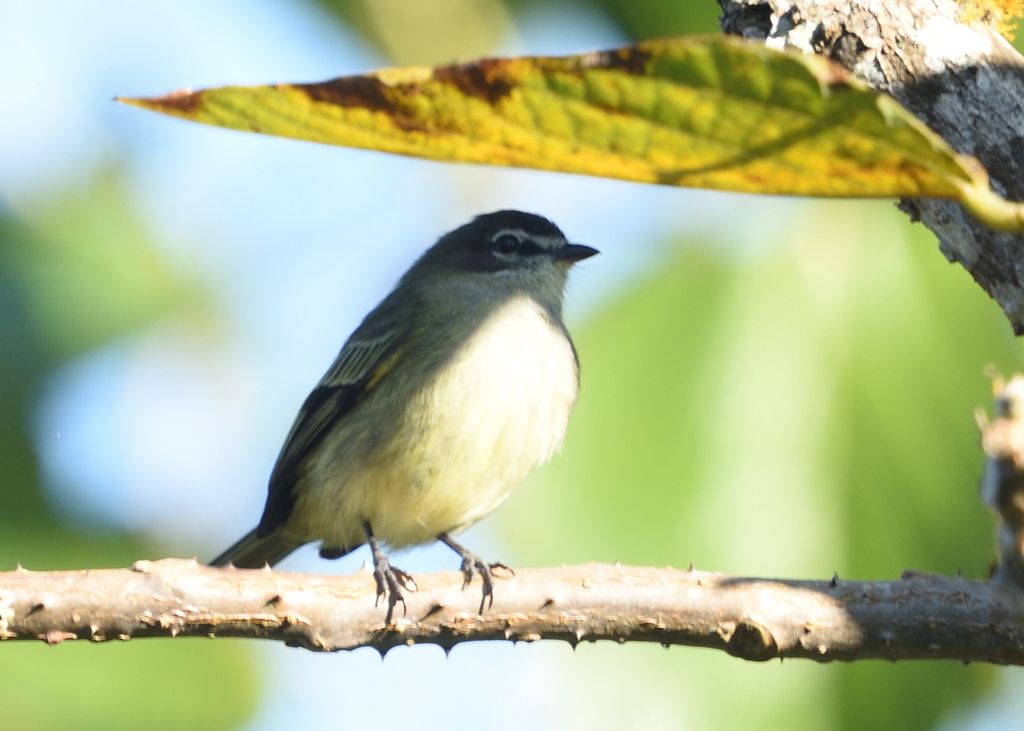
Spectacled Tyrannulet
Photo © Guy Babineau
Photo © Guy Babineau — CC BY 4.0 — Source: iNaturalist photo #255939491The spectacled tyrannulet (Zimmerius improbus), also known as the specious tyrannulet, mountain tyrannulet, and Venezuelan tyrannulet, is a small passerine bird in the family Tyrannidae, the tyrant flycatchers. It is found in Colombia and Venezuela. == Taxonomy and systematics == The spectacled tyrannulet was originally described in 1871 by the English naturalists Philip Sclater and Osbert Salvin under the binomial name Tyranniscus improbus. During much of the twentieth century the spectacled tyrannulet and several other tyrannulets were placed in genus Tyranniscus but a study published in 1977 erected the present genus Zimmerius for them. It was formerly treated as a subspecies of what was then the paltry tyrannulet (Zimmerius vilissimus sensu lato, now sensu stricto the Guatemalan tyrannulet). Taxonomic systems began recognizing them as separate species in 2004 but it took until 2020 to complete the change. Most systems eventually adopted the name "spectacled tyrannulet" for the species though for a time the International Ornithological Committee called it the "specious tyrannulet". BirdLife International's Handbook of the Birds of the World (HBW) for a time called it the "Venezuelan tyrannulet", a name now applied by all systems to Zimmerius petersi. As of late 2024 HBW called it the "mountain tyrannulet". The…
Natural Serranía de los Yariguíes National Park
El Carmen de Chucurí, Colombia
+320 birds+3 mammals
Where the northern cordilleras of Colombia rise toward cloud forest, the Serranía de los Yariguíes unfolds across nearly 1,820 square kilometers of some of the most…
VIEW NATIONAL PARKEl Tamá National Park
Toledo, Colombia
+435 birds
Where the Andes descend toward the Caribbean coastal lowlands of northern Colombia, El Tamá National Park sprawls across nearly 3,800 square kilometres of montane forest, cloud…
VIEW NATIONAL PARKNo community photos yet. Log in to add the first one.
No community observations of this species yet.