Identification
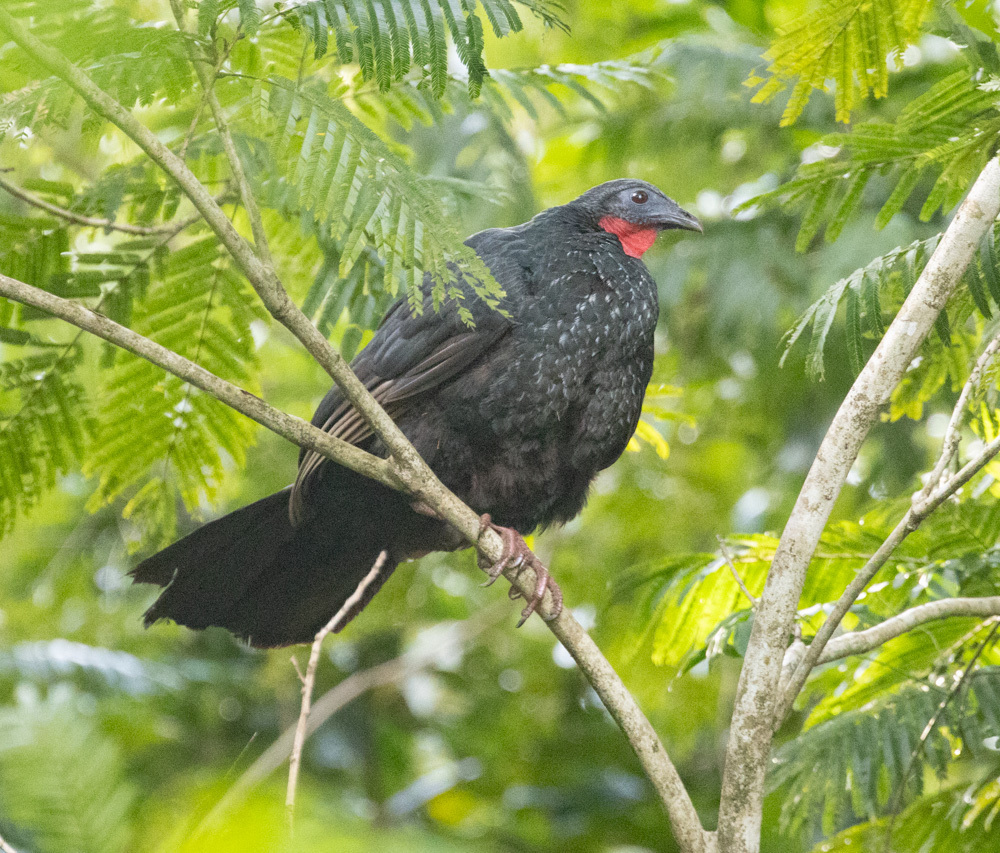
Spix's guan is a medium-sized bird in the cracid family, measuring 66–76 cm in length. Four recognized subspecies display notable plumage variations. The nominate subspecies, P. j. jacquacu, is the most distinctive: bronzy olive green above with a bright reddish underside. "Grant's" guan (P. j. granti) is considerably darker, with blue-green glossed upper parts and a darker red belly. The remaining two subspecies—P. j. orienticola and P. j. speciosa—occupy a middle ground between these extremes in both size and coloration. Males are generally heavier than females, with weights varying by subspecies from around 1.14 kg to 1.78 kg.
Range & Habitat
This species is the prototypical cracid of the Amazonian lowlands, inhabiting the upper Orinoco and western Amazon River basins across Bolivia, Brazil, Colombia, Ecuador, Guyana, Peru, Suriname, and Venezuela. The four subspecies are distributed from north to south in sequence: granti, orienticola, jacquacu, and speciosa. Spix's guan thrives in diverse forest types, occupying both terra firma and várzea (seasonally flooded) forests at lower elevations, and cloud forests in the upper elevations of Peru and Bolivia. The species is believed to be sedentary, remaining within its established range year-round.
Behaviour & Diet
These guans are primarily arboreal foragers, typically moving singly or in small family groups through the middle and upper canopy, though some regional populations also forage on the ground. Their diet consists mainly of fruits and seeds, making them important seed dispersers within their forest ecosystems. Interestingly, they have also been documented following army ants to capture arthropods, opportunistically exploiting the insects flushed by these mobile columns. Breeding timing varies geographically, ranging from January to May in Venezuela and August to September in Peru. Little is known about their reproductive biology; a single described nest was constructed from leaves and positioned about 5 meters up in a tree, but incubation and fledging periods remain undocumented.
Best Time & Places to See It
Spix's guan is common in at least parts of its extensive range, which spans approximately 5.9 million square kilometers across the western Amazon and Orinoco basins. The species is widely distributed and relatively approachable throughout humid rainforests and várzea forests in countries including Peru, Ecuador, Colombia, Brazil, Bolivia, and the Guianas. Breeding season varies by location but occurs during different months across the species' range, potentially making certain times more productive for observation in specific regions.
Photography Tips
The bright reddish underparts of the nominate subspecies and contrasting olive-green plumage offer striking photographic opportunities. Look for birds in the mid-to-upper canopy, particularly in areas with abundant fruiting trees. Early morning hours are typically best for activity and visibility. The species' relatively sedentary nature and tendency to move in small predictable groups can aid in locating and photographing individuals. Be aware that subspecific variation is significant—birds encountered will vary considerably in coloration depending on location, so understanding local subspecies identification is valuable for field photography.
Yasuní National Park
Aguarico, Ecuador
+601 birds+43 mammals
Where the western Amazon basin converges with Ecuador's Orellana Province, lowland rainforest reaches toward the horizon in an unbroken canopy of staggering botanical density. Yasuní National…
VIEW NATIONAL PARKSumaco Napo-Galeras National Park
Loreto, Ecuador
+563 birds+4 mammals
Where Ecuador's Amazon transitions into cloud forest, a massive shield volcano rises from the emerald lowlands of Orellana Province, anchoring one of the continent's most biodiverse…
VIEW NATIONAL PARKNatural Sierra de Chiribiquete National Park
Solano, Colombia
+359 birds+27 mammals
Massive table-top mountains rise abruptly from the lowland rainforest of southeastern Colombia, their sheer sandstone cliffs and isolated summits creating some of the most dramatic topography…
VIEW NATIONAL PARKNatural la Paya National Park
Puerto Leguízamo, Colombia
+262 birds+4 mammals
Where the Amazon's western reaches fold into the Andes foothills, La Paya National Park sprawls across more than 8,500 square kilometers of pristine Amazonian rainforest in…
VIEW NATIONAL PARKNatural Sierra de la Macarena National Park
Vista Hermosa, Colombia
+566 birds+15 mammals
Across nearly 20,000 square kilometres of Colombia's Meta Department, the terrain rises from lowland savanna into Andean foothills through a mosaic of gallery forests, palm-fringed wetlands,…
VIEW NATIONAL PARKAmacayacu National Park
Leticia, Colombia
+567 birds+25 mammals
Where the Rio Amazonas curves through the tri-border region where Colombia, Peru, and Brazil converge, Amacayacu National Park sprawls across more than 5,250 square kilometres of…
VIEW NATIONAL PARKChapada dos Guimarães National Park
Brazil
+450 birds+1 mammals
Where weathered sandstone plateaus rise above the cerrado grasslands of central Brazil, Chapada dos Guimarães National Park protects 624 square kilometres of ecological transition zone that…
VIEW NATIONAL PARKPantanal Matogrossense National Park
Brazil
+322 birds+17 mammals
Where the flooded forests of central Brazil meet vast seasonally inundated grasslands, Pantanal Matogrossense National Park sprawls across nearly 2,900 square kilometers of one of the…
VIEW NATIONAL PARKAmazônia National Park
Brazil
+439 birds+6 mammals
Where the Rio Amazonas and its tributaries weave through the heart of Pará state, a vast tapestry of rainforest stretches across 23,611 square kilometers of unbroken…
VIEW NATIONAL PARKMapinguari National Park
Brazil
+354 birds
Vast tracts of western Amazonian rainforest blanket the remote terrain of this 56,827 square kilometre national park in Amazonas state, where seasonal rivers wind through dense…
VIEW NATIONAL PARKJaú National Park
Brazil
+354 birds+3 mammals
Vast floodplain forests and blackwater rivers define this remote corner of western Amazonas, where the Rio Negro and its tributaries have carved an intricate mosaic of…
VIEW NATIONAL PARKPacaás Novos National Park
Brazil
+279 birds+1 mammals
Across the border between Rondônia and Amazonas, vast tracts of humid tropical forest rise and fall in gentle undulations, carved by clear-flowing rivers that feed into…
VIEW NATIONAL PARKAnavilhanas National Park
Brazil
+468 birds+8 mammals
Across the Rio Negro in central Amazonas, an archipelago of over a thousand islands rises from the world's largest rainforest river system, creating a labyrinth of…
VIEW NATIONAL PARKCampos Amazónicos National Park
Amazonas, Brazil
+434 birds+7 mammals
Sprawling across the southwestern Amazon basin in Amazonas state, this 27,263-square-kilometre national park encompasses some of the region's most pristine lowland rainforest, where terra firme forest…
VIEW NATIONAL PARKSerra do Divisor National Park
Brazil
+448 birds+10 mammals
Where the western Amazon meets the Andes foothills, Serra do Divisor National Park sprawls across one of South America's most biodiverse and least accessible frontiers. Spanning…
VIEW NATIONAL PARKPico da Neblina National Park
Brazil
+103 birds
Where the Amazon's western rampart rises into perpetual mist, Pico da Neblina National Park sprawls across more than 33,000 square kilometres of some of Earth's least…
VIEW NATIONAL PARKOtishi National Park
Río Tambo, Peru
+108 birds
Where the Andes descend toward the Amazon basin, vast cloud forests cloak the ridges and valleys of Peru's Río Tambo watershed, and this is where Otishi…
VIEW NATIONAL PARKYanachaga–chemillén National Park
Palcazu, Peru
+639 birds+6 mammals
Where the eastern slopes of Peru's central cordillera plunge into cloud forest, Yanachaga–Chemillén National Park protects nearly three thousand square kilometres of montane wilderness that few…
VIEW NATIONAL PARKManu National Park
Manu, Peru
+892 birds+26 mammals
Across the eastern slopes of the Peruvian Andes, tropical rainforest descends into the Amazon basin with a complexity that few terrestrial ecosystems match. Manu National Park…
VIEW NATIONAL PARKSierra del Divisor National Park
Alto Tapiche, Peru
+298 birds+2 mammals
Where the western Amazon meets the Andes foothills, nearly 41,000 square kilometres of pristine rainforest rise across Peru's Alto Tapiche region in a landscape of extraordinary…
VIEW NATIONAL PARKBahuaja Sonene National Park
San Pedro de Putina Punco, Peru
+602 birds+8 mammals
Where the Madre de Dios and Heath rivers converge in southeastern Peru rises one of South America's most biodiverse wilderness regions: a vast protected realm of…
VIEW NATIONAL PARKIchigkat Muja – Cordillera del Cóndor National Park
Río Santiago, Peru
+101 birds
Where the Andes descend into the western Amazon, the Río Santiago carves through a landscape of profound biological complexity. Ichigkat Muja – Cordillera del Cóndor National…
VIEW NATIONAL PARKTingo Maria National Park
Mariano Dámaso Beraún, Peru
+423 birds
Where the eastern slopes of the Peruvian Andes descend toward the Amazon basin, the landscape fractures into a maze of limestone ridges, humid gorges, and cloud-wrapped…
VIEW NATIONAL PARKNo community photos yet. Log in to add the first one.
No community observations of this species yet.