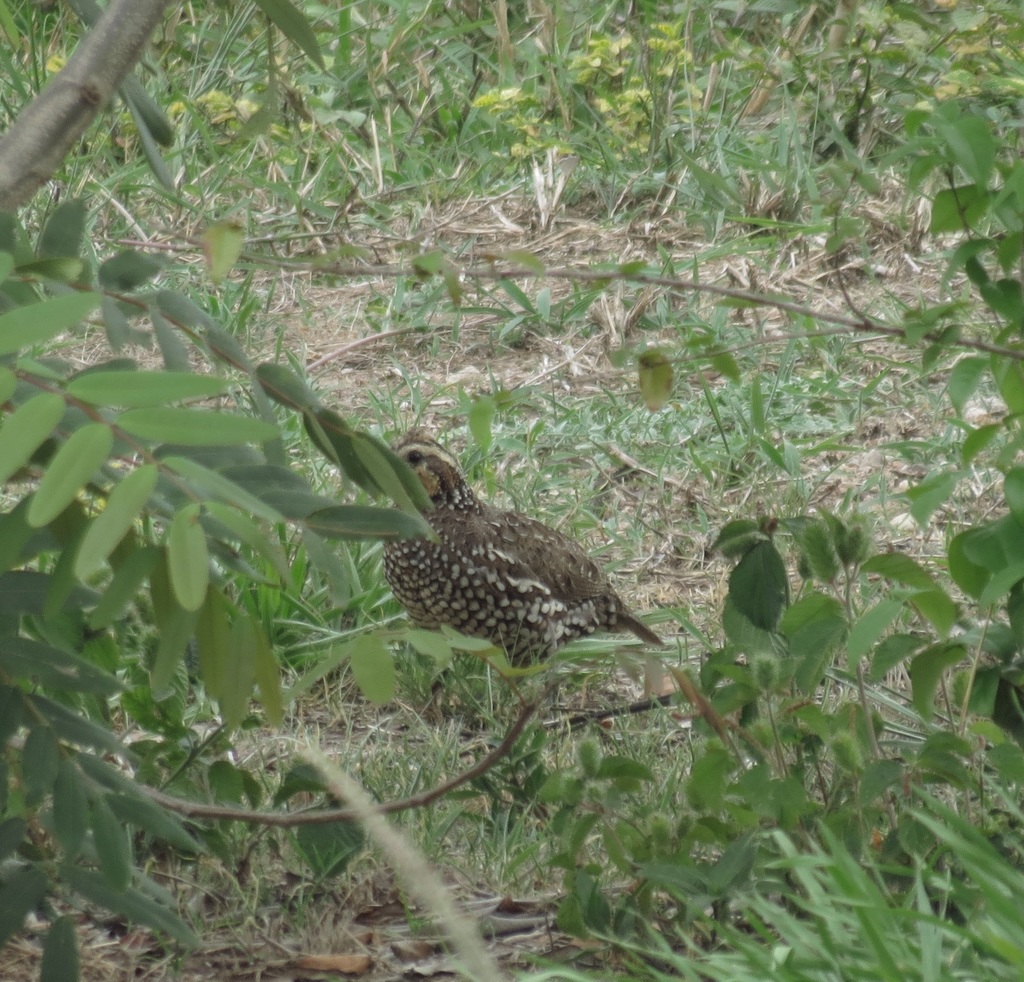
Spot-bellied Bobwhite
Photo © maryury
Photo © maryury — CC0 1.0 — Source: iNaturalist #80559851Identification
The spot-bellied bobwhite is a compact, ground-dwelling quail measuring 22–24 cm in length. Males are distinctly patterned with a brown back marked by black spotting on the nape, a white supercilium (eyebrow stripe), a dark line through the eye, and a short crest. The throat may be white or brown depending on subspecies. All males display the characteristic spotted lower belly that gives the species its name, while the rest of the underparts vary from pale to rufous-chested depending on the individual subspecies. Males average 140 g in weight. Females are noticeably duller, with a buff supercilium and mottled throat, and average 115 g.
The species is perhaps best identified by its distinctive call: a rising, scratchy song rendered as "bob-Wight!" or "bob-bob-White!"—a sound most often heard from males during spring and summer months. This vocalisation is often the first clue to a bird's presence in dense vegetation.
Range & Habitat
The spot-bellied bobwhite is found across Central America, occurring in El Salvador, Guatemala, Honduras, Nicaragua, and Costa Rica. Six recognised subspecies show geographic variation across this range, with the Costa Rican subspecies being the least similar to its close relative, the crested bobwhite.
This species favours open savanna with scattered bushes and trees, as well as other open woodland habitats. As the closely related crested bobwhite expands its range northward into Costa Rica, future range overlap between the two species is likely, though they remain distinct where they currently occur.
Behaviour & Diet
The spot-bellied bobwhite is a highly social bird outside the breeding season, forming groups called "coveys" typically comprising three to 15 individuals. During breeding, both males and females share incubation duties, though females usually incubate most nests. Each clutch consists of approximately 10 white eggs, and the chicks are precocial, leaving the nest within a few hours of hatching.
This shy species is primarily a seed-eater, though it supplements its diet with insects, particularly during the breeding season when protein demands increase. The birds are crepuscular, being most active during early morning and evening hours, making these periods the best times to encounter them in the field.
Best Time & Places to See It
Early morning and evening hours offer the best opportunities to locate spot-bellied bobwhites, as this is when they are most active. Spring and summer are particularly rewarding seasons for birdwatchers, as males are vocal during these months, making them easier to locate by their distinctive calls. Open savannas with scattered vegetation throughout El Salvador, Guatemala, Honduras, Nicaragua, and Costa Rica are your best bet for encounters.
Photography Tips
Patience and early starts are essential when photographing this shy species. Focus your efforts on open savanna habitats during dawn and dusk, when birds are most active and light conditions are favourable for photography. The male's striking head pattern and spotted underparts are diagnostic features worth capturing. Listen for the characteristic "bob-White!" call to locate birds, then approach slowly and quietly. Since coveys may scatter when disturbed, positioning yourself quietly near suitable habitat and waiting can yield better results than actively pursuing the birds.
Santa Rosa National Park
Santa Elena, Costa Rica
+359 birds+30 mammals
Where Pacific-facing slopes descend from volcanic uplands toward the Guanacaste lowlands, Santa Rosa National Park unfolds across a mosaic of tropical dry forest, gallery woodland, and…
VIEW NATIONAL PARKGuanacaste National Park
Santa Elena, Costa Rica
+461 birds+17 mammals
Where the Pacific slopes of northwestern Costa Rica rise toward the Continental Divide, dry tropical forest gives way to cloud-laden peaks and misty ridges—a landscape that…
VIEW NATIONAL PARKCarara National Park
Tárcoles, Costa Rica
+397 birds+19 mammals
Where the Pacific coastal plain meets transitional forest, Carara National Park straddles one of Central America's most dynamic ecological boundaries. The park's landscape encompasses lowland deciduous…
VIEW NATIONAL PARKPalo Verde National Park
Bagaces, Costa Rica
+318 birds+24 mammals
Dry forest spreads across Palo Verde's low-lying terrain in northwestern Guanacaste, where seasonal rivers and lagoons etch through deciduous woodland that sheds its canopy each winter.…
VIEW NATIONAL PARKRincón de la Vieja National Park
Liberia, Costa Rica
+451 birds+30 mammals
Where volcanic slopes rise abruptly from the Guanacaste lowlands, Rincón de la Vieja National Park sprawls across a landscape shaped by geothermal drama and seasonal extremes.…
VIEW NATIONAL PARKVolcán Tenorio National Park
Guatuso, Costa Rica
+480 birds+12 mammals
Where volcanic slopes rise through Costa Rica's northwestern borderlands, Volcán Tenorio National Park sprawls across terrain shaped by ancient lava flows and mineral-rich springs. The park's…
VIEW NATIONAL PARKMarino Las Baulas National Park
Santa Cruz, Costa Rica
+246 birds+9 mammals
Where the Pacific meets a mosaic of dry forest and mangrove estuary, this coastal national park protects one of Central America's most dynamic wildlife theatres. The…
VIEW NATIONAL PARKNo community photos yet. Log in to add the first one.
No community observations of this species yet.