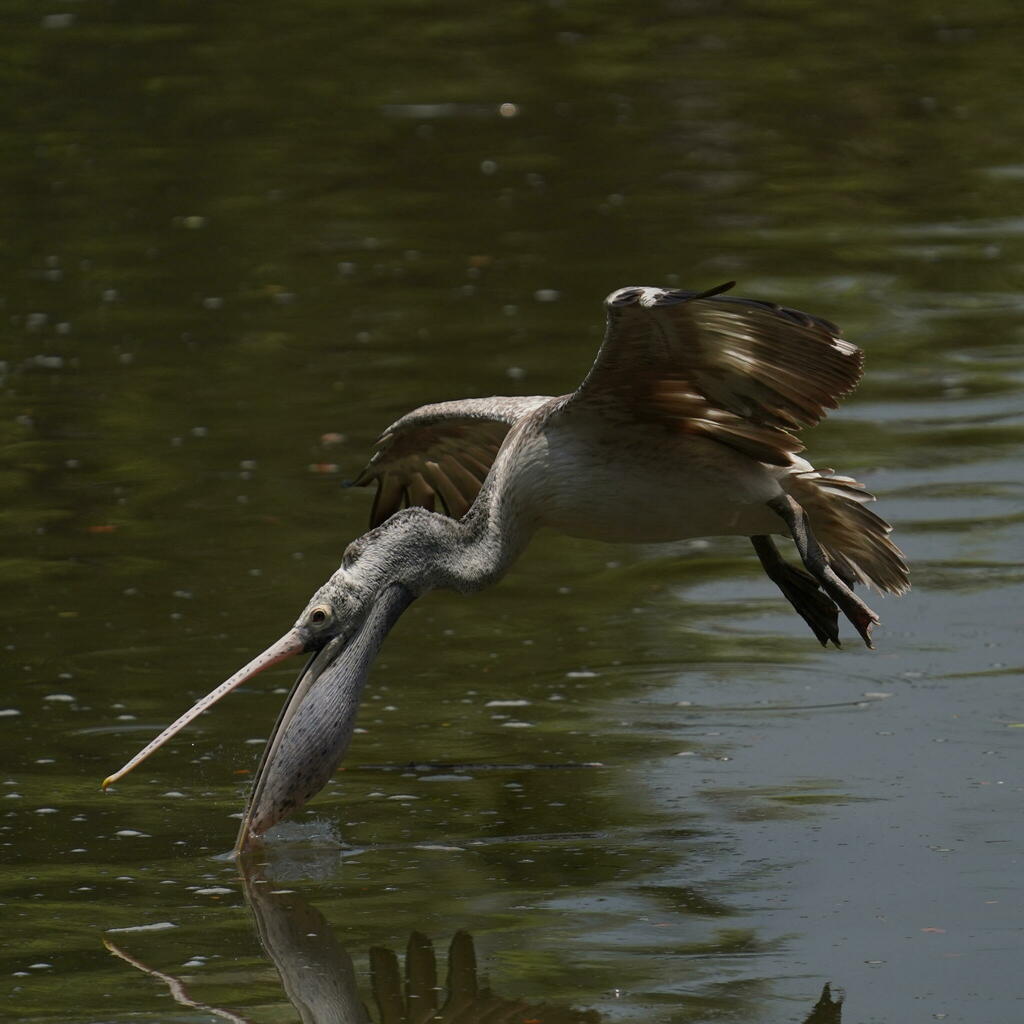
Spot-billed Pelican
Photo © Daniel S. Katz
Photo © Daniel S. Katz — CC BY 4.0 — Source: iNaturalist #164001356Identification
The spot-billed pelican is fairly small for a pelican, measuring 125–152 cm long with a wingspan of 213 to 250 cm. At a distance, it can be difficult to differentiate from other pelicans in the region, but close inspection reveals distinctive features: characteristic spots on the upper mandible, notably greyer plumage than relatives, and a general lack of bright colours. The bird is mainly white with a grey crest, hindneck, and brownish tail. The feathers on the hind neck are curly and form a greyish nape crest. Its large pouch is pink to purplish with pale spots, while the bill tip is yellow to orange. In breeding plumage, the skin at the base of the beak darkens and the orbital patch turns pink. Young birds lack the distinctive bill spots until after their first year, and do not acquire full adult breeding plumage until their third year.
Range & Habitat
The spot-billed pelican breeds in peninsular India, Sri Lanka, and Cambodia, with some Indian birds wintering in the Gangetic plains. The species is not migratory but makes local movements, becoming more widely distributed during the non-breeding season. It favours shallow lowland freshwaters and is a colonial breeder, often nesting in the company of other waterbirds. Nests are built on low trees near wetlands and sometimes near human habitations.
Historically abundant across much of southern Asia, the species has suffered significant declines. Populations in Southeast Asia, including parts of China and the Philippines, are now extinct or severely depleted. However, populations in southern India are thought to be rising, with increased protection enabling recovery. The species' conservation status was upgraded from vulnerable to near threatened in 2007.
Behaviour & Diet
These pelicans are generally silent birds, though they produce hisses, grunts, and bill-snaps at their nests. Like all pelicans, they catch fish using their enormous bill pouch while swimming at the surface. Unlike the great white pelican, they do not form large feeding flocks and typically fish singly or in small groups, though they may sometimes line up to drive fish towards shallow water. When flying to roosts or feeding areas, small groups move in formation with steady wing beats, and during the hottest part of the day they often soar on thermals.
Best Time & Places to See It
Peninsular India offers the most reliable opportunities for viewing spot-billed pelicans, particularly in areas with shallow freshwater lakes and wetlands where breeding colonies may be found near human settlements. Sri Lanka and Cambodia also host populations. The non-breeding season sees more widely dispersed birds, potentially increasing encounter chances beyond core breeding areas. Local knowledge of known breeding sites and wetlands will significantly improve your chances of observation.
Photography Tips
The spot-billed pelican's distinctive grey and white plumage, combined with its characteristic bill spots and crest, makes it a rewarding photographic subject. When photographing at colonies, approach carefully to avoid disturbing nesting birds. The pale coloration requires careful exposure metering to preserve detail in white feathers while maintaining contrast. Capture the birds in flight during their regular movements between roosts and feeding areas—their formation flying and thermal soaring behaviour provide dynamic compositional opportunities. Close-up shots of the head reveal the diagnostic spots on the upper mandible, pink pouch, and grey crest plumage that distinguish this species from congeners.
Lunugamvehera National Park
Sri Lanka
+204 birds+14 mammals
Dry scrubland and shallow wetlands converge in Sri Lanka's southeastern lowlands, where Lunugamvehera National Park anchors one of the island's most ecologically vital landscapes. The park's…
VIEW NATIONAL PARKMinneriya National Park
Sri Lanka
+158 birds+9 mammals
Across the dry zone of Sri Lanka's North Central Province spreads a landscape of shallow tanks, grassland margins, and scattered dry forest—a mosaic of water and…
VIEW NATIONAL PARKWasgamuwa National Park
Sri Lanka
+156 birds+8 mammals
Dry deciduous forest and open grassland sweep across the North Central lowlands where Wasgamuwa National Park protects one of Sri Lanka's largest remaining tracts of this…
VIEW NATIONAL PARKAngamedilla National Park
Polonnaruwa, Sri Lanka
+40 birds+2 mammals
Ancient tanks and sal forests define this water-rich sanctuary in Sri Lanka's North Central heartland, where seasonal wetlands and dry deciduous woodland create a mosaic of…
VIEW NATIONAL PARKMaduru Oya National Park
Sri Lanka
+74 birds+1 mammals
Granite ridges rise abruptly from the humid lowlands of Sri Lanka's Uva Province, their weathered slopes clothed in dry monsoon forest and scattered woodland where deciduous…
VIEW NATIONAL PARKOrang National Park
Rangagarapathar, India
+298 birds+1 mammals
Where the Brahmaputra's floodplains meet the foothills of Assam, Orang National Park unfolds across a mosaic of riverine grasslands, forests and wetlands that pulse with the…
VIEW NATIONAL PARKKhao Yai National Park
Prachantakham District, Thailand
+377 birds+46 mammals
Evergreen dipterocarp forest blankets the rolling terrain of this national park in eastern Thailand, where limestone hills rise abruptly from the forest floor and seasonal streams…
VIEW NATIONAL PARKKaziranga National Park
Kohora, India
+422 birds+26 mammals
Dawn breaks over the floodplains of the Brahmaputra, where tall grasslands stretch endlessly beneath monsoon-heavy skies. This sprawling wilderness of northeastern Assam is a mosaic of…
VIEW NATIONAL PARKBandipur National Park
Hirehalli, India
+302 birds+19 mammals
Where the Western Ghats descend into the Deccan plateau, ancient deciduous forests blanket a landscape carved by the Nugu River. Bandipur unfolds across 880 square kilometres…
VIEW NATIONAL PARKNagarahole Tiger Reserve
Nalkeri Forest, India
+323 birds+23 mammals
Where granite escarpments rise above dense deciduous forests and the Kabini River carves through pristine wilderness, one of India's most biodiverse landscapes unfolds across the Western…
VIEW NATIONAL PARKNo community photos yet. Log in to add the first one.
No community observations of this species yet.