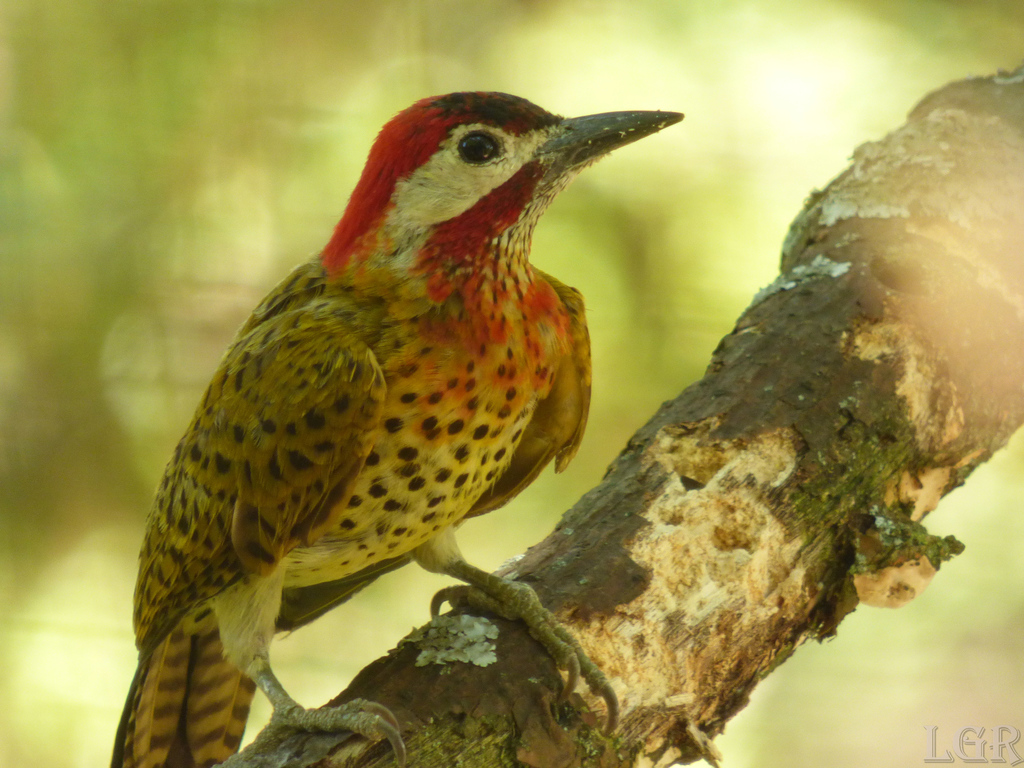
Spot-breasted Woodpecker
Photo © Luis G Restrepo
Photo © Luis G Restrepo — CC BY 4.0 — Source: iNaturalist photo #12624160Identification
The Spot-breasted Woodpecker is a small woodpecker, measuring 18 to 21 cm in length and weighing 50 to 79 grams. Sexual dimorphism is evident primarily on the head: males display a black forehead and forecrown with a red hindcrown and nape, while females show red only on the very back of the crown. Both sexes share distinctive bronze-green upperparts with brownish-black barring, and their most characteristic feature—small black spots on the chin, throat, upper breast, lower breast, flanks, and undertail coverts. The underparts are dull olive-yellow with a reddish tinge on the upper breast. The bill is blackish, the iris rufous-brown, and the legs greenish-gray. Subspecific variation is notable; for example, C. p. striatigularis has a very white throat with few black streaks and heavier spotting below, while C. p. ujhelyii exhibits much red to orange on the breast with less barring above.
Range & Habitat
The Spot-breasted Woodpecker is found in Panama and every mainland South American country except Argentina, Chile, Paraguay, and Uruguay. Different subspecies occupy distinct regions: eastern Panama and northern Colombia; west-central and eastern Colombia; northwestern and eastern Venezuela; the Guianas and northern Brazil; and the Amazon Basin across Ecuador, Peru, Bolivia, and Brazil.
This species shows a strong preference for humid lowland habitats, inhabiting rainforest, deciduous and gallery forest, várzea, mangroves, llanos, and palm savanna. It also frequents palm, shade coffee, and other treed plantations, preferring sparse woodlands to dense forest. Elevation ranges from sea level to 600 m in Venezuela, 1,500 m in Colombia, up to 1,600 m locally in Ecuador, and 900 m in Peru.
Behaviour & Diet
The Spot-breasted Woodpecker is a year-round resident throughout its range. It feeds almost exclusively on ants, their larvae, and pupae, foraging in pairs or family groups at any height from the ground to the forest's mid-level. Rather than the typical woodpecker's drilling behavior, this species relies on gleaning and probing to capture food, and often sweeps aside litter while foraging on the ground.
Breeding seasons vary geographically: October to May in Colombia, June to August in the Guianas, February to September in Peru, and April to October in much of the Amazon Basin. Both sexes excavate nest cavities in living or dead trees, and occasionally in fence posts. The species possesses a large vocal repertoire including high-pitched nasal calls, alarm peeks, courting whistles, display calls, and soft intimate contact notes.
Best Time & Places to See It
Year-round residency throughout its range makes the Spot-breasted Woodpecker accessible any season, though specific breeding seasons noted above may increase activity and vocalizations. The species is most readily encountered in open woodlands and forest edges rather than dense forest interiors. Look for it in várzea forests, gallery forests along waterways, and plantations with scattered trees. Its preference for foraging in pairs and family groups makes detection easier, particularly by listening for its distinctive vocal repertoire. The species is found at elevations accessible to most birdwatchers, typically below 1,500 m in most of its range.
Photography Tips
The Spot-breasted Woodpecker's small size and preference for mid-level foraging present both challenges and opportunities for photographers. Its habit of gleaning and probing on trunks and branches rather than drilling means it often remains more stationary than other woodpeckers, allowing longer observation and shooting opportunities. The distinctive spotted breast pattern and the sexual dimorphism of head coloring are key identification features worth capturing. Ground foraging behavior provides opportunities for different angles and lighting. Early morning hours typically yield the most vocal activity, making it easier to locate birds before attempting photography. The species' year-round presence means lighting conditions vary by season; in lowland tropical habitats, diffused morning or late afternoon light often provides the most flattering illumination for capturing plumage details.
Guided Birding Tour
Yasuní National Park
Aguarico, Ecuador
+601 birds+43 mammals
Where the western Amazon basin converges with Ecuador's Orellana Province, lowland rainforest reaches toward the horizon in an unbroken canopy of staggering botanical density. Yasuní National…
VIEW NATIONAL PARKSumaco Napo-Galeras National Park
Loreto, Ecuador
+563 birds+4 mammals
Where Ecuador's Amazon transitions into cloud forest, a massive shield volcano rises from the emerald lowlands of Orellana Province, anchoring one of the continent's most biodiverse…
VIEW NATIONAL PARKNatural Sierra de Chiribiquete National Park
Solano, Colombia
+359 birds+27 mammals
Massive table-top mountains rise abruptly from the lowland rainforest of southeastern Colombia, their sheer sandstone cliffs and isolated summits creating some of the most dramatic topography…
VIEW NATIONAL PARKNatural Utría National Park
Alto Baudó (Pie de Pató), Colombia
+372 birds+11 mammals
Where the Chocó's coastal mountains plunge toward the Pacific, Utría National Park preserves one of Colombia's most biodiverse and least-visited wilderness expanses. Sprawling across 1,287 square…
VIEW NATIONAL PARKNatural Serranía de los Yariguíes National Park
El Carmen de Chucurí, Colombia
+320 birds+3 mammals
Where the northern cordilleras of Colombia rise toward cloud forest, the Serranía de los Yariguíes unfolds across nearly 1,820 square kilometers of some of the most…
VIEW NATIONAL PARKNatural Farallones de Cali National Park
Buenaventura, Colombia
+733 birds+27 mammals
Where the Pacific coastal plain meets the western slopes of the Andes, Farallones de Cali National Park sprawls across nearly 3,500 square kilometers of dramatic topography…
VIEW NATIONAL PARKMorrocoy National Park
Municipio Silva
+290 birds
Where the Caribbean coast of northwestern Venezuela meets protected coastal waters, a mosaic of mangrove forests, sandy beaches, and coral reef systems defines Morrocoy National Park.…
VIEW NATIONAL PARKEl Tamá National Park
Toledo, Colombia
+435 birds
Where the Andes descend toward the Caribbean coastal lowlands of northern Colombia, El Tamá National Park sprawls across nearly 3,800 square kilometres of montane forest, cloud…
VIEW NATIONAL PARKNatural Sierra de la Macarena National Park
Vista Hermosa, Colombia
+566 birds+15 mammals
Across nearly 20,000 square kilometres of Colombia's Meta Department, the terrain rises from lowland savanna into Andean foothills through a mosaic of gallery forests, palm-fringed wetlands,…
VIEW NATIONAL PARKAmacayacu National Park
Leticia, Colombia
+567 birds+25 mammals
Where the Rio Amazonas curves through the tri-border region where Colombia, Peru, and Brazil converge, Amacayacu National Park sprawls across more than 5,250 square kilometres of…
VIEW NATIONAL PARKViruá National Park
Brazil
+389 birds+6 mammals
Across the northern frontier of Roraima, where the forest canopy rises from ancient Amazonian lowlands, Viruá National Park protects nearly 3,700 square kilometres of terra firme…
VIEW NATIONAL PARKJaú National Park
Brazil
+354 birds+3 mammals
Vast floodplain forests and blackwater rivers define this remote corner of western Amazonas, where the Rio Negro and its tributaries have carved an intricate mosaic of…
VIEW NATIONAL PARKAnavilhanas National Park
Brazil
+468 birds+8 mammals
Across the Rio Negro in central Amazonas, an archipelago of over a thousand islands rises from the world's largest rainforest river system, creating a labyrinth of…
VIEW NATIONAL PARKSerra do Divisor National Park
Brazil
+448 birds+10 mammals
Where the western Amazon meets the Andes foothills, Serra do Divisor National Park sprawls across one of South America's most biodiverse and least accessible frontiers. Spanning…
VIEW NATIONAL PARKManu National Park
Manu, Peru
+892 birds+26 mammals
Across the eastern slopes of the Peruvian Andes, tropical rainforest descends into the Amazon basin with a complexity that few terrestrial ecosystems match. Manu National Park…
VIEW NATIONAL PARKSierra del Divisor National Park
Alto Tapiche, Peru
+298 birds+2 mammals
Where the western Amazon meets the Andes foothills, nearly 41,000 square kilometres of pristine rainforest rise across Peru's Alto Tapiche region in a landscape of extraordinary…
VIEW NATIONAL PARKBahuaja Sonene National Park
San Pedro de Putina Punco, Peru
+602 birds+8 mammals
Where the Madre de Dios and Heath rivers converge in southeastern Peru rises one of South America's most biodiverse wilderness regions: a vast protected realm of…
VIEW NATIONAL PARKIchigkat Muja – Cordillera del Cóndor National Park
Río Santiago, Peru
+101 birds
Where the Andes descend into the western Amazon, the Río Santiago carves through a landscape of profound biological complexity. Ichigkat Muja – Cordillera del Cóndor National…
VIEW NATIONAL PARKTingo Maria National Park
Mariano Dámaso Beraún, Peru
+423 birds
Where the eastern slopes of the Peruvian Andes descend toward the Amazon basin, the landscape fractures into a maze of limestone ridges, humid gorges, and cloud-wrapped…
VIEW NATIONAL PARKDarién National Park
Tucutí, Panama
+534 birds+13 mammals
Where the spine of Central America crumbles into wetland and rainforest, Darién National Park sprawls across more than 20,000 square kilometres of some of the tropics'…
VIEW NATIONAL PARKNo community photos yet. Log in to add the first one.
No community observations of this species yet.