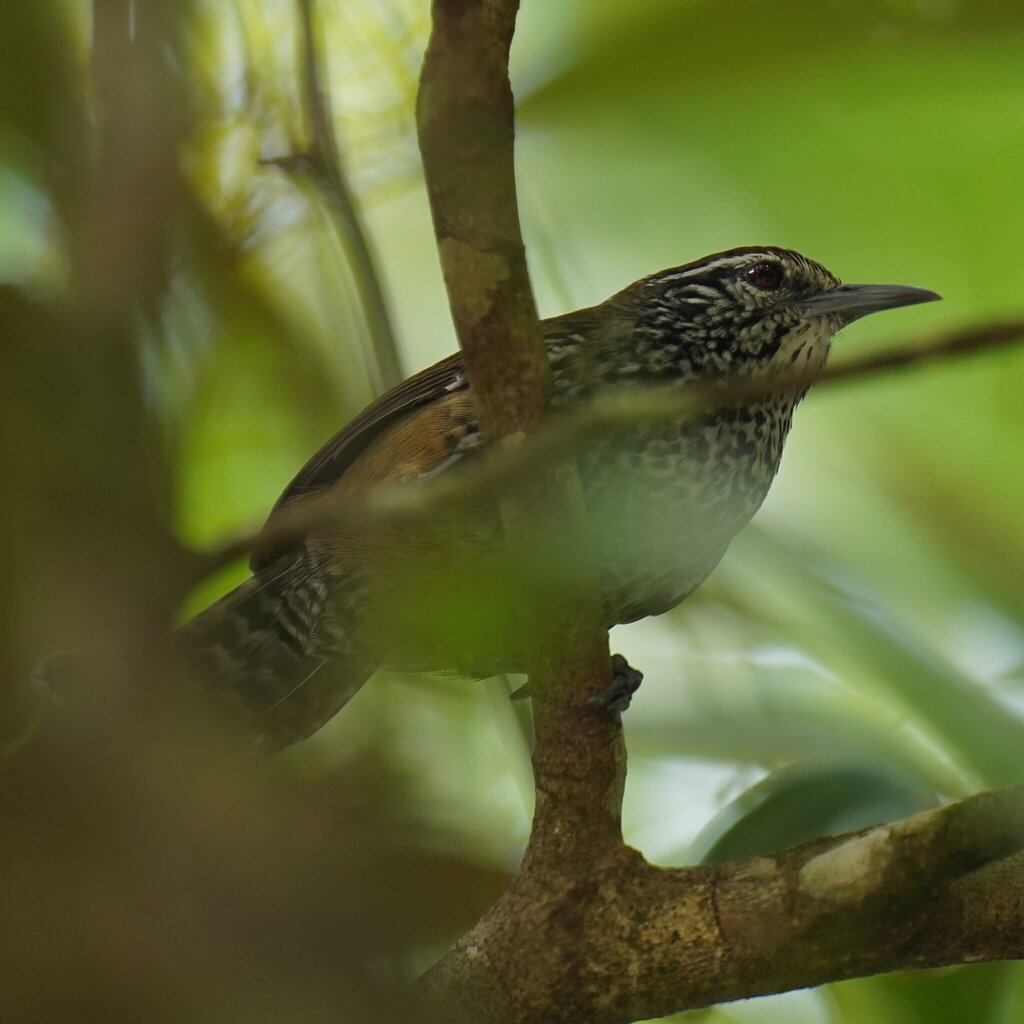
Spot-breasted Wren
Photo © Daniel S. Katz
Photo © Daniel S. Katz — CC BY 4.0 — Source: iNaturalist #329368972Identification
The spot-breasted wren is a small wren, measuring 12.5 to 14 cm in length. Adults of the nominate subspecies display a distinctive reddish-brown crown and upperparts, with a more chestnut rump. The tail is dull brown with narrow dark barring. A white supercilium (eyebrow stripe) contrasts with streaked black-and-white facial markings. The key field mark is the pale gray throat, chest, and belly center adorned with black spots, while the flanks and lower belly are orange-buff and spotless. Subspecies vary in plumage intensity: some are less reddish with smaller breast spots, others are paler with buffy-cinnamon crowns, and some are noticeably larger and darker overall. Juveniles are paler with less extensive and dimmer markings.
Range & Habitat
The spot-breasted wren is found from northeastern Mexico south through Central America, occurring in Belize, Costa Rica, El Salvador, Guatemala, Honduras, Mexico, and Nicaragua. Different subspecies occupy distinct regions across this range. The species is highly adaptable, inhabiting humid coastal forests, dry forests (whether intact, disturbed, or regenerating), and agricultural areas including cocoa and citrus plantations. Elevational range extends from sea level to 1,300 m in Mexico and Honduras, though in Costa Rica it is restricted to below 200 m.
Behaviour & Diet
Spot-breasted wrens forage in pairs or family groups at low levels within dense vegetation. While their diet is not comprehensively documented, it is presumed to consist primarily of invertebrates. The breeding season varies by latitude. Nests are distinctive dome-shaped structures with a side entrance, typically positioned in tree crotches or within ferns up to 6 m above ground. Clutches contain three to four eggs, and both parents feed the young. The species produces a cheerful song of clear whistling gurgles, delivered by both males and females.
Best Time & Places to See It
The spot-breasted wren's wide habitat tolerance and stable population of at least 500,000 individuals make it reasonably accessible throughout its range, particularly in lowland and foothill forests of Guatemala, Honduras, Nicaragua, and Belize. The species' preference for dense undergrowth means observers should focus on thicketed areas and forest edges. Early morning hours typically offer the best viewing opportunities, when birds are most vocal and active. The species occurs year-round throughout its range, though breeding phenology varies geographically.
Photography Tips
The spot-breasted wren's small size, low-level foraging behaviour, and preference for dense vegetation present considerable photographic challenges. A telephoto lens of at least 400mm is recommended to fill the frame while maintaining safe distance from the bird. Early morning light works best for capturing the reddish-brown tones of the crown and upperparts. Patience and positioning near known feeding areas in understory vegetation increases encounter probability. The bird's habit of moving in pairs or small groups offers opportunities for behavioral shots, particularly when family groups are together. Focus on the distinctive spotted breast pattern as a key identification feature in your images.
Guanacaste National Park
Santa Elena, Costa Rica
+461 birds+17 mammals
Where the Pacific slopes of northwestern Costa Rica rise toward the Continental Divide, dry tropical forest gives way to cloud-laden peaks and misty ridges—a landscape that…
VIEW NATIONAL PARKDzibilchantún National Park
Barcelona, Mexico
+144 birds+2 mammals
Across the limestone plains of Yucatán, where cenotes pierce the bedrock and tropical forest clings to shallow soils, lies Dzibilchantún—a modest yet ecologically vital national park…
VIEW NATIONAL PARKLagunas de Montebello National Park
Laguna de Montebello, Mexico
+360 birds+2 mammals
Where turquoise lagoons pierce the limestone plateau of southeastern Chiapas, the Lagunas de Montebello National Park unfolds across roughly 174 square kilometers of spectral water and…
VIEW NATIONAL PARKSian Ka’an
Chunyaxché, Mexico
+350 birds+16 mammals
Where the Yucatán Peninsula dissolves into wetland and mangrove, a vast mosaic of forest, lagoon, and coastal margin creates one of Mexico's most biodiverse strongholds. Across…
VIEW BIOSPHERE RESERVESierra de Tamaulipas
El Porvenir, Mexico
+98 birds+19 mammals
Where limestone peaks thrust skyward through dense subtropical forest, Mexico's northeastern frontier reveals one of the continent's most biodiverse mountain ranges. Canyons carved by perennial rivers…
VIEW NATURE RESERVEMontes Azules
Candelaria, Mexico
+395 birds+47 mammals
Where jungle-clad limestone plateaus plunge into canyon systems carved by the Usumacinta River, Mexico's most pristine rainforest reserve unfolds across the Lacandón region of Chiapas. Montes…
VIEW BIOSPHERE RESERVETikal National Park
Tikal, Guatemala
+399 birds+16 mammals
Dense rainforest canopy rises above the limestone plateau of Petén, where archaeological wonder and ecological richness merge seamlessly across one of Central America's most biodiverse landscapes.…
VIEW NATIONAL PARKLaguna del Tigre National Park
Petén, Guatemala
+399 birds+29 mammals
Where the Petén lowlands dissolve into wetland and forest, Laguna del Tigre National Park protects one of Guatemala's most ecologically vital landscapes. This sprawling reserve encompasses…
VIEW NATIONAL PARKSierra del Lacandón National Park
Petén, Guatemala
+348 birds+7 mammals
Where the Petén rainforest rises into limestone ridges and deep ravines, Sierra del Lacandón National Park protects one of Central America's most intact tropical wilderness zones.…
VIEW NATIONAL PARKCaño Negro National Wildlife Refuge
Caño Negro District, Costa Rica
+486 birds+16 mammals
Where the San Juan River's seasonal floodplain opens into expansive wetlands, Caño Negro Wildlife Sanctuary sprawls across one of Central America's most productive freshwater ecosystems. This…
VIEW WILDLIFE SANCTUARYNo community photos yet. Log in to add the first one.
No community observations of this species yet.