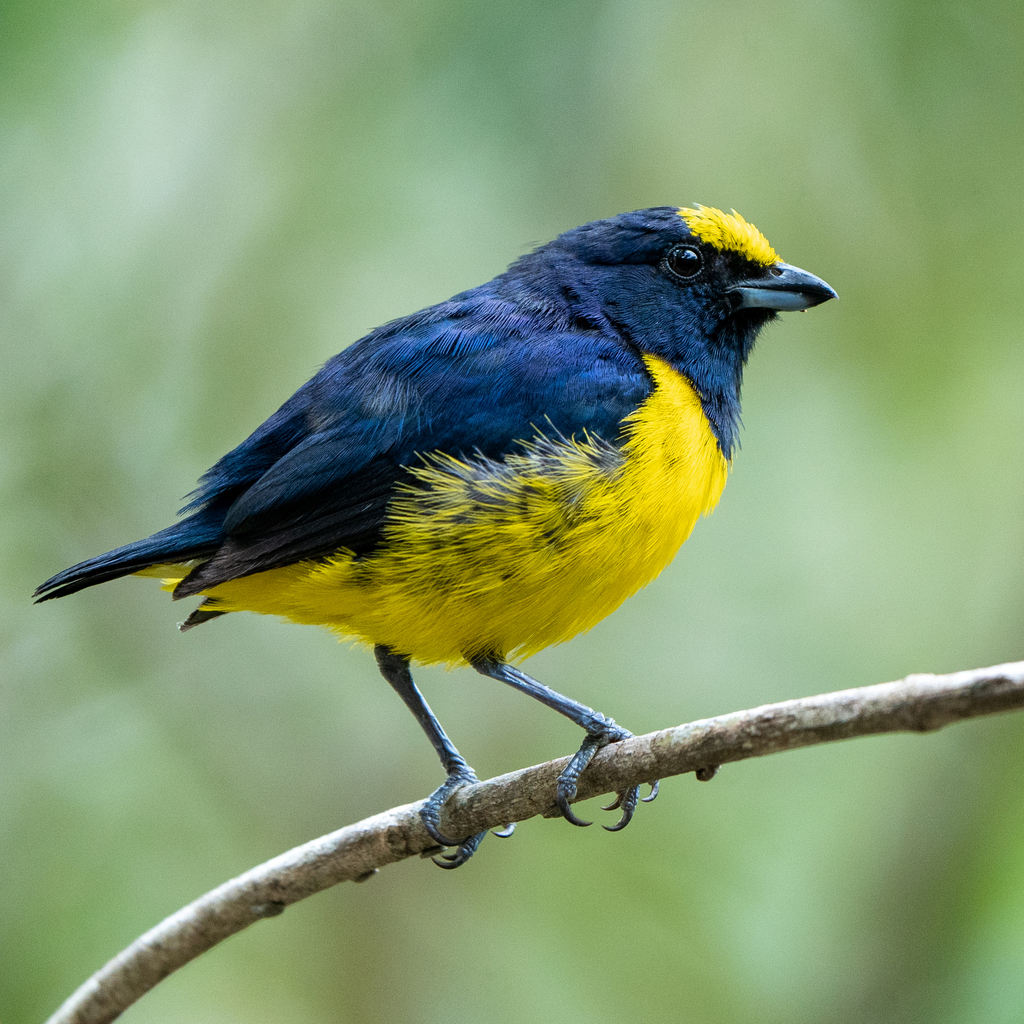
Spot-crowned Euphonia
Photo © Anthony Batista
Photo © Anthony Batista — CC BY 4.0 — Source: iNaturalist #169718949Identification
The spot-crowned euphonia is a tiny bird, measuring just 10 cm (3.9 in) long and weighing approximately 14 g (0.49 oz). Both males and females sport the species' characteristic stubby bill, dark brown iris, and blackish bill with a pale blue-gray base to the mandible. Sexual dimorphism is pronounced: adult males display a bright yellow forehead speckled with black, extending to the rear of the eye, while their crown, face, nape, throat, chest, and upperparts are steely blue-black. Their wings show dusky flight feathers with blue-black tinges and white bases on the inner webs, and their underparts from the lower breast downward are bright yellow. Females are distinctly different, with a rufous-chestnut forehead and dark olive-green crown and nape with a grayish-blue tinge. Their lower back and tail are yellowish olive-green, their wings dusky with wide yellowish-olive edges, and their underparts combine tawny-rufous on the lower breast and belly with olive-yellow on the rest.
Range & Habitat
Found exclusively on the Pacific slope from central Costa Rica (Puntarenas and San José provinces) south through Panama's Chiriquí Province, the spot-crowned euphonia inhabits the interior, edges, and clearings of evergreen and mature secondary forests in tropical and lower subtropical zones. The species occurs from lowlands up to approximately 1,350–1,400 m (4,400–4,600 ft) elevation. It is considered uncommon in Costa Rica and occurs in a few protected areas, though much native forest within its range has been destroyed, leaving populations fragmented.
Behaviour & Diet
A year-round resident throughout its range, the spot-crowned euphonia primarily feeds on small fruits, supplementing its diet with larger fruits, nectar, and insects. It forages mostly singly or in pairs, though it regularly joins mixed-species feeding flocks, typically working from the mid-canopy to the canopy level. The species is vocal, producing rolling, buzzy utterances that vary from clear sweet warbles to chaffy, wheezy sounds. Males deliver songs consisting of repeated notes or phrases (typically 5–8 repetitions) before abruptly shifting to another series, with song bouts lasting up to 30 minutes. Breeding occurs between March and June in Costa Rica, with pairs often attempting two broods. Both sexes construct an enclosed dome nest made from moss, rootlets, and ferns, usually placed 2–7.5 m (7–25 ft) high in a clump of epiphytes. Clutches typically contain two eggs, occasionally three, which are white or pinkish-white with sparse brown markings. The female incubates alone for approximately 18 days.
Best Time & Places to See It
Travellers seeking the spot-crowned euphonia should focus on protected forest areas in central and southern Costa Rica and western Panama during the breeding season (March to June), when birds are most vocal and active. The species' preference for mid-canopy and canopy foraging means patience and attention to mixed feeding flocks will increase sighting chances. Early morning hours, when euphonias are most vocal, offer the best opportunities to locate this uncommon resident.
Photography Tips
The dramatic sexual dimorphism of the spot-crowned euphonia—with males' brilliant yellow and steely blue-black plumage contrasting sharply against females' subtle olive and rufous tones—makes it an exciting photography subject. Photograph males in bright light to capture the glossy sheen of their blue-black upperparts and the vibrant yellow forehead patch. The bird's small size and canopy preference require patience; position yourself in clearings or near known feeding trees where mixed flocks congregate. Early morning light is ideal for rendering the males' iridescent plumage, while the bird's active foraging behaviour provides frequent opportunities for dynamic, natural poses.
Corcovado National Park
Puerto Jiménez, Costa Rica
+444 birds+48 mammals
Where the Osa Peninsula juts into the Pacific, rainforest descends almost to the tide line, and Corcovado National Park protects one of Central America's most intact…
VIEW NATIONAL PARKManuel Antonio National Park
Quepos, Costa Rica
+426 birds+22 mammals
Where tropical rainforest descends steeply to a rocky Pacific coastline, Manuel Antonio National Park distills Central American biodiversity into one of Costa Rica's most compressed and…
VIEW NATIONAL PARKChirripó National Park
Rivas, Costa Rica
+274 birds+6 mammals
Where the volcanic spine of Costa Rica's Central Cordillera reaches its apex, Chirripó National Park encompasses a landscape that shifts dramatically with elevation, from montane cloud…
VIEW NATIONAL PARKPiedras Blancas National Park
Golfito, Costa Rica
+386 birds+24 mammals
Where the Golfo Dulce meets the southwestern Pacific coast of Costa Rica, Piedras Blancas National Park protects a dramatic transition zone where lowland rainforest descends toward…
VIEW NATIONAL PARKCarara National Park
Tárcoles, Costa Rica
+397 birds+19 mammals
Where the Pacific coastal plain meets transitional forest, Carara National Park straddles one of Central America's most dynamic ecological boundaries. The park's landscape encompasses lowland deciduous…
VIEW NATIONAL PARKLa Amistad International Park
Crorina, Costa Rica
+532 birds+20 mammals
Where the Caribbean slopes of Costa Rica's Talamanca Mountains rise steeply inland from Limón, the boundary between two nations dissolves into an unbroken expanse of rainforest.…
VIEW NATIONAL PARKMarino Ballena National Park
Bahía Ballena, Costa Rica
+336 birds+8 mammals
Where mangrove forests meet coral-fringed shorelines along Costa Rica's southern Pacific coast, Marino Ballena National Park encompasses a marine and terrestrial mosaic that ranks among Central…
VIEW NATIONAL PARKNo community photos yet. Log in to add the first one.
No community observations of this species yet.