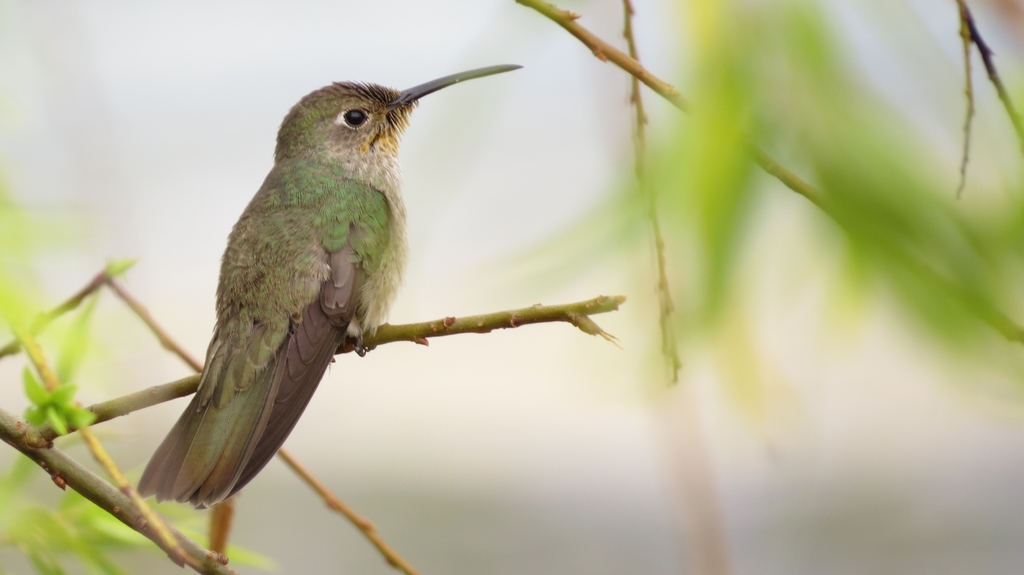
Spot-throated Hummingbird
Photo © Manuel Roncal
Photo © Manuel Roncal — CC0 1.0 — Source: iNaturalist photo #127931229Identification
The spot-throated hummingbird is a small emerald hummingbird measuring 11.5 to 12.5 cm in length and weighing approximately 6 to 7 grams. Males and females are essentially alike in plumage, making this species monotypic with no recognizable subspecies. The most distinctive features include a somewhat curved black bill, though the mandible may occasionally show gray-brown or yellow coloration with a black tip.
The bird's upperparts display grayish-green to bronze-green tones, with a bronze crown and uppertail coverts. The tail feathers transition from grayish-green on the inner feathers to grayish on the outer feathers, which are marked with a bronze band near the end. The underparts are characterized by drab gray coloring with golden-green speckles adorning the chin, throat, and flanks. The undertail coverts feature pale brown centers with whitish edges, providing useful diagnostic marks for field identification.
Range & Habitat
The spot-throated hummingbird is endemic to Peru, where it occurs on the western slope of the Andes and throughout the Marañon River valley, ranging from near the Ecuadorean border southward to Ancash Department. Unconfirmed sightings in far southern Ecuador exist, but the species is officially listed as hypothetical in that country by the South American Classification Committee of the American Ornithological Society.
This species favors arid scrublands and the edges of deciduous forest. On the Andean slopes, it predominantly occurs between 900 and 1,900 meters in elevation, though it has been found locally as low as 200 meters. In the Marañon valley, the species ranges across a broader elevation band between 350 and 2,800 meters, demonstrating its adaptability to varying conditions within its Peruvian range.
Behaviour & Diet
The spot-throated hummingbird forages for nectar from the understory to mid-story vegetation. Known flowering plants include Inga trees, Agave, and banana plants, though detailed information about preferred food sources remains limited. Beyond nectar, the species supplements its diet by catching small arthropods in flight, a behavior common to many hummingbirds.
Breeding in this species occurs at least between November and January, based on photographic and specimen evidence. The nest is a delicate cup constructed from plant fibers, seeds, and thin twigs, lined with plant down and other soft plant material, often adorned externally with lichens. Females typically lay single eggs, though nests with two eggs have been documented. The incubation period and fledging duration remain undescribed. The spot-throated hummingbird produces a complex song of chips and wheezing electric warbles, along with dry chatters and tip notes. Migration patterns, if any, have not been documented.
Best Time & Places to See It
The spot-throated hummingbird is considered fairly common throughout its Peruvian range and is classified as Least Concern by the IUCN. Evidence suggests its population remains stable with no identified immediate threats. The species is best sought in its preferred arid scrubland and deciduous forest-edge habitats along the western Andean slopes and Marañon valley.
The breeding season spans at least November through January, making these months potentially productive for observing nesting behavior and family groups. However, the species' movements throughout the year have not been documented, so it may be present year-round or exhibit undocumented seasonal patterns. Human activity has little documented effect on the species in the short term, and it remains relatively accessible within protected and unprotected areas of its Peruvian range.
Photography Tips
Photographers should focus on the spot-throated hummingbird's distinctive features: the bronze crown contrasting with grayish-green upperparts, and the characteristic golden-green speckles on the throat and chin. The subtle coloration requires careful lighting to reveal these details; side-lighting or backlighting often enhances the metallic green tones that characterize emerald hummingbirds.
Position yourself in arid scrubland and forest-edge habitats where flowering plants like Inga and Agave provide natural perching and feeding opportunities. The bird's small size and foraging behavior in mid-story vegetation demand fast shutter speeds and patient waiting. Early morning or late afternoon light will best showcase the bronze and green iridescence in the bird's plumage. Listen for the complex warbling song and dry chatters to locate birds actively singing from exposed perches.
No community photos yet. Log in to add the first one.
No community observations of this species yet.