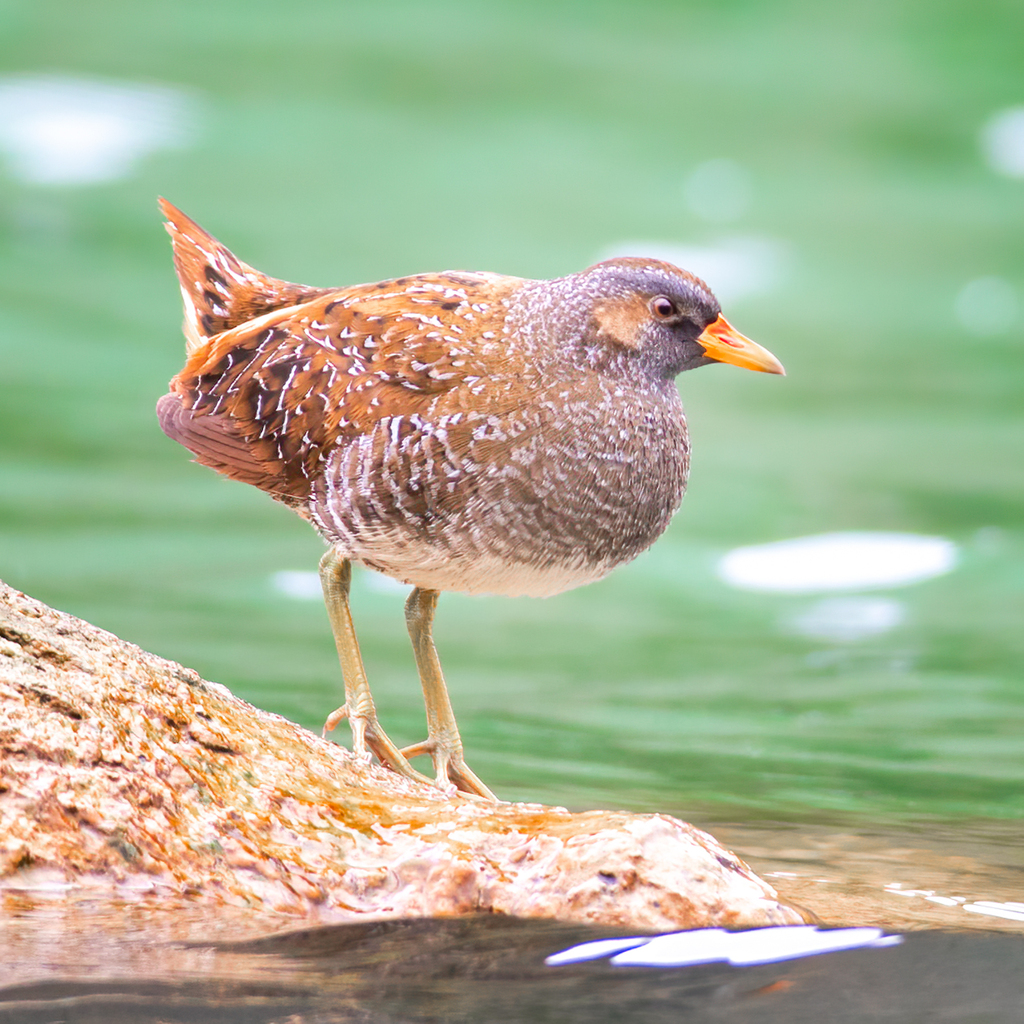
Spotted Crake
Photo © egorbirder
Photo © egorbirder — CC BY 4.0 — Source: iNaturalist photo #335319926Identification
The spotted crake is a small, compact waterbird measuring 19–22.5 cm (7.5–8.9 in) in length, making it slightly smaller than its relative the water rail. Adults are readily identified by their distinctive plumage: mainly brown upperparts contrasted with a blue-grey breast, dark barring and white spots on the flanks, and a short buff-coloured tail underneath. The short, straight bill is yellow with a red base—a key field mark that separates this species from similar rails. Their green legs are notably long relative to their body size.
Immature spotted crakes lack the striking blue-grey breast of adults, showing brown colouration in its place, though they retain the characteristic spotted flanks. Downy chicks are uniformly black, as with all rails. The sora, a rare North American vagrant, is a potential confusion species, but can be distinguished by its lack of breast spotting and unstreaked crown stripe.
Range & Habitat
The spotted crake breeds across temperate Europe and into western Asia, where it favours marshes and sedge beds as its breeding habitat. This is a migratory species, abandoning its breeding grounds to winter in Africa and Pakistan. The species is covered by the Agreement on the Conservation of African-Eurasian Migratory Waterbirds (AEWA), reflecting its importance as a transnational migratory species.
Breeding birds nest in dry locations within marsh vegetation, where females lay clutches of 6–15 eggs. The Western European population has experienced significant decline in recent decades, and the species is now a very rare breeding bird in Great Britain.
Behaviour & Diet
The spotted crake is an exceptionally secretive bird during the breeding season, making visual observation challenging. Instead, these birds are often identified by their distinctive calls—they are notably noisy during breeding, producing a characteristic repetitive whiplash-like "hwuit, hwuit" call that carries across marshland habitats.
Spotted crakes feed by probing with their bill in mud and shallow water, and also picking up food by sight. Their diet consists mainly of insects and aquatic animals, which they obtain from the wetland environments they inhabit.
Best Time & Places to See It
Although spotted crakes are very secretive during the breeding season and are mostly heard rather than seen, they become considerably easier to observe during migration periods. Travellers visiting temperate European marshes and sedge beds during migration seasons will have better opportunities for sightings than during the breeding season itself. However, patience and early morning visits to suitable wetland habitats will reward dedicated birdwatchers with views of this elusive species.
Photography Tips
Photographing spotted crakes presents a genuine challenge due to their secretive nature and preference for dense marsh vegetation. Photographers should focus their efforts during migration periods when birds are more mobile and less tied to hidden breeding territories. Early morning light in wetland habitats offers the best opportunities for capturing images as birds forage in shallow water and mud. A telephoto lens will be essential given the bird's wariness and tendency to remain partially concealed in vegetation. Listen for their distinctive call to locate birds, and position yourself downwind to avoid alarming them.
S’Albufera Natural Park
Platja de Muro, Spain
+253 birds+6 mammals
Where Mediterranean lagoons meet the Balearic coast, S'Albufera stretches across nearly 1,600 hectares of wetland and dune systems that rank among Europe's most ecologically vital shallow-water…
VIEW NATURAL PARKMarjal Pego-Oliva Natural Park
Molinell, Spain
+219 birds+2 mammals
Where the Valencian littoral flattens into wetland and reed-bed, Marjal Pego-Oliva straddles the boundary between the Mediterranean and its inland margins, a mosaic of shallow lagoons,…
VIEW NATURAL PARKL’Albufera Natural Park
València, Spain
+321 birds+18 mammals
Where shallow lagoons meet Mediterranean coastal marshland, L'Albufera Nature Park unfolds as one of Spain's most vital wetland complexes. This protected landscape, designated under IUCN Category…
VIEW NATURAL PARKLower Oder Valley National Park
Schwedt/Oder, Germany
+216 birds+21 mammals
Where the Oder River winds through northeastern Brandenburg, the Lower Oder Valley National Park protects one of Central Europe's most vital wetland systems. This sprawling mosaic…
VIEW NATIONAL PARKSchleswig-Holsteinisches Wattenmeer National Park
Germany
+378 birds+49 mammals
Where the North Sea ebbs and flows across a vast expanse of exposed mud and sand, the Schleswig-Holsteinisches Wattenmeer National Park reveals one of Europe's most…
VIEW NATIONAL PARKDoñana National Park
Hinojos, Spain
+300 birds+13 mammals
Where the Guadalquivir River delta spreads into the Atlantic, vast marshes, cork woodlands, and coastal dunes converge to create one of southwestern Europe's most biodiverse wetland…
VIEW NATIONAL PARKTablas de Daimiel National Park
Daimiel, Spain
+246 birds+6 mammals
Where the Guadiana River spreads into a labyrinth of shallow lagoons and reed beds across the sun-baked plains of central Spain, Tablas de Daimiel National Park…
VIEW NATIONAL PARKSouth Downs National Park
Chichester, United Kingdom
+298 birds+45 mammals
Chalk downland ridges rise and fall across the South Downs, their open grasslands and beech hangers creating a mosaic of habitats that has shaped human settlement…
VIEW NATIONAL PARKCabo de Gata-Níjar Natural Park
San José, Spain
+274 birds+11 mammals
Where volcanic ridges plunge toward the Mediterranean, Cabo de Gata-Níjar Nature Park unfolds across one of Europe's most arid coastlines, a landscape sculpted by tectonic violence…
VIEW NATURAL PARKLagunas de Archidona Nature Reserve
Archidona, Spain
+142 birds+4 mammals
Where shallow freshwater lagoons merge with reed beds and Mediterranean scrub, Lagunas de Archidona in Andalusia creates a wetland mosaic of profound ecological importance. These interconnected…
VIEW NATURE RESERVEDelta de l’Ebre Natural Park
Eucaliptus, Spain
+341 birds+18 mammals
Where the Ebro River spreads into a vast labyrinth of shallow lagoons, reed beds, and brackish marshes before surrendering to the Mediterranean, one of southern Europe's…
VIEW NATURAL PARKDanube Delta Biosphere Reserve
Tulcea, Romania
+277 birds+27 mammals
Where the Danube surrenders to the Black Sea, a vast labyrinth of channels, reed beds, and freshwater lakes sprawls across nearly 13,400 square kilometers of eastern…
VIEW NATIONAL PARKParc del Foix
Castellet i la Gornal, Spain
+180 birds+4 mammals
Where the Foix River carves through limestone ridges southwest of Barcelona, a natural park of modest area but outsized ecological richness unfolds across roughly 37 square…
VIEW NATURAL PARKCollserola Natural Park
Barcelona, Spain
+194 birds+20 mammals
Where Mediterranean scrubland rises steeply from Barcelona's urban edge, Collserola unfolds across 173 square kilometres of low mountains that form a crucial ecological buffer between city…
VIEW NATURAL PARKHortobágy National Park
Hortobágy, Hungary
+260 birds+17 mammals
Across the North Great Plain of Hungary stretches one of Europe's most expansive semi-natural grassland systems, where horizon-wide vistas of steppe and wetland create a landscape…
VIEW NATIONAL PARKFertő–hanság National Park
Fertőszéplak, Hungary
+246 birds+11 mammals
Where the Austro-Hungarian plains meet the foothills of Western Transdanubia, nearly 900 square kilometres of wetland, reed bed, and mixed woodland form one of Central Europe's…
VIEW NATIONAL PARKSierra de Andújar Natural Park
Our Lady of Cabeza, Spain
+198 birds+19 mammals
Where granite gorges slice through Mediterranean scrubland and cork forests cascade down Andalusian hillsides, one of Spain's most pristine wilderness areas unfolds across 74,000 hectares of…
VIEW NATURAL PARKEspacio Natural Remolar-Filipinas
El Prat del Llobregat, Spain
+297 birds+7 mammals
Where the Llobregat River delta meets the Mediterranean, a patchwork of salt marshes, reed beds, and shallow lagoons creates one of Catalonia's most dynamic wetland ecosystems.…
VIEW NATURE RESERVEUrdaibai Biosphere Reserve
Txatxarramendi, Spain
+268 birds+8 mammals
Where the Pyrenean foothills surrender to the Bay of Biscay, tidal estuaries carve through Basque limestone, creating one of Europe's most ecologically vital wetland complexes. Salt…
VIEW BIOSPHERE RESERVECamargue Regional Nature Park
Saintes-Maries-de-la-Mer, France
+378 birds+48 mammals
Where the Rhône Delta sprawls into the Mediterranean, a landscape of stark and haunting beauty emerges—vast salt marshes punctuated by shallow lagoons, reed beds, and scrubland…
VIEW NATURAL PARKRegional Park of the Catalan Pyrenees
Olette, France
+244 birds+63 mammals
Where granite peaks thrust skyward above cloud-laden valleys, a wild tapestry of Mediterranean and alpine ecosystems interweaves across the Franco-Spanish frontier. These Pyrenean slopes harbour extraordinary…
VIEW NATURE RESERVECairngorms National Park
Muir, United Kingdom
+192 birds+31 mammals
Where ancient granite massifs rise above the Scottish Highlands, a subarctic wilderness unfolds across 1,748 square kilometres of raw, elemental terrain. Windswept plateaus give way to…
VIEW NATIONAL PARKLoch Lomond & the Trossachs National Park
Duchray, United Kingdom
+188 birds+40 mammals
Where ancient woodlands rise from glassy lochs and rugged Highland peaks pierce the lowland horizon, Scotland's most biodiverse landscape unfolds across 720 square kilometres of wild…
VIEW NATIONAL PARKDirigida Laguna de Gallocanta Nature Reserve
Las Cuerlas, Spain
+250 birds+7 mammals
Where continental steppe meets the vast mirror of inland water, Spain's largest natural lagoon reveals a landscape of haunting beauty. The shallow alkaline lake, cradled in…
VIEW NATURE RESERVEKarula National Park
Võru County, Estonia
+110 birds+9 mammals
Where glacial lakes pierce a landscape of boreal forest and bogland, Karula National Park sprawls across 222 square kilometers of southeastern Estonia, a sanctuary where the…
VIEW NATIONAL PARKSoomaa National Park
Viljandi County, Estonia
+172 birds+20 mammals
Across the boglands of south-central Estonia, where water dominates more than half the landscape, lies one of northern Europe's most hydrologically dynamic national parks. The terrain…
VIEW NATIONAL PARKLahemaa National Park
Lääne-Viru County, Estonia
+237 birds+25 mammals
Where the Baltic coast meets temperate forest in northwestern Estonia, Lahemaa National Park sprawls across more than 1,300 square kilometers of deeply character-filled terrain. Coastal wetlands…
VIEW NATIONAL PARKLosiny Ostrov National Park
Balashikhinsky District, Russia
+173 birds+20 mammals
Across the forested plateaus of Moscow Oblast, where the Losinka River winds through mixed woodland and marshy clearings, lies a national park that captures the ecological…
VIEW NATIONAL PARKCirceo National Park
Italy
+232 birds+6 mammals
Where limestone headlands plunge toward the Tyrrhenian Sea, Circeo National Park preserves a rare mosaic of Mediterranean coastal habitats that few Italian reserves can match. The…
VIEW NATIONAL PARKTuscan Archipelago National Park
Rio, Italy
+174 birds+8 mammals
Where the Tyrrhenian Sea fragments into granite and schist islands, the Arcipelago Toscano National Park protects one of the Mediterranean's most biodiverse maritime realms. Scattered across…
VIEW NATIONAL PARKKeoladeo National Park
Shreenagar Rural, India
+326 birds+14 mammals
Where shallow wetlands shimmer beneath vast Rajasthani skies, one of Asia's finest bird sanctuaries pulses with extraordinary life. This former maharaja's hunting reserve, now spanning 29…
VIEW NATIONAL PARKPolesie National Park
Michałów, Poland
+172 birds+9 mammals
Where the Pripyat River winds through eastern Poland, Polesie National Park sprawls across 418 square kilometres of a landscape shaped by water, peat, and millennia of…
VIEW NATIONAL PARKWolin National Park
Kamień County, Poland
+232 birds+21 mammals
Where the Baltic shoreline meets vast wetland complexes and Pleistocene woodlands, Wolin National Park unfolds across nearly 440 square kilometres of northwestern Poland's most biodiverse terrain.…
VIEW NATIONAL PARKKampinos National Park
Roztoka, Poland
+183 birds+18 mammals
Sandy pine forests and wetland mosaics spread across the glacial plains northwest of Warsaw, where Kampinos National Park protects one of central Europe's most distinctive lowland…
VIEW NATIONAL PARKUjście Warty National Park
Gorzów County, Poland
+212 birds+9 mammals
Where the Warta River spreads into its delta before joining the Oder, wetland and woodland merge into one of central Europe's most vital ecological crossroads. Ujście…
VIEW NATIONAL PARKBiebrza National Park
Goniądz, Poland
+242 birds+33 mammals
Where the Narew River sprawls across northeastern Poland's flatlands, Biebrza National Park unfolds as one of Europe's largest and most ecologically vital wetland complexes. Encompassing roughly…
VIEW NATIONAL PARKBiałowieża National Park
Bialowieza, Poland
+177 birds+23 mammals
Straddling the border between Poland and Belarus, this primordial forest landscape encompasses one of Europe's last remaining expanses of old-growth woodland, where ancient trees rise through…
VIEW NATIONAL PARKKerkini Lake National Park
Serres, Greece
+291 birds+18 mammals
Where the Strymon River widens into a sprawling freshwater lake hemmed by the Rhodope Mountains, Kerkini National Park unfolds across northern Greece as one of southeastern…
VIEW NATIONAL PARKCabo Peñas
Susacasa, Spain
+303 birds+21 mammals
Where sea cliffs rise sheer from the Bay of Biscay, Susacasa's observation point commands one of Asturias's most dramatic coastal vistas. The landscape here is defined…
VIEW OBSERVATION POINTZyuratkul National Park
Satkinsky District, Russia
+72 birds+7 mammals
Where granite ridges rise above the southern Urals, Zyuratkul National Park unfolds across a landscape shaped by continental climate and ancient geology. The park's defining feature…
VIEW NATIONAL PARKPort-Cros National Park
Hyères, France
+271 birds+29 mammals
Where Mediterranean granite islands rise from crystalline waters off the Provençal coast, Port-Cros National Park protects one of Europe's most intact marine and terrestrial ecosystems. The…
VIEW NATIONAL PARKInsh Marshes National Nature Reserve
Insh, United Kingdom
+120 birds+14 mammals
Shallow channels and open water weave through expansive reedbeds and wet grassland where the River Spey meanders across the Cairngorms foothills in the Scottish Highlands. Insh…
VIEW NATURE RESERVEDyfi National Nature Reserve
Aberdyfi, United Kingdom
+148 birds+25 mammals
Where the River Dyfi widens into a broad coastal basin, a 2,400-hectare mosaic of saltmarsh, reedbed, mudflat and freshwater wetland spreads across the Cardigan Bay estuary…
VIEW NATURE RESERVENo community photos yet. Log in to add the first one.
No community observations of this species yet.