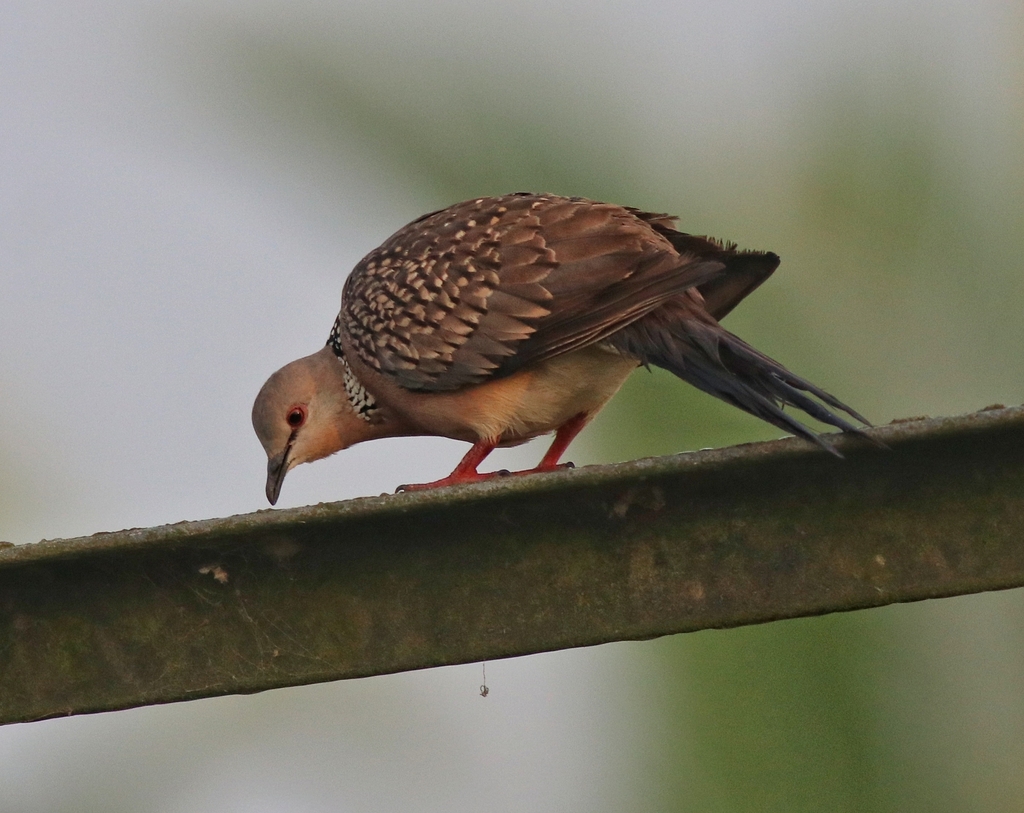
Spotted Dove
Photo © Afsar Nayakkan
Photo © Afsar Nayakkan — CC BY 4.0 — Source: iNaturalist photo #276187887Identification
The Spotted Dove is a small, long-tailed pigeon with distinctive plumage that makes it readily identifiable. Its ground colour is rosy buff below, shading into grey on the head and belly. The most striking feature is a half collar on the back and sides of the neck made of black feathers with white spots at their tips, giving the bird its characteristic "spotted" appearance. The wing coverts bear light buff spots, while the outer tail feathers are tipped in white—a feature that becomes visible when the bird takes flight. Sexes are similar in appearance, though juveniles are duller and lack the distinctive neck spots until they mature. Adults range from 28 to 32 centimetres in length, making them relatively modest in size compared to other pigeons.
Range & Habitat
Native to the Indian subcontinent and East and Southeast Asia, the Spotted Dove is now a common resident breeding bird across this vast range, with considerable plumage variations across different populations. The species thrives in diverse habitats including light forests, woodlands, scrub, farmland, gardens, and urban areas. In India, they favour moister regions, where they are more frequently encountered than their drier-habitat cousin, the Laughing Dove. These birds are predominantly ground-dwellers, typically found foraging on the ground or in low vegetation.
Beyond its native Asian range, the Spotted Dove has been successfully introduced to many parts of the world. Established feral populations now exist in Hawaii, southern California, Mauritius, Australia, and New Zealand. In Australia, introduced populations arrived in Melbourne during the 1860s and have since spread widely, becoming a common urban wildlife species throughout eastern Australia and major towns across the south, inhabiting streets, parks, gardens, agricultural areas, and tropical shrublands.
Behaviour & Diet
Spotted Doves are sociable birds, moving around in pairs or small groups as they forage methodically on the ground for grass seeds, grains, fallen fruits, and seeds of various plants. They occasionally supplement their diet with insects, including winged termites. Their flight is characteristically quick with regular wing beats and occasional sharp flicks of the wings. A distinctive display flight involves taking off at a steep angle with a loud clapping of the wings, followed by a slow glide downward with the tail spread.
During breeding season, males perform elaborate courtship displays including cooing, bowing, and aerial manoeuvres. The breeding season varies by location—spread out in warm regions but concentrated in summer in temperate areas. In Hawaii and other introduced populations, breeding occurs year-round, while in southern Australia breeding predominantly occurs from September to January, and in the north during autumn.
Best Time & Places to See It
For travellers in Asia, the Spotted Dove is common across its native range on the Indian subcontinent and throughout East and Southeast Asia, making it relatively easy to encounter. In introduced populations, the species is now well-established and common in urban areas of Hawaii, parts of California, Australia, and New Zealand, where it frequents parks, gardens, and urban streets. The best viewing opportunities are typically in the early morning or late afternoon when these ground-feeding birds are most active in their foraging.
Photography Tips
The Spotted Dove's characteristic white-spotted black neck collar provides an excellent focal point for portraiture photography. Photographers should focus on capturing this distinctive feature, which is most visible when the bird is at rest or in profile. The white tail tips are particularly striking during flight, making takeoff and landing sequences rewarding subjects to pursue. Since these birds are ground feeders, a low shooting angle will help create more engaging compositions. Their display flight—with its explosive takeoff and graceful glide—offers dynamic photography opportunities for patient observers. Urban settings where these doves have established populations may provide more approachable subjects than in denser natural habitats.
Kanha Tiger Reserve
Minneriya National Park
Aketajawe Lolobata National Park
Angamedilla National Park
Baima Snow Mountain National Nature Reserve
Bako National Park
Bald Rock National Park
Bandhavgarh National Park
Bandipur National Park
Nothing matches these filters.
No community photos yet. Log in to add the first one.
No community observations of this species yet.