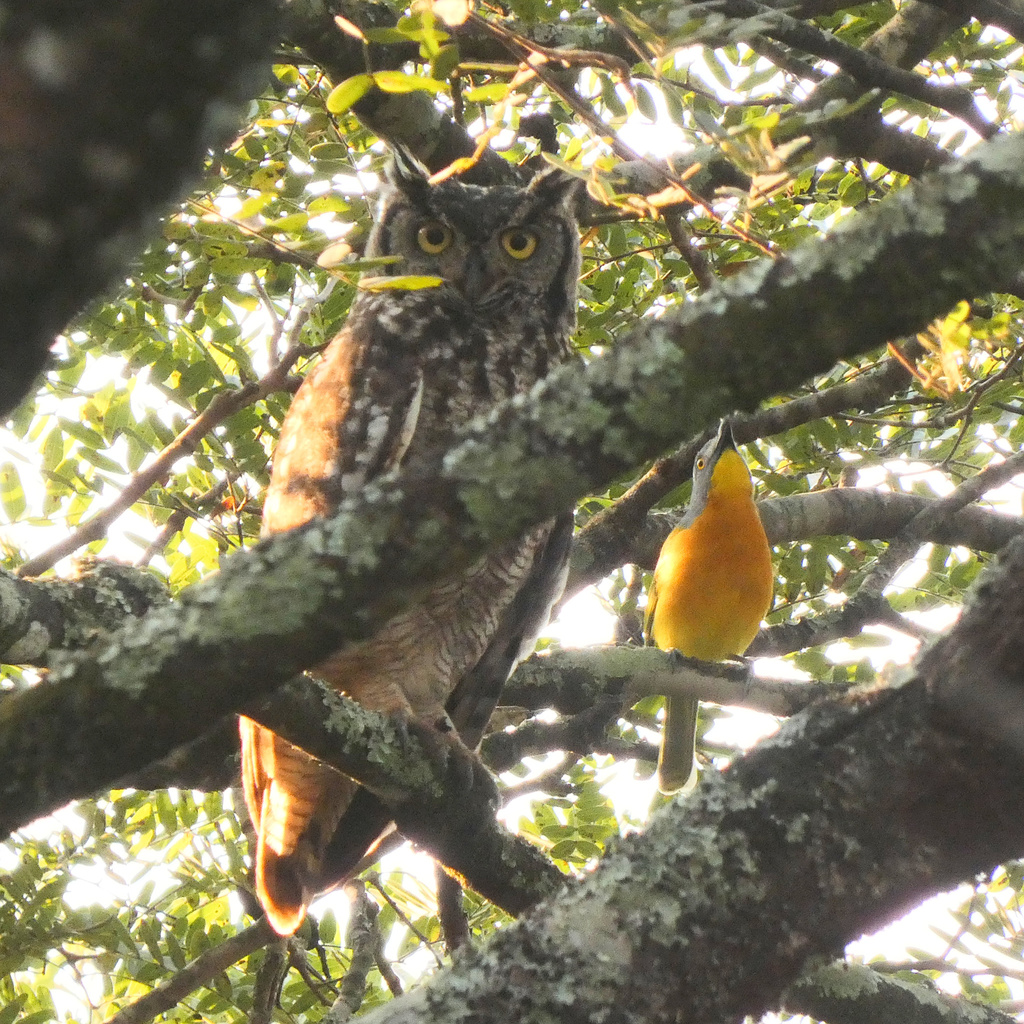
Spotted Eagle-Owl
Photo © Jonathan Whitaker
Photo © Jonathan Whitaker — CC0 1.0 — Source: iNaturalist #95136467Identification
The spotted eagle-owl is a medium-sized owl and one of the smallest of the eagle-owl species, measuring 45 cm in length with a wingspan of 100 to 140 cm. It weighs between 454 and 907 grams. The most distinctive features include prominent ear-tufts, striking yellow eyes, and an off-white to pale ochre facial disk. The upper body is dusky brown, while the lower parts are off-white with brown barring. This combination of features makes it readily identifiable in its range.
Range & Habitat
Spotted eagle-owls are the most common owl species found in Southern Africa and occur throughout Sub-Saharan Africa and the Arabian Peninsula. They are highly adaptable urban owls, readily inhabiting suburban gardens and areas in close proximity to human habitation, such as the outskirts of Harare, Zimbabwe. They also favour thorn savanna and rocky areas, preferring to roost in open locations including the ground, rocky outcrops, and tree crowns.
Behaviour & Diet
These owls produce distinctive musical hoots, with males calling in two notes—"Hooo hooopoooo"—and females responding with three notes of less emphatic tone. Young birds do not hoot until nearly adult, but will hiss and snap their beaks threateningly when alarmed, spreading their wings in an umbrella-like defensive posture. Spotted eagle-owls are regular bathers, particularly during summer thunderstorms.
Their diet is highly varied, consisting primarily of small mammals such as rodents, shrews, bats, hedgehogs, and young hares, but also including birds up to the size of terns and falcons, insects, reptiles, frogs, and carrion. They are generalist feeders that remain itinerant, hunting in a region for weeks or months before moving on when local prey becomes scarce. Adult pairs are aggressively territorial in defence of their hunting grounds.
Best Time & Places to See It
Spotted eagle-owls are best encountered in Southern African locations with suitable rocky or open habitats, including suburban and urban gardens. They are nocturnal, so observers should search at dusk and throughout the night. During the day, they may be located by listening for the calls of harassing birds such as the grey loerie, which often indicates the presence of a roosting owl. Summer thunderstorms may provide opportunities to observe them bathing on exposed branches or the ground.
Photography Tips
Photograph these owls using night-vision or high-ISO techniques, as they are strictly nocturnal. Focus on capturing their distinctive yellow eyes and prominent ear-tufts, which are key identification features. If encountering young owls during the fledging period (approximately five to seven weeks after hatching), photograph their characteristic defensive posture with spread wings and lowered head. Daytime photography of their roosting sites, particularly in rocky outcrops or tree crowns, may reveal their off-white facial disk and dusky brown plumage. Exercise caution near nesting sites and young birds to avoid disturbance.
Bwindi Impenetrable National Park
Lake Mburo National Park
Murchison Falls National Park
Queen Elizabeth National Park
Aberdare National Park
Addo Elephant National Park
Agulhas National Park
Amboseli National Park
Arusha National Park
Nothing matches these filters.
No community photos yet. Log in to add the first one.
No community observations of this species yet.