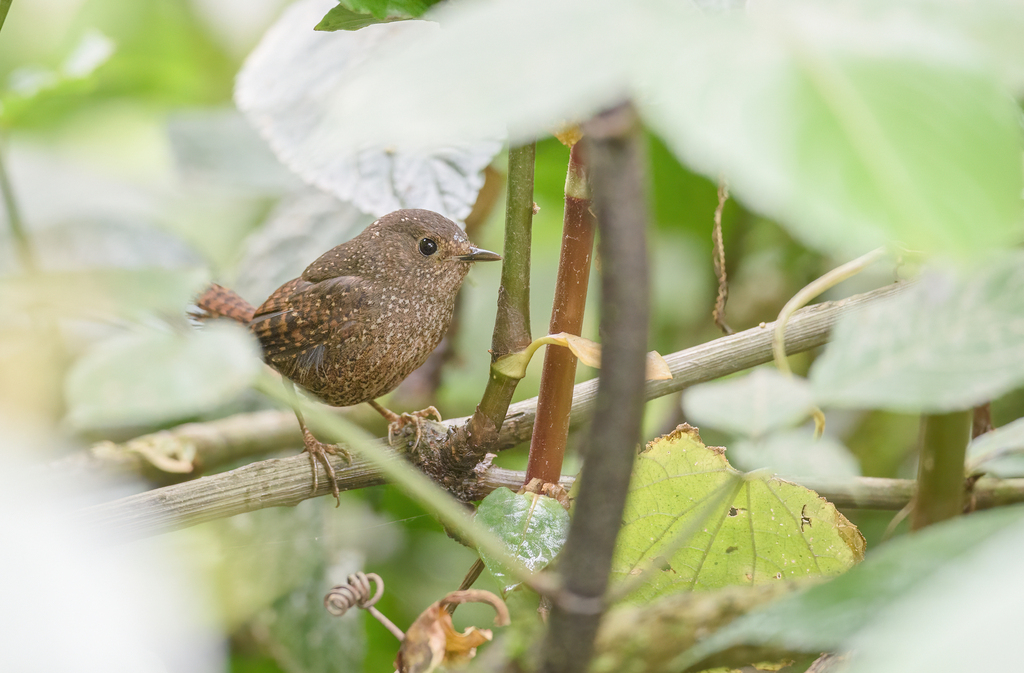
Spotted Elachura
Photo © Morten Ross
Photo © Morten Ross — CC BY 4.0 — Source: iNaturalist #125179901The spotted elachura or spotted wren-babbler (Elachura formosa) is a species of passerine bird found in the forests of the eastern Himalayas and Southeast Asia. In the past it was included in the babbler genus Spelaeornis as S. formosus, but molecular phylogenetic studies in 2014 provided evidence that it was distinct from the babblers, having no other close living relatives within the passerine bird clade Passerida. This led to the creation of a new family, Elachuridae, to accommodate just one species (a monotypic taxon). == Description == The spotted elachura measures 10 cm including its short tail. It is dark brown all over, with rufous wings and tail. It also has white speckles all over its body, shifting to black barring on its wings and tail. == Habitat and distribution == It is found in Bangladesh, Bhutan, China, India, Laos, Myanmar, Nepal, and Vietnam. Its natural habitat is subtropical or tropical moist montane forests. This species is found in undergrowth and dense thickets of this type of forest, with a preference for thick fern ground cover, mossy rocks and decaying trunks of fallen trees and brushwood (often near a stream or creek), long grass, and scrub.
Khangchendzonga National Park
Sakkyong, India
+290 birds+1 mammals
Where the eastern Himalayas surge toward their crowning peaks, Khangchendzonga National Park embraces a landscape of almost overwhelming vertical drama. Rising from subtropical river valleys into…
VIEW NATIONAL PARKWuyishan National Park
Yanshan County, China
+141 birds+2 mammals
Where subtropical monsoon rains sustain a perpetually humid landscape, Wuyishan National Park rises from Fujian's eastern plateau as a realm of forested ridges, cascading streams, and…
VIEW NATIONAL PARKGaoligong Mountain National Nature Reserve
Nujiang Lisu Autonomous Prefecture, China
+443 birds+13 mammals
VIEW NATURE RESERVENo community photos yet. Log in to add the first one.
No community observations of this species yet.