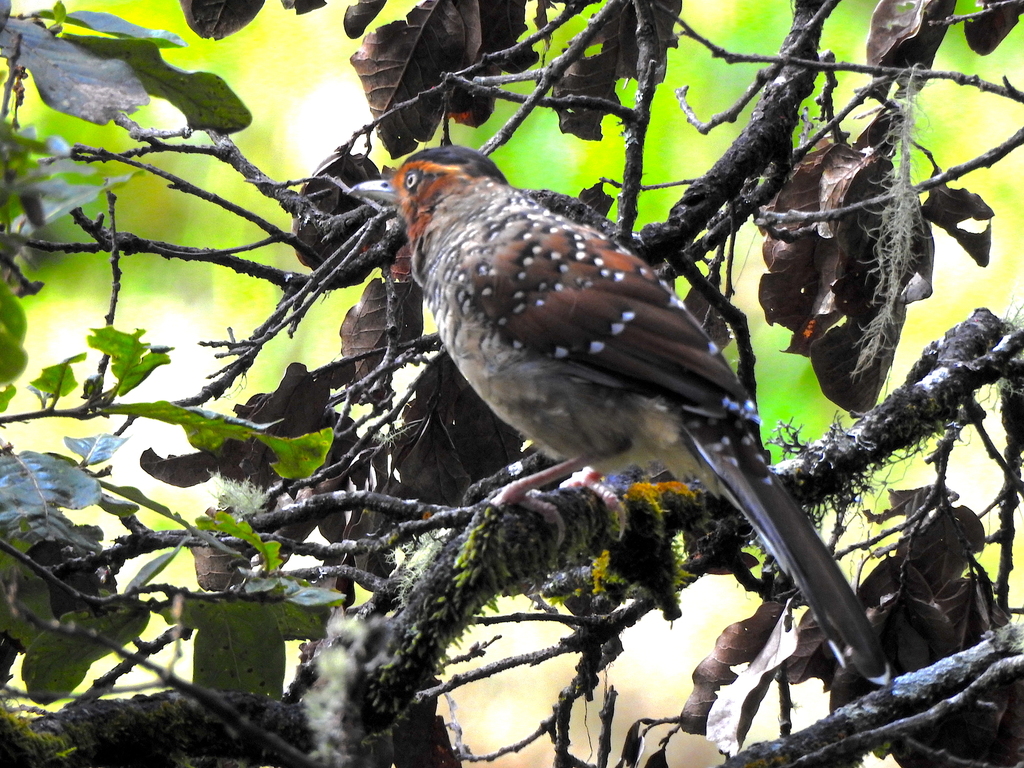
Spotted Laughingthrush
Photo © Hopeland
Photo © Hopeland — CC BY 4.0 — Source: iNaturalist #100157428The spotted laughingthrush (Ianthocincla ocellata) is a bird species in the family Leiothrichidae. It is found in Bhutan, China, India, Myanmar, and Nepal. Its natural habitat is subtropical or tropical moist montane forests. The spotted laughingthrush was at one time placed in the genus Garrulax but following the publication of a comprehensive molecular phylogenetic study in 2018, it was moved to the resurrected genus Ianthocincla. == Gallery ==
Langtang National Park
Helambu, Nepal
+364 birds+14 mammals
Where the southern slopes of the Himalayan highlands descend toward the subtropical valleys of central Nepal, Langtang National Park sprawls across one of the subcontinent's most…
VIEW NATIONAL PARKSagarmatha National Park
Khumjung, Nepal
+219 birds+7 mammals
Soaring peaks and deep glacial valleys define this alpine wilderness in northeastern Nepal, where the terrain rises from forested foothills into a realm of high-altitude tundra…
VIEW NATIONAL PARKKhangchendzonga National Park
Sakkyong, India
+290 birds+1 mammals
Where the eastern Himalayas surge toward their crowning peaks, Khangchendzonga National Park embraces a landscape of almost overwhelming vertical drama. Rising from subtropical river valleys into…
VIEW NATIONAL PARKGiant Panda National Park
Mianyang, China
+447 birds+47 mammals
Where the eastern slopes of China's Sichuan plateau descend into cloud-wrapped valleys, one of Asia's most biodiverse landscapes unfolds across more than 350,000 square kilometres. This…
VIEW NATIONAL PARKWolong National Nature Reserve
Wenchuan County, China
+333 birds+17 mammals
Where the Qingyi River cuts through the eastern flanks of the Minshan Range, a temperate montane forest cloaks steep valleys in dense canopy that thins dramatically…
VIEW NATURE RESERVEGaoligong Mountain National Nature Reserve
Nujiang Lisu Autonomous Prefecture, China
+443 birds+13 mammals
VIEW NATURE RESERVENo community photos yet. Log in to add the first one.
No community observations of this species yet.