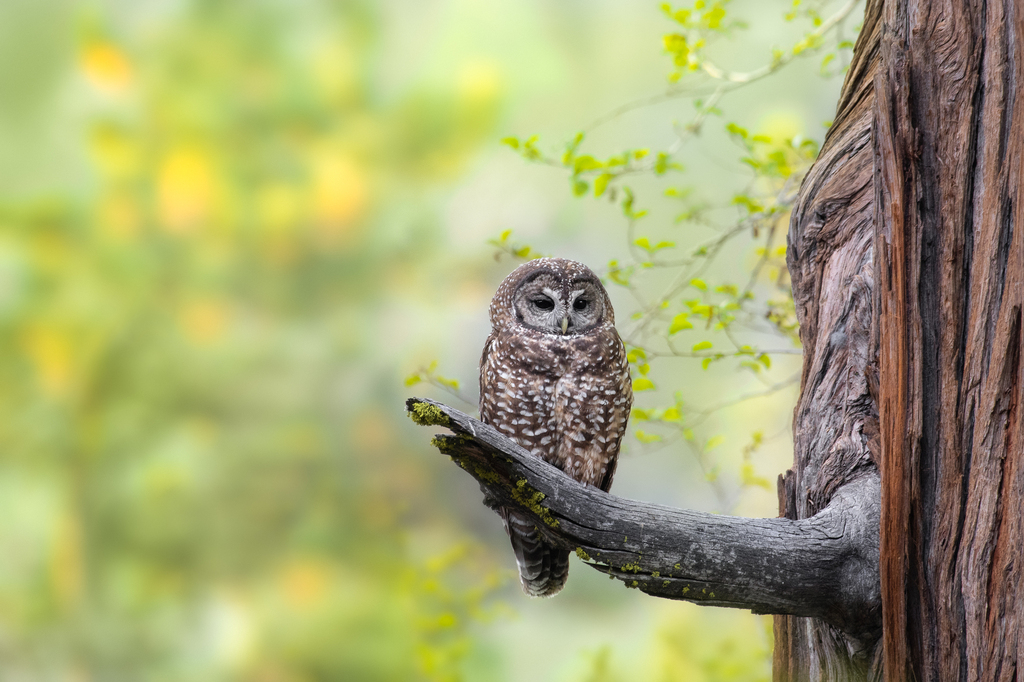
Spotted Owl
Photo © Adam Jackson
Photo © Adam Jackson — CC0 1.0 — Source: iNaturalist photo #339612871Identification
The spotted owl is a medium-sized owl with an average length of 43 cm (17 inches) and a wingspan of 114 cm (45 inches). Weighing around 600 grams (1.3 pounds), it is noticeably smaller and darker than the similar barred owl. The key distinguishing feature is the spotted owl's cross-shaped markings on its underparts, whereas the barred owl displays alternating bars on the breast and streaks on the belly. Barred owls are also grayer in appearance, making them relatively straightforward to differentiate once you know what to look for.
Range & Habitat
Three subspecies of spotted owl are recognized across western North America, each occupying distinct ranges. The northern spotted owl extends from southwestern British Columbia south through Washington and Oregon to Marin County, California. The California subspecies ranges through the Sierra Nevada and coastal mountains from the southern Cascades to northern Baja California. The Mexican spotted owl inhabits mountain ranges and canyons across the southwestern United States—including Utah, Colorado, Arizona, New Mexico, and western Texas—as well as western Mexico, with the Gila Wilderness supporting the largest population of this subspecies.
Spotted owls are strongly associated with old-growth and late-successional forests, preferring closed-canopy, uneven-aged woodlands in both hardwood and coniferous settings. The Mexican subspecies shows greater flexibility, also utilizing chaparral and pinyon woodlands in deep canyons. All three subspecies seek out areas with substantial canopy cover (often exceeding 70%) and large trees for nesting and roosting, along with nearby water sources. Elevation preferences vary by subspecies, ranging from 70 feet in the north to over 8,500 feet in the south and Mexican populations.
Behaviour & Diet
The spotted owl is entirely nocturnal, hunting under cover of darkness for small mammals and birds. This secretive owl does not build its own nest; instead, it occupies cavities in trees, deadwood, and snags, as well as abandoned nests of raptors or squirrels, typically positioning these nest sites between 12 and 60 metres (40 and 200 feet) above ground. Some favored nest sites are used repeatedly across years.
Spotted owls are monogamous and breed from early spring through late summer or fall. Pairs have an average breeding probability of 62%, meaning they do not breed every year. Clutch size is normally two eggs, though occasionally four may be laid. The female incubates the eggs for about a month and tends the young, while the male provides food. Fledglings remain dependent for three to four months after leaving the nest, dispersing in late summer and fall. These long-lived owls can reach 16 or 17 years of age, with annual survival rates typically exceeding 80%.
Best Time & Places to See It
Spotted owls are nocturnal and elusive, making them challenging subjects for observation. The northern subspecies is found from southwestern British Columbia through western Washington and Oregon; the California subspecies inhabits the Sierra Nevada and coastal mountains; and the Mexican subspecies frequents mountain ranges and canyons of the Southwest and Mexico. The Gila Wilderness in New Mexico is particularly notable as home to the largest population of Mexican spotted owls. Breeding season activity from early spring through summer may increase detectability, as pairs become more vocal during courtship and territorial displays.
Photography Tips
Photographing spotted owls demands patience, nighttime capability, and respect for the bird's threatened status. Night-vision or thermal imaging equipment is essential given their strictly nocturnal behavior. Focus on areas of old-growth forest with dense canopy cover and large trees, where these owls roost and nest. Early morning hours just before dawn may offer brief opportunities as owls return to roost. Always maintain distance and avoid disturbing nesting sites, particularly during breeding season from February through fall. Be aware that barred owls, which are larger and more aggressive, increasingly displace spotted owls in some regions, so confirm identification carefully before approaching.
Saguaro National Park
Rincon Valley, United States
+354 birds+40 mammals
Where the Sonoran Desert meets sky-island mountains, two geographically separated districts of Saguaro National Park sprawl across nearly two thousand square kilometers of Arizona's most iconic…
VIEW NATIONAL PARKZion National Park
Washington County, United States
+244 birds+30 mammals
Towering sandstone cliffs in shades of crimson, rust, and cream rise abruptly from the Virgin River's winding canyon floor, their sculpted faces bearing witness to millions…
VIEW NATIONAL PARKCapitol Reef National Park
Garfield County, United States
+196 birds+22 mammals
Wrinkled ridges of crimson and gold sandstone rise from the floor of south-central Utah, their weathered faces carved by the Fremont River into one of the…
VIEW NATIONAL PARKYosemite National Park
Mariposa County, United States
+224 birds+28 mammals
Granite cliffs soar nearly a kilometer above the valley floor in this expanse of high Sierra wilderness, where glacial U-shaped valleys sculpt a landscape of dramatic…
VIEW NATIONAL PARKSequoia National Park
Tulare County, United States
+187 birds+27 mammals
Granite peaks rising above 3,600 meters dominate the southern Sierra Nevada, where Sequoia National Park sprawls across one of North America's most vertically compressed wilderness zones.…
VIEW NATIONAL PARKKings Canyon National Park
Fresno County, United States
+186 birds+20 mammals
Where granite peaks fracture the Sierra Nevada skyline and the Kings River has carved one of North America's most dramatic canyons, a landscape of extreme relief…
VIEW NATIONAL PARKGuadalupe Mountains National Park
Culberson County, United States
+262 birds+14 mammals
Where fossil-laden limestone ridges thrust skyward above the Chihuahuan Desert floor, Guadalupe Mountains National Park reveals a landscape sculpted by ancient seas and relentless aridity. These…
VIEW NATIONAL PARKNo community photos yet. Log in to add the first one.
No community observations of this species yet.