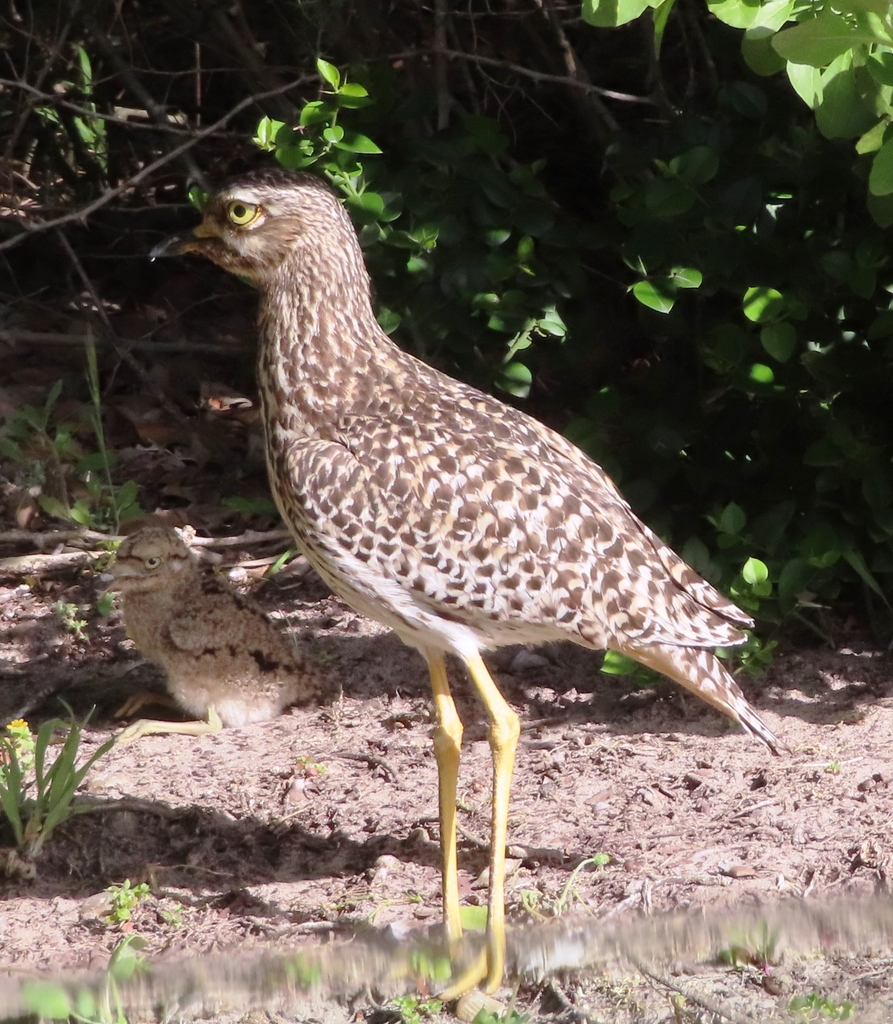
Spotted Thick-knee
Photo © linkie
Photo © linkie — CC BY 4.0 — Source: iNaturalist #100057055Identification
The spotted thick-knee is a medium-sized wader reaching up to 45.5 cm in height, instantly recognizable by its long yellow legs and distinctively swollen tibiotarsal joints—the enlarged "knees" that give the species its name. Its plumage is brown and white with speckled patterns that provide excellent camouflage in its grassland and savanna habitats. The bird has a large, round head with a prominent bright yellow eye and a short, stout beak, giving it a characterful appearance. When in flight or displaying with wings raised, it reveals striking contrasting wing patterns that are quite eye-catching.
Range & Habitat
The spotted thick-knee is native to tropical regions of central and southern Africa, with a very extensive range spanning from Senegal, Mali and Mauritania in the west to Ethiopia, Kenya, Tanzania and South Africa in the east and south. Its range also extends into south Yemen in West Asia. The species is found in grasslands and savannas across sub-Saharan Africa, where its cryptic plumage helps it blend seamlessly into these open habitats.
Behaviour & Diet
This is a strictly nocturnal bird that remains hidden and inactive during daylight hours, squatting motionless on the ground where its speckled plumage provides excellent concealment. The spotted thick-knee hunts exclusively on the ground at night, feeding on insects, small mammals and lizards. During the breeding season, both males and females share parental duties. The female typically lays two eggs in a simple ground nest lined with grasses, feathers, pebbles and twigs. Both parents bring food to the nest and fiercely defend it, adopting an aggressive posture with wings spread and tail cocked. They will even peck intruders or employ distraction displays, feigning injury to lead predators away from their nest.
Best Time & Places to See It
The spotted thick-knee's nocturnal habits make it a challenging species to observe, as it remains hidden during the day. However, your best chance of seeing one is after dusk when it becomes active. Look for it in grasslands and savanna habitats across its wide African range, particularly in areas from East Africa through central Africa to South Africa. The species' stable population and "Least Concern" conservation status means it remains fairly common throughout its extensive range, improving your odds of an encounter with patience and night work.
Photography Tips
Photographing this nocturnal species requires night-time fieldwork and artificial lighting or infrared equipment. During daylight hours, search carefully through grasslands for roosting birds—their camouflaged plumage makes them extremely difficult to spot, so scan the ground methodically. If you locate a bird, approach carefully and slowly to avoid flushing it. When active at night, the bird's distinctive yellow eye and legs photograph well if you can position your light source appropriately. The characteristic posture with raised wings and the striking flight patterns are worth capturing if the bird takes flight.
Lake Mburo National Park
Murchison Falls National Park
Queen Elizabeth National Park
Addo Elephant National Park
Agulhas National Park
Amboseli National Park
Arusha National Park
Augrabies Falls National Park
Awash National Park
Nothing matches these filters.
No community photos yet. Log in to add the first one.
No community observations of this species yet.