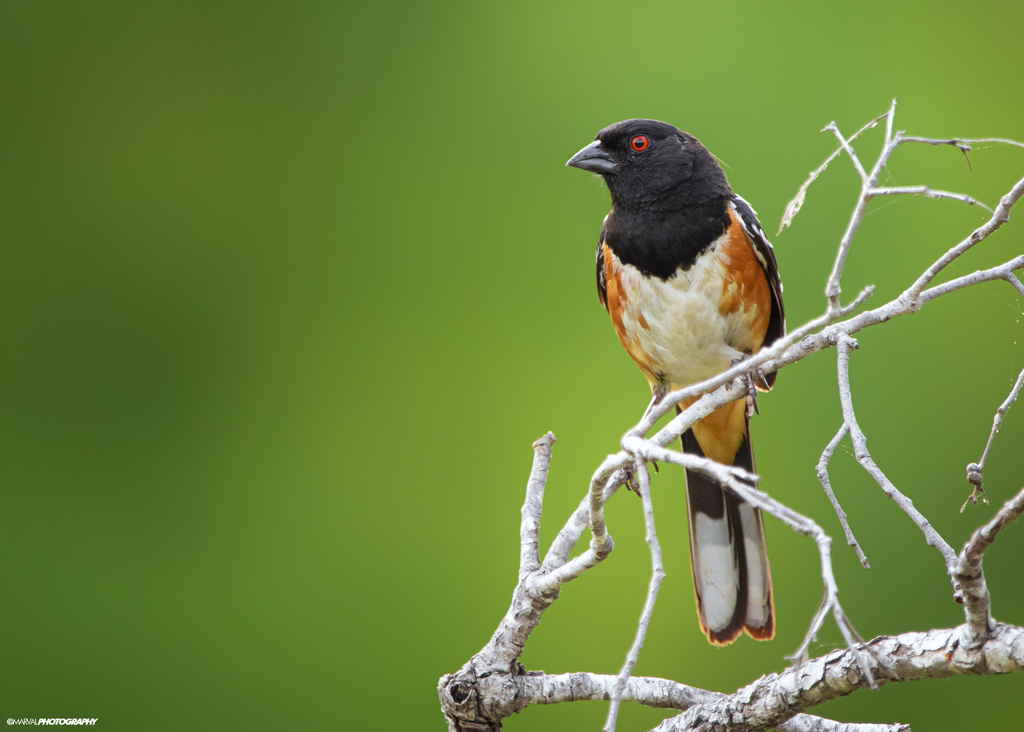
Spotted Towhee
Photo © MarvalPhotography19
Photo © MarvalPhotography19 — CC BY 4.0 — Source: iNaturalist photo #315034548Identification
The spotted towhee is a large New World sparrow, roughly the same size as a gray catbird, measuring 17–21 cm long with a wingspan of 28 cm and weighing 33–49 g. It has a distinctive long, dark, fan-shaped tail with white corners, a round body, bright red eyes, and dull pink legs. Adult males are striking: they display a dark head, upper body and tail contrasting with a white belly and rufous sides, plus white spots on the back and white wing bars. Females are similar in pattern but dusky brown and grey rather than black. The white spots on primary and secondary feathers are a key field mark distinguishing this species from the eastern towhee, which lacks these spots.
Range & Habitat
The spotted towhee breeds across northwestern North America and is present year-round in California, Nevada, Arizona, Utah, Oregon, Washington, Idaho, and southern British Columbia. The species avoids arid climates and is absent from the Sonoran Desert, though it inhabits northern Arizona and all of California except the southeastern corner. It has expanded as far east as western Iowa and southwestern Minnesota. The bird favors dry upland forests, open forests, brushy fields, chaparral, and riparian forests adjacent to uplands. It avoids burned chaparral due to lack of ground cover but thrives in recovering post-fire areas (less than 15 years old) where understory vegetation provides excellent foraging. Breeding habitat in the southwest depends heavily on coastal sage scrub for predator cover.
Behaviour & Diet
The spotted towhee has a call that may be harsher and more varied than that of the eastern towhee. The species forages primarily on the ground, exploiting vegetation for food. It hybridizes with the eastern towhee where ranges overlap in the Midwest (mainly Nebraska and North and South Dakota) and with the collared towhee where ranges overlap in southwestern Mexico. Some populations are year-round residents, while northwestern birds migrate eastward to the central plains, particularly the northwestern-central Great Plains, to breed in scrubland, parks, and suburban gardens. In other areas, some birds move to lower elevations during winter.
Best Time & Places to See It
For the best viewing opportunities, visit the Pacific Northwest, California, and the interior western mountains during breeding season. Year-round residents can be found in California, Nevada, Arizona, Utah, Oregon, Washington, Idaho, and southern British Columbia. In winter, check lower elevations and the central Great Plains. The species prefers brushy, chaparral, and scrubby habitats where it can forage on or near the ground. Recently burned areas recovering with new vegetation are particularly productive, as the bird exploits the developing understory.
Photography Tips
The spotted towhee's striking plumage and bright red eyes make it rewarding to photograph. Males with their bold black-and-white markings and rufous flanks offer the most dramatic images. Focus on ground-level behavior, as this species spends considerable time foraging on the forest floor and in low vegetation. Early morning light in chaparral and scrubland habitats will enhance the contrast of male plumage. Look for birds in recovering post-fire habitats where reduced canopy cover and accessible understory vegetation make them more visible and accessible for photography.
Alaska Maritime National Wildlife Refuge
Arches National Park
Badlands National Park
Banff National Park
Bear River Migratory Bird Refuge
Big Bend National Park
Bitter Lake National Wildlife Refuge
Black Canyon of the Gunnison National Park
Bosque del Apache National Wildlife Refuge
Nothing matches these filters.
No community photos yet. Log in to add the first one.
No community observations of this species yet.