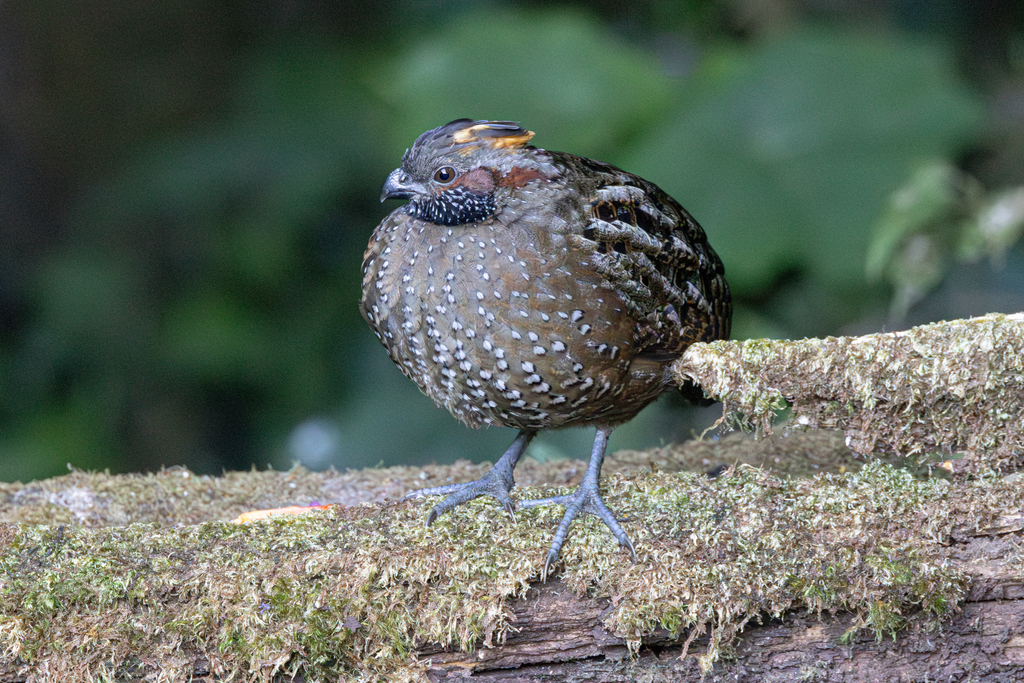
Spotted Wood Quail
Photo © Ryan F. Mandelbaum
Photo © Ryan F. Mandelbaum — CC BY 4.0 — Source: iNaturalist photo #350271001Identification
The spotted wood quail is a compact ground-dwelling bird measuring 25 cm in length and weighing around 300 g. Its most distinctive feature is a bright orange crest that becomes prominently raised when the bird is excited. The upperparts are dark brown with black and rufous flecking, while the underparts are boldly spotted with white. Two colour morphs exist: birds may have olive-brown or rufous underparts, but both display the characteristic white spotting. The face is strikingly marked with a dark brown forehead, black cheeks, and a white-streaked throat.
The sexes are similar in appearance, though males average slightly larger and females display a duller crest. Immature birds are distinguishable by smaller, more buff-tinted spotting and a dusky rather than black throat. There is only one subspecies across the bird's range.
Range & Habitat
This resident breeder inhabits the mountains of Central America from southern Mexico through to western Panama. The species is locally common in suitable habitat, particularly in Costa Rica and Panama, though it has been adversely impacted by deforestation across much of its range.
Spotted wood quails occupy highland elevations of 1000 m or higher, extending up to the timberline. They favour dense understory thickets and bamboo stands, preferring the shelter these dense habitats provide.
Behaviour & Diet
These quails are found in small groups of 4 to 10 birds and are notably shy and wary. They forage on the ground, vigorously scratching at the soil in search of seeds, fallen fruit, and insects. When disturbed, they typically escape on foot, but if startled suddenly they will burst into a short, fast flight to reach cover.
The advertising call is distinctive: a clear, whistled duet rendered as "coowit CAWwit coowit COO". Contact calls between birds consist of clear chirps and peeps. Nesting details remain largely undescribed, but eggs are known to be creamy-white with brown spots.
Best Time & Places to See It
The spotted wood quail is most readily observed at dawn, when it is most active and may feed along forest roads or track edges. The bird's shy nature and preference for dense cover make daytime encounters challenging, so timing your search for early morning hours significantly improves your chances of observation.
Costa Rica and Panama offer the best opportunities to find this species in locally common populations within suitable highland habitat. Look for areas with dense understory thickets and bamboo stands at elevations above 1000 m.
Photography Tips
Early morning is essential for photography, as this is when spotted wood quails are most active and visible. Position yourself quietly along forest tracks or roadsides within appropriate habitat, remaining patient and alert for movement.
The bird's explosive escape flight and preference for dense cover present challenges; however, the striking orange crest and bold white spotting on the underparts offer rewarding photographic subjects when glimpsed. A telephoto lens will prove invaluable given the species' wariness and tendency to keep to thick vegetation.
Chirripó National Park
Rivas, Costa Rica
+274 birds+6 mammals
Where the volcanic spine of Costa Rica's Central Cordillera reaches its apex, Chirripó National Park encompasses a landscape that shifts dramatically with elevation, from montane cloud…
VIEW NATIONAL PARKBraulio Carrillo National Park
Las Horquetas, Costa Rica
+547 birds+18 mammals
Where the Caribbean slope descends from the central volcanic cordillera toward the humid lowlands of Heredia, Braulio Carrillo National Park preserves one of Costa Rica's most…
VIEW NATIONAL PARKVolcán Poás National Park
Toro Amarillo, Costa Rica
+237 birds+4 mammals
Where volcanic slopes rise sharply from the Central Valley floor, Volcán Poás National Park protects one of Costa Rica's most active and accessible volcanic systems. The…
VIEW NATIONAL PARKBaru Volcano National Park
Cerro Punta, Panama
+402 birds+6 mammals
Where the land rises sharply toward the Caribbean's western spine, Baru Volcano National Park sprawls across roughly 220 square kilometres of southwestern Panama, anchored by the…
VIEW NATIONAL PARKParque Internacional la Amistad
Teribe, Panama
+325 birds+11 mammals
Where the continental divide rises between the Caribbean and Pacific watersheds, a wilderness of extraordinary biological richness unfolds across the Talamanca Range and into lowland rainforest—a…
VIEW NATIONAL PARKLagunas de Montebello National Park
Laguna de Montebello, Mexico
+360 birds+2 mammals
Where turquoise lagoons pierce the limestone plateau of southeastern Chiapas, the Lagunas de Montebello National Park unfolds across roughly 174 square kilometers of spectral water and…
VIEW NATIONAL PARKMontes Azules
Candelaria, Mexico
+395 birds+47 mammals
Where jungle-clad limestone plateaus plunge into canyon systems carved by the Usumacinta River, Mexico's most pristine rainforest reserve unfolds across the Lacandón region of Chiapas. Montes…
VIEW BIOSPHERE RESERVETikal National Park
Tikal, Guatemala
+399 birds+16 mammals
Dense rainforest canopy rises above the limestone plateau of Petén, where archaeological wonder and ecological richness merge seamlessly across one of Central America's most biodiverse landscapes.…
VIEW NATIONAL PARKLaguna del Tigre National Park
Petén, Guatemala
+399 birds+29 mammals
Where the Petén lowlands dissolve into wetland and forest, Laguna del Tigre National Park protects one of Guatemala's most ecologically vital landscapes. This sprawling reserve encompasses…
VIEW NATIONAL PARKSierra del Lacandón National Park
Petén, Guatemala
+348 birds+7 mammals
Where the Petén rainforest rises into limestone ridges and deep ravines, Sierra del Lacandón National Park protects one of Central America's most intact tropical wilderness zones.…
VIEW NATIONAL PARKLos Quetzales National Park
Copey, Costa Rica
+232 birds+3 mammals
Cloud forest sweeps across the upper slopes of the Central Valley watershed, where elevation and persistent moisture forge an ecosystem unlike any other in Costa Rica.…
VIEW NATIONAL PARKTapantí Macizo de la Muerte National Park
Orosi, Costa Rica
+503 birds+18 mammals
Where montane cloud forest rises steeply from the Orosi Valley, Tapantí Macizo de la Muerte National Park enfolds a landscape of perpetual moisture and emerald complexity.…
VIEW NATIONAL PARKLa Amistad International Park
Crorina, Costa Rica
+532 birds+20 mammals
Where the Caribbean slopes of Costa Rica's Talamanca Mountains rise steeply inland from Limón, the boundary between two nations dissolves into an unbroken expanse of rainforest.…
VIEW NATIONAL PARKBarbilla National Park
Chirripó, Costa Rica
+226 birds
Where the Caribbean slope of Costa Rica's eastern cordillera plunges into perpetual moisture, Barbilla National Park rises as one of Central America's most water-rich ecosystems. Fed…
VIEW NATIONAL PARKNo community photos yet. Log in to add the first one.
No community observations of this species yet.