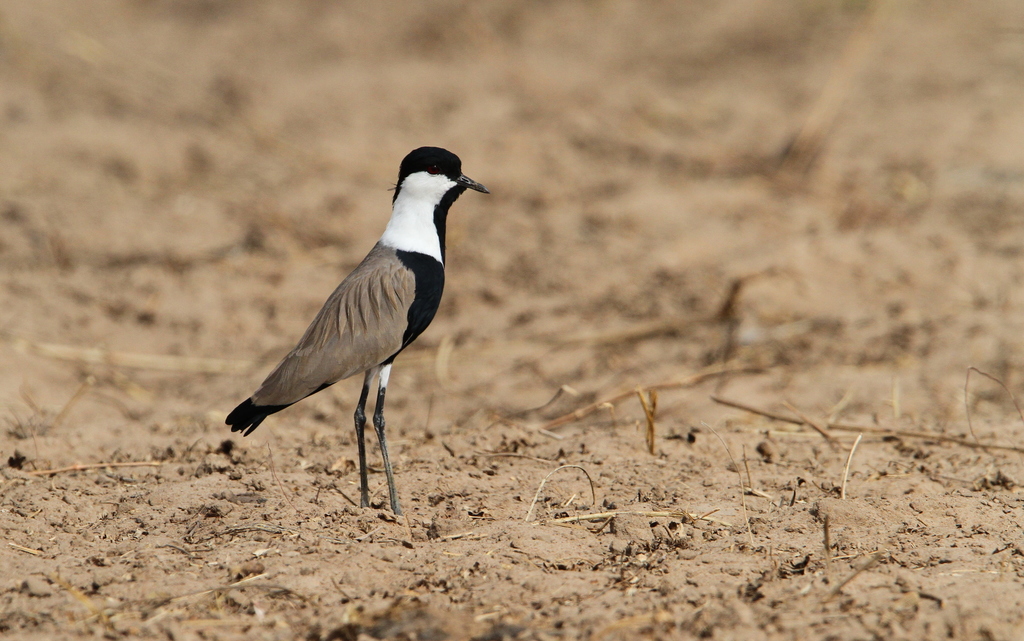
Spur-winged Lapwing
Photo © Christoph Moning
Photo © Christoph Moning — CC BY 4.0 — Source: iNaturalist photo #95177867Identification
The spur-winged lapwing is a medium-large wader with striking plumage that makes it relatively easy to identify. Look for a black crown, chest, and foreneck stripe, contrasting sharply with a white face, neck, and belly. The wings and back are light brown, while the bill and legs are black. The bird's common name refers to a small, hidden claw or spur concealed within each wing—a feature unique among lapwings. In the field, listen for its loud, distinctive call: "did-he-do-it," which is often the first sign of the bird's presence.
Range & habitat
The spur-winged lapwing breeds around the eastern Mediterranean and across a wide band stretching from sub-Saharan West Africa to Arabia. Northern populations, particularly those breeding in Greece and Turkey, are migratory, while populations elsewhere remain resident year-round. The species is abundant throughout much of tropical Africa and can be encountered at almost any wetland habitat within its range. Notably, the species has expanded its distribution in eastern and southern Africa in recent decades, with the species first recorded in Zambia in 1999 and subsequently spreading further south and west—a trend suggesting successful adaptation to new regions.
Behaviour & diet
Spur-winged lapwings show a clear preference for marshes and freshwater wetland habitats, where they forage for food. Their diet consists primarily of insects and other invertebrates, which they pick from the ground. These birds lay four blotchy yellowish eggs in a simple ground scrape, and they are notably protective of their exposed offspring. They are known to use their characteristic wing-spurs defensively in attacks on animals—and rarely, on people—who venture too close to their nesting areas during the breeding season. Interestingly, spur-winged plovers are frequently observed feeding around basking Nile crocodiles and are tolerated by them, though reliable evidence of true symbiotic cleaning behavior remains elusive.
Best time & places to see it
The spur-winged lapwing is abundant and widespread across tropical African wetlands, making it relatively accessible to wildlife travellers and birdwatchers throughout the species' range. Any wetland habitat—marshes, shallow lakes, or river margins—offers potential viewing opportunities. In migratory northern populations (Greece and Turkey), the breeding season is the best time to encounter the species, while in sub-Saharan Africa, the birds can be seen year-round. Their loud calls often announce their presence before they are visually located.
Photography tips
The spur-winged lapwing's striking black-and-white plumage and active ground-foraging behavior make it an attractive photographic subject. The contrast between the black crown and white face is particularly striking in direct sunlight. Photograph birds in their preferred wetland habitats during early morning or late afternoon when light is favorable and bird activity peaks. Exercise caution during the breeding season, as defensive birds may approach photographers near nests. The small wing-spurs are difficult to capture in flight, but patient observation may reward close-up shots of perched birds where this distinctive feature might be visible.
Bwindi Impenetrable National Park
Lake Mburo National Park
Mabamba Swamp
Murchison Falls National Park
Queen Elizabeth National Park
Aberdare National Park
Abijata-Shalla Lakes National Park
Amboseli National Park
Arabuko Sokoke Forest Reserve
Nothing matches these filters.
No community photos yet. Log in to add the first one.
No community observations of this species yet.