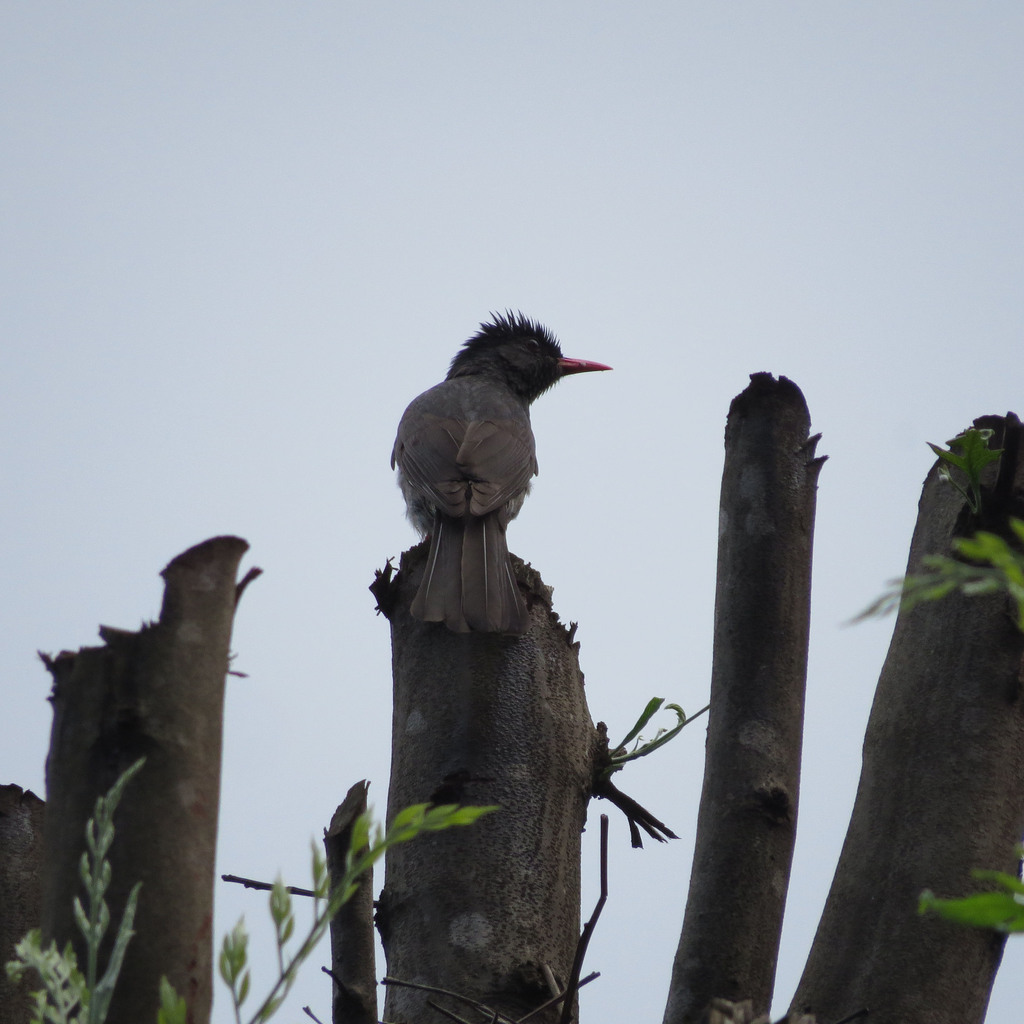
Square-tailed Bulbul
Photo © Paulmathi Vinod
Photo © Paulmathi Vinod — CC BY 4.0 — Source: iNaturalist #92216222Identification
The square-tailed bulbul is a songbird belonging to the bulbul family. As its name suggests, this species is distinguished by its square-shaped tail. One of the most useful field marks for separating it from the closely related black bulbul is the absence of a black streak behind the eye and on the ear-coverts—a feature that is prominent in black bulbuls. The Sri Lankan subspecies (H. g. humii) can be distinguished from its Indian counterpart by a noticeably heavier bill.
Range & Habitat
The square-tailed bulbul is endemic to the Indian subcontinent, occurring in south-western India and throughout Sri Lanka. It was previously considered a subspecies of the black bulbul before being recognized as a distinct species. Two subspecies are currently recognized: the Indian bulbul (H. g. ganeesa), found in south-western India, and the Sri Lanka bulbul (H. g. humii), restricted to Sri Lanka.
This species favours subtropical and tropical moist montane forests, making it a bird of the highlands and forested hills where moisture and elevation combine to create lush forest conditions.
Behaviour & Diet
Square-tailed bulbuls are responsive to seasonal changes, making movements in relation to the monsoon. In southern India, the breeding season is well-defined, with nesting activity beginning in February and reaching its peak in May. The breeding cycle is relatively rapid: eggs hatch after an incubation period of 12 to 13 days, and chicks fledge after approximately 11 to 12 days.
Like other bulbuls, this species faces predation from various sources. Nest predators include birds of prey and snakes, notably the black-winged kite and the oriental ratsnake. Adult birds are preyed upon by the crested goshawk, indicating that this bulbul occupies a position in the middle of its forest food chain.
Best Time & Places to See It
The breeding season from February to May in southern India offers excellent opportunities to observe nesting behaviour and hear the vocalizations of territorial birds. However, since populations make movements in response to the monsoon, the best time to see them varies by location and local rainfall patterns. In Sri Lanka, where the species is found year-round, the montane forests provide consistent habitat throughout the year.
Look for this species in subtropical and tropical moist montane forests in south-western India and Sri Lanka. The highland forest regions of both areas, where moisture levels are high and elevation provides cooler temperatures, are the most reliable locations.
Photography Tips
The montane forest habitat of the square-tailed bulbul can present challenging lighting conditions, so be prepared for dappled, low-light environments typical of dense forest canopy. The species' relatively small size makes a telephoto lens essential. During the peak breeding season in May, birds may be more active and vocal, offering better opportunities for photography and observation.
Pay particular attention to capturing the square tail shape and the absence of the dark eye-streak, as these are key identifying features. Early morning sessions in the forest when birds are most active will yield the best results for both photography and sightings.
Eravikulam National Park
Devikulam, India
+192 birds+7 mammals
High in the Western Ghats of Kerala, where monsoon mists cling to slopes that rise above 2,000 metres, Eravikulam National Park preserves one of South India's…
VIEW NATIONAL PARKPeriyar National Park
Mlappara, India
+232 birds+4 mammals
Dawn breaks over mist-shrouded ridges where the Western Ghats tumble toward Kerala's spice-scented lowlands. Here, ancient tropical forests envelope a glittering artificial lake, creating a mosaic…
VIEW NATIONAL PARKPampadum Shola National Park
Vattavada, India
+258 birds+14 mammals
Where misty shola forests cling to the high plateaus of the Nilgiri Mountains, ancient evergreen remnants create a world apart. This 2,316-hectare reserve protects one of…
VIEW NATIONAL PARKNagarahole Tiger Reserve
Nalkeri Forest, India
+323 birds+23 mammals
Where granite escarpments rise above dense deciduous forests and the Kabini River carves through pristine wilderness, one of India's most biodiverse landscapes unfolds across the Western…
VIEW NATIONAL PARKNo community photos yet. Log in to add the first one.
No community observations of this species yet.