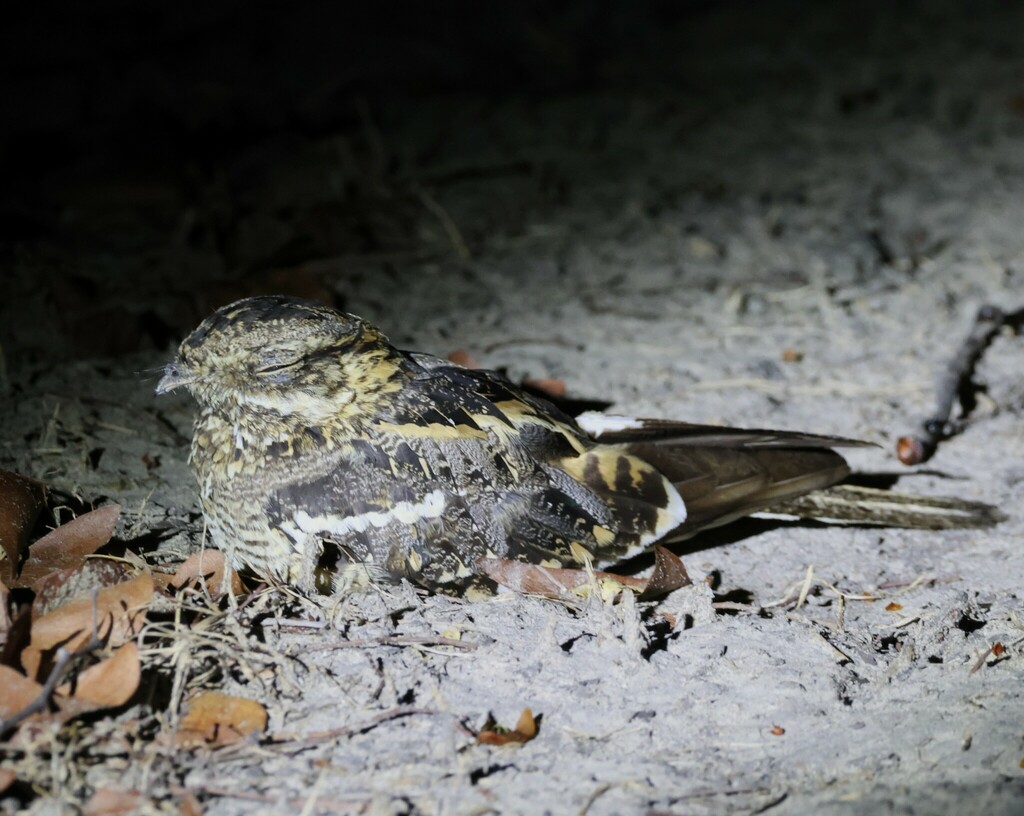
Square-tailed Nightjar
Photo © scaup
Photo © scaup — CC BY 4.0 — Source: iNaturalist #198431535Identification
The square-tailed nightjar is a medium-sized nightjar with plumage similar to several related species, making field identification challenging. Its distinguishing feature is its tail shape—despite its common name, it does not possess a completely square tail, but the tail configuration is notably different from its closest relatives. The most reliable way to distinguish it from the similarly plumaged slender-tailed nightjar is by observing the tail: the slender-tailed nightjar has distinctly protruding central tail feathers, whereas the square-tailed nightjar's tail is comparatively more even. The bird is also known by alternative names reflecting different geographic regions: the Gabon nightjar, Gaboon nightjar, or Mozambique nightjar.
Range & Habitat
The square-tailed nightjar has an extensive range across the African continent, occurring mainly south of the equator but migrating into tropical regions during the northern hemisphere summer. An isolated population exists in Equatorial Guinea and western Gabon. The species is a seasonal visitor to the northern Democratic Republic of the Congo, northern Tanzania, southern Kenya, and southern Uganda, arriving during the summer months.
Year-round residents can be found throughout a wide belt of countries including Angola, Botswana, Burundi, the Republic of the Congo, Eswatini, Lesotho, Malawi, Mozambique, Namibia, Rwanda, South Africa, Tanzania, Zambia, and Zimbabwe. The species inhabits tropical and subtropical woodlands across its range, with different subspecies showing preferences for particular habitats: some occupy mainly inland plateaus, others prefer lowlands and lowveld regions, while another subspecies is associated with Kalahari desert habitats.
Behaviour & Diet
Like other nightjars, the square-tailed nightjar is primarily nocturnal and insectivorous, hunting for flying insects during twilight and night hours. The bird is highly vocal and can be readily identified by its distinctive call, a prolonged churring sound that alternates between fast and slow paces roughly every second. This rhythmic pattern differs notably from related species: the long-tailed nightjar produces consistently fast churrs, while the slender-tailed nightjar produces consistently slow churrs. This acoustic distinction provides an excellent identification tool for birdwatchers in areas where multiple nightjar species overlap.
Best Time & Places to See It
The best time to locate square-tailed nightjars varies by location. In southern African countries where they are year-round residents—such as South Africa, Botswana, Zimbabwe, and Zambia—they can be found throughout the year. For observers in the northern reaches of their range, including southern Kenya, southern Uganda, and northern Tanzania, the summer months offer the best opportunity to encounter this seasonal visitor.
Listening for the bird's distinctive alternating churring call during dusk and nighttime hours is often more productive than attempting visual observation, as nightjars are cryptically plumaged and remain well-hidden during daylight.
Photography Tips
Photographing square-tailed nightjars presents significant challenges due to their nocturnal habits and cryptic coloration. Night photography equipment with infrared or thermal capability offers the best chance of capturing images. Alternatively, photographers may attempt to photograph roosting birds during dawn or dusk when light levels are marginal but still usable. Locating calling birds by following their distinctive alternating-pace churring during evening hours will increase the likelihood of finding a subject. Wide-angle lenses may be necessary to capture the diagnostic tail shape, which is the key field mark distinguishing this species from similar nightjars.
Serengeti National Park
Tanzania
+558 birds+57 mammals
Across Tanzania's northern plateau, where volcanic soils meet acacia woodland and open grassland, unfolds one of Earth's most dynamic ecosystems. The Serengeti National Park sprawls across…
VIEW NATIONAL PARKArusha National Park
Tanzania
+555 birds+16 mammals
Where the slopes of Mount Mawenzi rise above the Arusha region, a compact yet ecologically rich national park unfolds across montane forest, moorland, and alpine zones.…
VIEW NATIONAL PARKMapungubwe National Park
Musina Local Municipality, South Africa
+358 birds+29 mammals
Where the Limpopo River cuts through sandstone ridges at the convergence of South Africa, Botswana, and Zimbabwe, Mapungubwe National Park preserves a landscape of profound ecological…
VIEW NATIONAL PARKChobe National Park
Botswana
+446 birds+45 mammals
Where the Chobe River cuts a sinuous path through northern Botswana, the landscape transforms into one of Africa's most dynamic wetland-savanna mosaics. This national park encompasses…
VIEW NATIONAL PARKNxai Pan National Park
Botswana
+226 birds+16 mammals
Across the northwestern reaches of Botswana stretches a landscape of profound seasonal transformation—a sprawling pan system where shallow depressions fill and empty with the rains, creating…
VIEW NATIONAL PARKBwindi Impenetrable National Park
Kanyashogi, Uganda
+603 birds+26 mammals
Steep ridges cloaked in montane forest rise from Uganda's southwestern borderlands, where the landscape grows so dense and tangled that early explorers named it impenetrable. At…
VIEW NATIONAL PARKKidepo Valley National Park
Uganda
+478 birds+24 mammals
Where the Narus and Kidepo rivers carve through northeastern Uganda's semi-arid lowlands, a landscape of sparse acacia woodland, grassland, and riverine thickets creates one of East…
VIEW NATIONAL PARKMurchison Falls National Park
Uganda
+608 birds+33 mammals
Where the Victoria Nile compresses through a narrow gorge and explodes across a 45-meter precipice, the landscape speaks in thunder. Murchison Falls National Park sprawls across…
VIEW NATIONAL PARKLake Mburo National Park
Uganda
+505 birds+24 mammals
Rolling acacia woodland and scattered lakes define this intimate savanna preserve in southwestern Uganda, where the rift valley's geological drama shapes every water source and grassland.…
VIEW NATIONAL PARKTsavo East National Park
Athi ward, Kenya
+468 birds+50 mammals
Across the semi-arid lowlands of southeastern Kenya, where acacia woodland fragments into scrubland and the landscape rolls toward the Indian Ocean horizon, lies one of Africa's…
VIEW NATIONAL PARKTsavo West National Park
Mwatate, Kenya
+513 birds+49 mammals
Where volcanic ridges and weathered lava flows meet the semi-arid lowlands of south-central Kenya, Tsavo West National Park unfolds across a landscape sculpted by fire and…
VIEW NATIONAL PARKAmboseli National Park
Etonet/Lenkism ward, Kenya
+501 birds+43 mammals
Where the Amboseli basin opens toward the Tanzanian frontier, a shallow alkaline lake mirrors vast skies across one of East Africa's most iconic savanna landscapes. The…
VIEW NATIONAL PARKTarangire National Park
Tanzania
+527 birds+50 mammals
Acacia woodland and grassland sweep across the Manyara Region where the Tarangire River carves through low hills and volcanic soils, creating one of East Africa's most…
VIEW NATIONAL PARKNgorongoro Conservation Area
Tanzania
+626 birds+55 mammals
Volcanic calderas and open grassland dominate this high plateau in northern Tanzania, where the landscape rises above 2,000 metres and ancient geological forces have shaped both…
VIEW WILDLIFE MANAGEMENT AREAToro-Semliki Proposed National Park
Uganda
+474 birds+5 mammals
Where the Albertine Rift's western escarpment rises above the Semliki River valley, a vast mosaic of forest, savanna and wetland converges to create one of East…
VIEW NATIONAL PARKQueen Elizabeth National Park
Uganda
+672 birds+30 mammals
Across the southwestern escarpment of Uganda, where the Western Rift Valley descends through ancient volcanic terrain, Queen Elizabeth National Park sprawls across more than 8,300 square…
VIEW NATIONAL PARKMabamba Swamp
Memere, Uganda
+464 birds+2 mammals
Across the Central Region of Uganda spreads one of Africa's most biodiverse freshwater wetlands, a sprawling nature reserve of roughly 283 square kilometres where papyrus swamps…
VIEW NATURE RESERVEKruger National Park
Ba-Phalaborwa Local Municipality, South Africa
+540 birds+91 mammals
Across the low-lying savanna of northeastern South Africa unfolds one of Africa's largest and most ecologically intact protected areas, where acacia woodlands merge into mopane scrub…
VIEW NATIONAL PARKIthala Game Reserve
uPhongolo Local Municipality, South Africa
+328 birds+26 mammals
Rolling thornbush savanna and acacia woodland dominate the landscape of this 494-square-kilometre national park in KwaZulu-Natal's uPhongolo Local Municipality, where granite outcrops punctuate grassland plateaus and…
VIEW NATIONAL PARKMarakele National Park
Modimolle Local Municipality, South Africa
+341 birds+36 mammals
Granite ridges and sprawling grasslands dominate this 1,176-square-kilometre reserve in Limpopo's heartland, where bushveld transitions between rocky outcrops and open savanna. The park's rugged topography creates…
VIEW NATIONAL PARKZiwa Rhino and Wildlife Ranch
Nakasongola, Uganda
+359 birds+11 mammals
Where papyrus wetlands merge into sprawling savanna, Uganda's central landscape opens into one of East Africa's most vital rhino recovery zones. Ziwa Rhino and Wildlife Ranch…
VIEW WILDLIFE SANCTUARYNkasa Rupara National Park
Namibia
+283 birds+17 mammals
Where the Zambezi's floodplains spill across the border between Namibia and Botswana, Nkasa Rupara National Park unfolds across 518 square kilometers of wetland and woodland mosaic.…
VIEW NATIONAL PARKBwabwata National Park
Namibia
+377 birds+35 mammals
Where the Kavango River winds through northeastern Namibia, vast floodplains and dense riparian woodland create one of southern Africa's most ecologically dynamic protected landscapes. Spanning 14,249…
VIEW NATIONAL PARKEtosha National Park
Namibia
+356 birds+58 mammals
Across northern Namibia's stark semi-arid plateau, a vast shallow depression transforms seasonally into one of Africa's most dramatic wildlife theaters. Etosha National Park, encompassing more than…
VIEW NATIONAL PARKNo community photos yet. Log in to add the first one.
No community observations of this species yet.