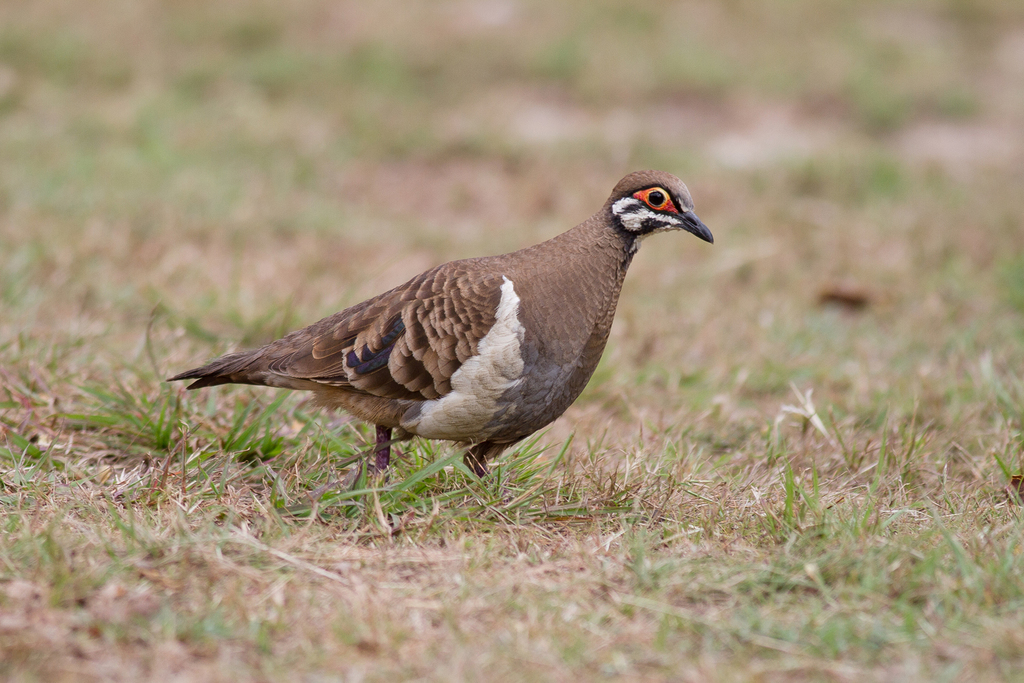
Squatter Pigeon
Photo © Kym Nicolson
Photo © Kym Nicolson — CC BY 4.0 — Source: iNaturalist photo #118881476Identification
The Squatter Pigeon is a compact ground-dwelling dove measuring approximately 30 cm in length and weighing between 190 and 250 grams. Adults display distinctive grey-brown plumage with striking black and white facial markings and a characteristic white stripe running up each side of the body. The species features blue-grey skin around the eyes, dark brown upper wings with patches of iridescent green or violet iridescence, and blue-grey coloring on the lower breast and belly contrasting with the white lower region. Both sexes are similar in appearance, though juveniles can be distinguished by duller overall coloration, less pronounced facial stripes, and paler facial skin.
Two subspecies exist: the southern squatter pigeon (G. s. scripta), which tends to be slightly larger, and the northern squatter pigeon (G. s. peninsulae). The subspecies can be differentiated by eye-ring coloration, and hybridization occurs where their distributions overlap.
Range & Habitat
Endemic to northeastern Australia, the Squatter Pigeon is found from south of Cape York Peninsula extending to the Border Rivers region of northern New South Wales and southeastern Queensland. The southern subspecies remains common north of the Carnarvon Ranges, where it forms a notable subpopulation. In 2000, the population was estimated at approximately 40,000 breeding birds.
These pigeons inhabit arid and semi-arid environments, favoring grasslands and dry sclerophyll forests. They are ground nesters, creating shallow depressions for breeding sites.
Behaviour & Diet
The Squatter Pigeon is primarily granivorous, with approximately 95% of its diet consisting of seeds. The species is notably terrestrial, spending considerable time foraging on the ground in search of food. This ground-based lifestyle has shaped its nesting behavior, with birds laying eggs in shallow depressions rather than constructing elevated nests.
Best Time & Places to See It
The southern squatter pigeon is currently listed as vulnerable under Australia's environmental protection classifications. Travellers seeking this species should focus on northeastern Australia, particularly Queensland and northern New South Wales. The region north of the Carnarvon Ranges offers the best opportunities for encountering this species, where it remains relatively common within suitable habitat.
Photography Tips
Photograph this ground-feeding pigeon in early morning or late afternoon when birds are most active foraging. The species' distinctive facial markings and iridescent wing patches photograph well in soft, directional light. Use a longer lens to avoid disturbing birds and maintain distance while observing their ground-foraging behavior. The white side stripes and facial pattern provide good contrast for identification shots, and patience in grassland and open sclerophyll forest habitats will reward photographers with natural behavioral images.
Kroombit Tops National Park
Valentine Plains, Australia
+152 birds+6 mammals
Where eucalypt woodlands rise into sandstone plateaus, Kroombit Tops unfolds across nearly 906 square kilometres of northeastern Queensland's most biodiverse terrain. The park's defining feature is…
VIEW NATIONAL PARKCarnarvon National Park
Philadelphia, Australia
+179 birds+17 mammals
Across 15,000 square kilometres of inland Queensland, rugged sandstone plateaus rise above eucalypt woodlands and open grasslands, carved by creeks that have worn deep gorges into…
VIEW NATIONAL PARKKakadu National Park
Kakadu, Australia
+273 birds+46 mammals
Kakadu National Park is Australia’s largest national park and one of the world’s most remarkable protected areas, covering nearly 20,000 square kilometres in the tropical north…
VIEW NATIONAL PARKDaintree National Park
Dedin, Australia
+362 birds+37 mammals
Daintree National Park is one of the world’s oldest and most biologically diverse tropical rainforests, protecting an extraordinary landscape where ancient forests meet the Great Barrier…
VIEW NATIONAL PARKSundown National Park
Australia
+211 birds+9 mammals
Granite ridges and eucalypt woodlands define this 305-square-kilometre expanse of southeastern Queensland, where the landscape descends from sandstone plateaus into open forests and grassy clearings that…
VIEW NATIONAL PARKRinyirru National Park
Lakefield, Australia
+258 birds+7 mammals
Where the savanna grasslands of far north Queensland meet seasonal wetlands and eucalypt woodlands, Rinyirru National Park sprawls across more than 12,500 square kilometres of rugged,…
VIEW NATIONAL PARKGirringun National Park
Australia
+231 birds+10 mammals
Where granite gorges cleave through subtropical woodland in North Queensland, Girringun National Park unfolds across rugged terrain shaped by millions of years of weathering and erosion.…
VIEW NATIONAL PARKWooroonooran National Park
Australia
+240 birds+28 mammals
Where the Great Dividing Range rises sharply inland from Queensland's tropical coast, Wooroonooran National Park encompasses a landscape of steep, forested gorges and cascading waterways carved…
VIEW NATIONAL PARKNo community photos yet. Log in to add the first one.
No community observations of this species yet.