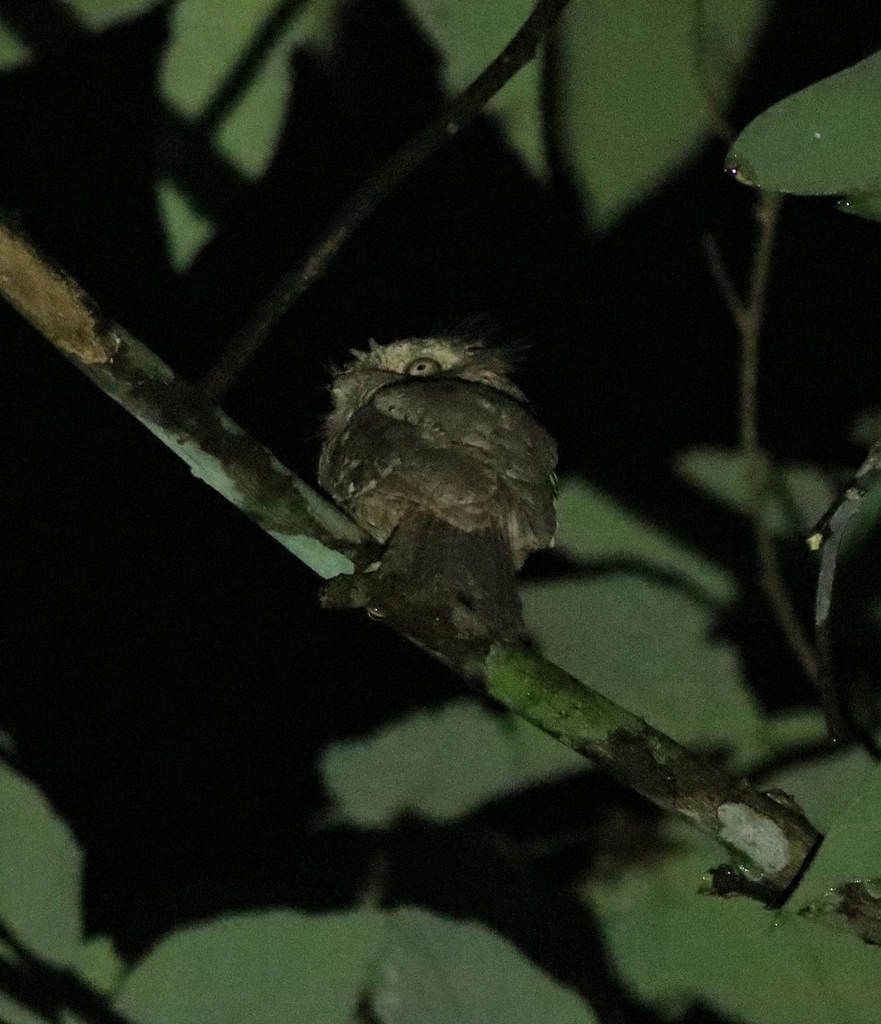
Sri Lanka Frogmouth
Photo © Afsar Nayakkan
Photo © Afsar Nayakkan — CC BY 4.0 — Source: iNaturalist #308383865Identification
The Sri Lanka frogmouth is a small, compact bird reaching just 23 centimetres in length. Like all frogmouths, it possesses a distinctive wide, hooked bill with slit-like nostrils and a large head with forward-facing eyes that provide exceptional binocular vision. Short, stiff bristles surround the eyes, characteristic of the family. The species has relatively small wings compared to other frogmouths, marked by distinctive white-tipped black spots on the wing coverts.
Plumage varies subtly between the sexes and geographically. Males are predominantly gray-brown with fine barring and a spotted crown, though some individuals appear browner and resemble females. Females are notably more rufous or chestnut-brown. Indian females display very fine black speckles on the crown, while Sri Lankan females may lack or show reduced markings. The Western Ghats subspecies (roonwali) differs slightly: males have a brownish-grey wing mirror with yellowish underside spots, while females show a bright reddish-brown wing mirror. Overall, the plumage resembles dried leaves, providing excellent camouflage against tree bark and branches.
Range & Habitat
The Sri Lanka frogmouth is endemic to the Western Ghats of southwest India and Sri Lanka, representing the southernmost member of its genus. It inhabits tropical forest with dense undergrowth, though it occasionally appears in more disturbed habitats such as plantations and secondary growth. The bird's presence is often overlooked due to its strictly nocturnal behaviour combined with its exceptional camouflage and cryptic roosting habits.
Behaviour & Diet
This nocturnal specialist relies heavily on crypsis for survival, spending daylight hours perched motionless on tree branches where it resembles a jagged, broken snag. Each bird maintains a favoured roost that it uses regularly over months, unless disturbed. When alarmed, the bird slowly raises its head and points its bill upward, remaining still for extended periods before attempting escape. As a threat display, it may gape its wide mouth dramatically. Small songbirds frequently mob it at daytime roosts.
The Sri Lanka frogmouth feeds exclusively on insects, capturing them either in flight or by gleaning from ground, foliage, and branches. It is vocal at dusk and dawn, producing distinctive calls including a loud, screechy "shkeerauuw" that drops in volume and ends in a series of hiccups, and rapid "skwar-skwar-skwar" notes produced by both sexes. Breeding occurs January to April in southern India and February to March in Sri Lanka, with a single white egg laid on a small moss pad lined with down and covered with lichens and bark. The male often incubates during daylight hours, and both parents share nighttime duties. Juveniles remain with parents for several months after fledging.
Best Time & Places to See It
Locating this species requires patience and timing. The best opportunities occur during dawn and dusk when the bird is most vocal and active. Visitors to the Western Ghats of southwest India and Sri Lanka should focus on tropical forests with dense undergrowth, the bird's preferred habitat. Since it regularly returns to the same roosting branch, finding a known roost site greatly increases sighting chances. The bird's nocturnal nature and superb camouflage make daytime observation challenging, but knowing its preferences and habits significantly improves your odds.
Photography Tips
Photographing the Sri Lanka frogmouth presents considerable challenges due to its nocturnal habits and cryptic behaviour. Success depends on locating a regular roost site and visiting during dawn or dusk transitions when the bird is most active. Use headlamp or red-filtered light to avoid alarming the bird. The bird's leaf-like plumage and branch-like posture demand careful composition—avoid high contrast that destroys camouflage, and use natural lighting when possible. Patient, static positioning near known roosts during vocal periods offers the best opportunity for compelling images of this remarkable and elusive species.
Periyar National Park
Mlappara, India
+232 birds+4 mammals
Dawn breaks over mist-shrouded ridges where the Western Ghats tumble toward Kerala's spice-scented lowlands. Here, ancient tropical forests envelope a glittering artificial lake, creating a mosaic…
VIEW NATIONAL PARKNagarahole Tiger Reserve
Nalkeri Forest, India
+323 birds+23 mammals
Where granite escarpments rise above dense deciduous forests and the Kabini River carves through pristine wilderness, one of India's most biodiverse landscapes unfolds across the Western…
VIEW NATIONAL PARKNo community photos yet. Log in to add the first one.
No community observations of this species yet.