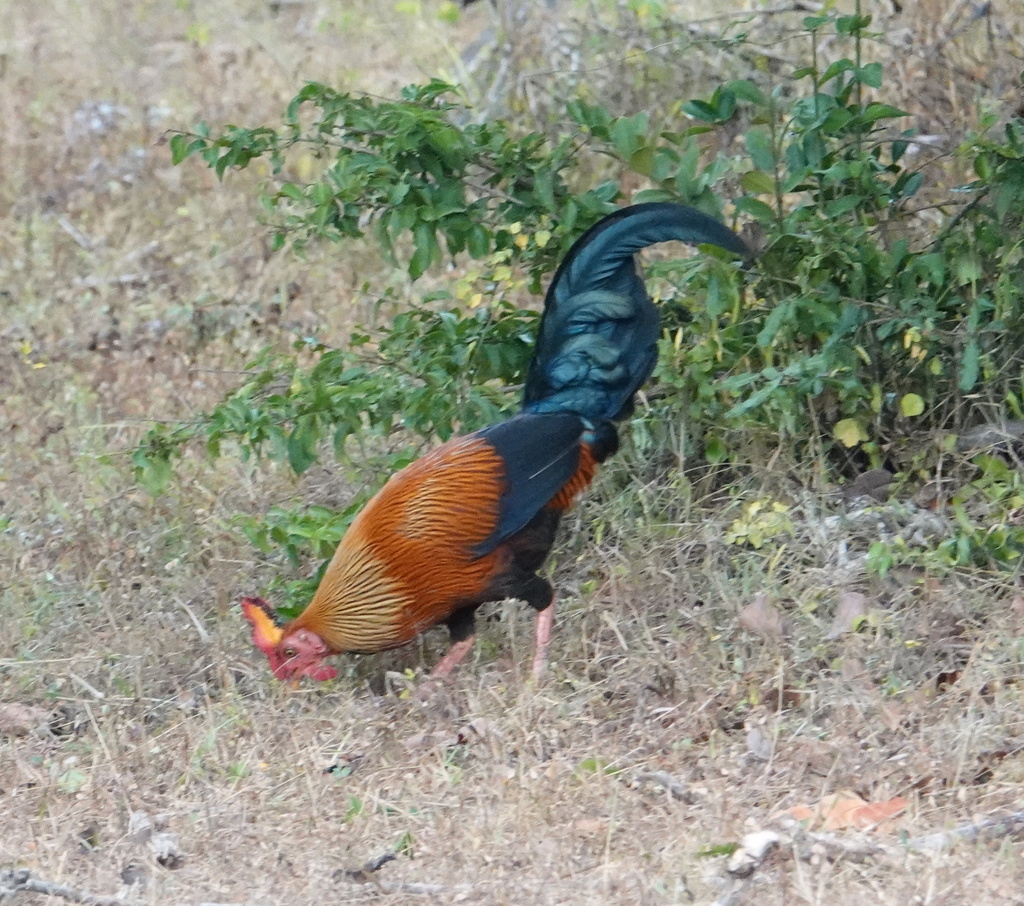
Sri Lanka Junglefowl
Photo © Matthew Blissett
Photo © Matthew Blissett — CC BY 4.0 — Source: iNaturalist #20672004Identification
The Sri Lankan junglefowl is strongly sexually dimorphic, with males and females bearing little resemblance to one another. Males are impressive birds, ranging from 66–72 cm in length and weighing 790–1,140 g, resembling large, muscular roosters. They display vibrant orange-red body plumage contrasted with dark purple to black wings and tail. Golden feathers descend from the head to the base of the spine, while the bare facial skin and wattles are bright red, and the comb is red with a yellow centre.
Females are considerably smaller at just 35 cm in length and 510–645 g in weight, with dull brown plumage and white patterning on the lower belly and breast—camouflage ideally suited to nesting birds. Unlike some other junglefowl species, males lack an eclipse plumage phase.
Range & Habitat
The Sri Lankan junglefowl is endemic to Sri Lanka, where it holds the distinguished status of being the national bird. It is common throughout the island across a wide range of elevations, from sea-level up to 2,000 metres. The species favours forests and scrub habitats and is commonly spotted at well-known sites such as Kitulgala, Yala, and Sinharaja.
Behaviour & Diet
Like other junglefowl, this species is primarily terrestrial, spending most of its time foraging on the ground by scratching for seeds, fallen fruit, and insects. Males are notably vocal, particularly during breeding season, uttering short calls of "kreeu, kreeu, kreeuu" while foraging and producing high-pitched rooster-like crows of "cor-cor-chow" at dawn, often from tree branches. Females give distinctive "kwikkuk, kwikkukkuk" calls.
Sri Lankan junglefowl employ a unique reproductive strategy known as facultative polyandry, where a single female typically bonds with two or three males, usually siblings, that form a protective pride. The female lays two to four variably-coloured eggs in nests either on the forest floor or in abandoned nests of other birds and squirrels. Remarkably, this species has the shortest incubation period among junglefowl, sometimes as brief as 20 days. Both parents actively participate in nest protection and chick rearing, with beta males guarding territory from predators such as snakes and mongooses.
Best Time & Places to See It
The Sri Lankan junglefowl is a common endemic species, making it relatively accessible to visitors throughout Sri Lanka. Prime locations include Yala, Sinharaja, and Kitulgala. The species is found across all elevations, so sightings are possible in both lowland and montane forests. Early morning hours are typically best for observing these birds, as males are most vocal at dawn.
Photography Tips
The striking sexual dimorphism of this species offers excellent photographic opportunities. Males' vivid orange-red and black plumage contrasts beautifully with forest backgrounds, particularly when photographed in early morning light. Their elaborate combs and wattles photograph well at moderate distances. Females' cryptic brown and white plumage requires patience and careful positioning to capture effectively, though their camouflage against leaf litter and undergrowth can create compelling natural-history images. Ground-level angles often work best for capturing males during their characteristic foraging behaviour.
Lunugamvehera National Park
Sri Lanka
+204 birds+14 mammals
Dry scrubland and shallow wetlands converge in Sri Lanka's southeastern lowlands, where Lunugamvehera National Park anchors one of the island's most ecologically vital landscapes. The park's…
VIEW NATIONAL PARKMinneriya National Park
Sri Lanka
+158 birds+9 mammals
Across the dry zone of Sri Lanka's North Central Province spreads a landscape of shallow tanks, grassland margins, and scattered dry forest—a mosaic of water and…
VIEW NATIONAL PARKWasgamuwa National Park
Sri Lanka
+156 birds+8 mammals
Dry deciduous forest and open grassland sweep across the North Central lowlands where Wasgamuwa National Park protects one of Sri Lanka's largest remaining tracts of this…
VIEW NATIONAL PARKAngamedilla National Park
Polonnaruwa, Sri Lanka
+40 birds+2 mammals
Ancient tanks and sal forests define this water-rich sanctuary in Sri Lanka's North Central heartland, where seasonal wetlands and dry deciduous woodland create a mosaic of…
VIEW NATIONAL PARKMaduru Oya National Park
Sri Lanka
+74 birds+1 mammals
Granite ridges rise abruptly from the humid lowlands of Sri Lanka's Uva Province, their weathered slopes clothed in dry monsoon forest and scattered woodland where deciduous…
VIEW NATIONAL PARKNo community photos yet. Log in to add the first one.
No community observations of this species yet.